3rd Grade Adding and Subtracting Within 1,000 Worksheets with Answers (Free PDF)
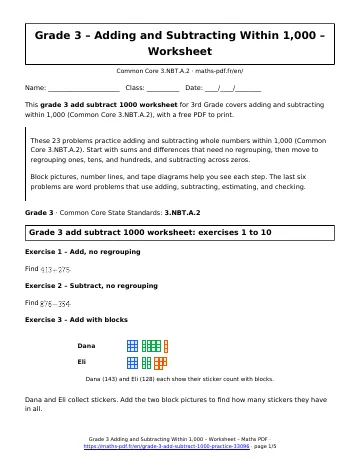
This 3rd grade addition and subtraction within 1000 worksheet covers adding and subtracting within 1,000 (Common Core 3.NBT.A.2), with a free PDF to print.
Key takeaway: This worksheet helps Grade 3 students practice adding and subtracting within 1,000.
- Topic: Adding and Subtracting Within 1,000 (3rd grade)
- Content: 23 worksheet problems, from easy to challenging
- Standards: 3.NBT.A.2
- Answers: On a separate page, so you can try every worksheet problem first
- Format: Free printable PDF, US Letter, black and white
This worksheet helps Grade 3 students practice adding and subtracting within 1,000. First, children add and subtract without regrouping. Then they regroup the ones, the tens, and both, and subtract across zeros.
The 19 problems also use blocks, number lines, and friendly numbers. Next, children estimate by rounding, check with the inverse operation, and compare totals. Finally, they find a missing digit and solve stories about library books and ticket sales. Plan about 30 minutes, and keep scratch paper handy for the columns. Also, a pencil and scratch paper help children show each step.
These 23 problems practice adding and subtracting whole numbers within 1,000 (Common Core 3.NBT.A.2). Start with sums and differences that need no regrouping, then move to regrouping ones, tens, and hundreds, and subtracting across zeros.
Block pictures, number lines, and tape diagrams help you see each step. The last six problems are word problems that use adding, subtracting, estimating, and checking.
Key takeaway: This Grade 3 worksheet on Adding and Subtracting Within 1,000 gives 23 problems, from warm-up questions to harder applications. The answer key is on a separate page; free printable PDF.
Grade 3 · Common Core State Standards: 3.NBT.A.2
3rd grade addition and subtraction within 1000 worksheet: worksheet problems 1 to 10
1 – Add, no regrouping
2 – Subtract, no regrouping
3 – Add with blocks
Dana and Eli collect stickers. Add the two block pictures to find how many stickers they have in all.
4 – Regroup the ones
5 – Regroup the tens
6 – Regroup twice
First, find \(586 + 247\).
7 – Subtract and regroup a ten
8 – Subtract and regroup a hundred
9 – Subtract across zeros
Now, find \(400 – 167\).
10 – Read the number line
Also, the jumps show \(358 + 226\). Write the number where the last jump lands.
Worksheet problems 11 and up
11 – Count up to subtract
First, add the three jumps to find \(612 – 257\).
12 – Make a friendly number
13 – Compensate to subtract
14 – Estimate first
15 – Check with the inverse
16 – Compare totals
17 – Find the missing digit
18 – Library books
Then, the library at Maya’s school has 268 picture books and 359 chapter books. How many books does it have in all?
19 – Ticket sales
20 – Apples left
Diego brought 750 apples to the farmers market. He sold 387 of them. How many apples were left?
Worksheet problem 21 and after
21 – Bake sale total
22 – Pages left
23 – Find the mistake

Key facts behind this 3rd grade addition and subtraction within 1000 worksheet
- Within 1,000 means every number and every answer is 1,000 or less.
- 10 ones make 1 ten and 10 tens make 1 hundred; trading them is called regrouping.
- Next, in addition, regroup when a column sum is 10 or more.
- In subtraction, regroup when the top digit is smaller than the bottom digit.
- Then, check a subtraction by adding the difference to the number subtracted.
Common mistakes with this 3rd grade addition and subtraction within 1000 worksheet
- When subtracting across zeros, students cannot take from the zero. For example, in 300 – 124, regroup a hundred into tens, then a ten into ones, before subtracting.
- Also, when using a friendly number, students forget to adjust. For example, adding 299 means adding 300 and then taking 1 away.
- When estimating, students round to the nearest ten when the problem asks for hundreds. Read the instruction and round to the place it names.
Tips before you start the worksheet problems
- Estimate first for every problem. Then use the estimate to check that your exact answer is reasonable. In other words, slow and careful work pays off here.
- For a missing digit, work from the ones column. Also check each column after you fill the digit. As a result, small mistakes are easier to catch.
- Teachers can ask which strategy fits each problem. For example, discuss when a number line is quicker than a column.
Download the 3rd grade addition and subtraction within 1000 worksheet as a PDF with the button below and keep it with your notes.
3rd grade addition and subtraction within 1000 worksheet: frequently asked questions
When should I use a number line instead of a column?
Use a number line when the numbers are close together or when one number is friendly, like a multiple of ten. For example, counting up from 297 to 305 takes just two jumps. Columns work better for larger regrouping.
How do you find a missing digit in an addition problem?
Work from the ones column. Ask what digit makes the ones add to the digit shown, with or without a carry. Then move to the tens and hundreds. Finally, add the full numbers to check. Also, saying the steps aloud helps you spot a slip.
How do you compare a sum to a number without adding exactly?
Estimate by rounding. If the rounded sum is far from the number, you can decide quickly. If it is close, compute the exact sum. Then compare the two numbers by hundreds, tens, and ones. Then check the result once more before moving on.
All Grade 3 chapters: Grade 3 math.
More 3rd Grade math
Lessons
See all Two-Step Word Problems and Patterns Lesson: Notes and Examples
- Scaled Graphs and Line Plots Lesson: Notes and Examples
- Understanding Division Lesson: Notes and Examples
- Perimeter Lesson: Notes and Examples
- Understanding Fractions Lesson: Notes and Examples
- Quadrilaterals and Partitioning Shapes Lesson: Notes and Examples





Worksheets
See all



Tests
See all





Quizzes
See all- Properties of Multiplication Quiz: 10 Questions with Answers
- Adding and Subtracting Within 1,000 Quiz: 10 Questions with Answers
- Multiplying by Multiples of 10 Quiz: 10 Questions with Answers
- Scaled Graphs and Line Plots Quiz: 10 Questions with Answers
- Perimeter Quiz: 10 Questions with Answers
- Understanding Division Quiz: 10 Questions with Answers