3rd Grade Understanding Multiplication Worksheets with Answers (Free PDF)
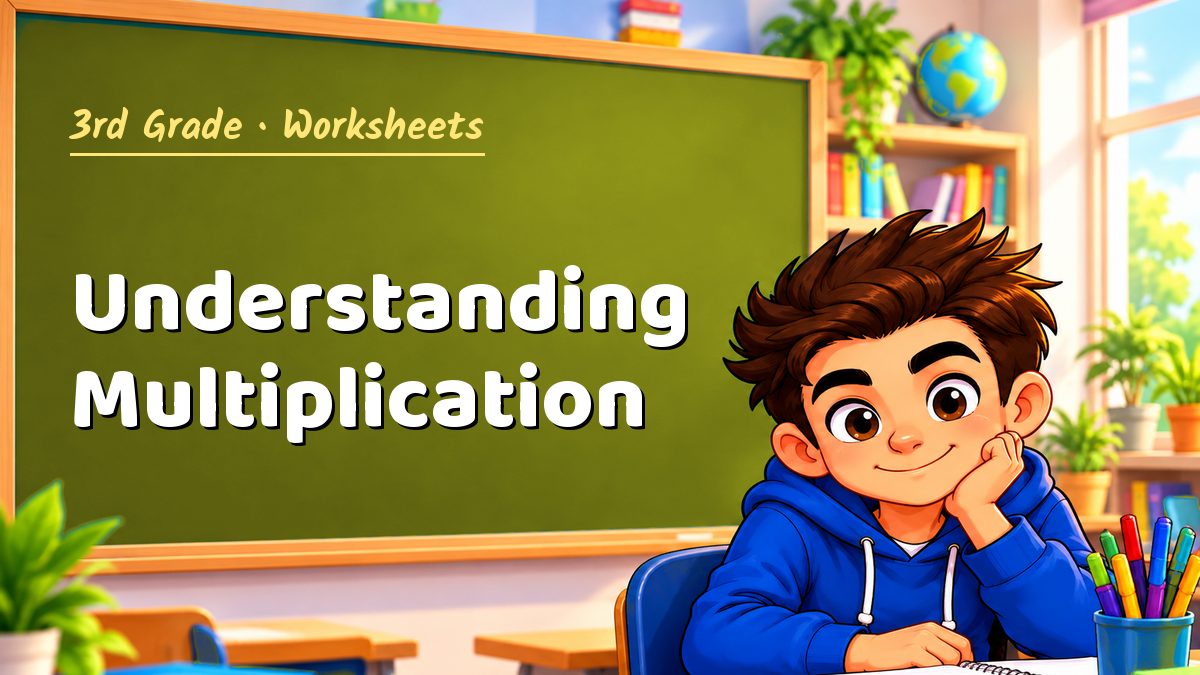
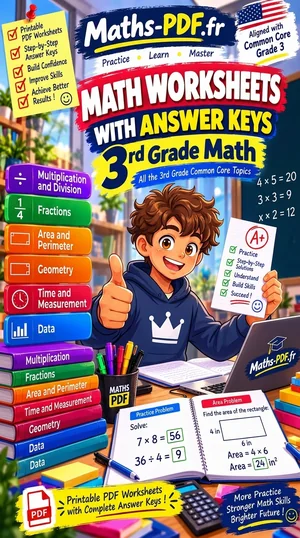
This 3rd grade multiplication worksheet covers understanding multiplication (Common Core 3.OA.A.1, 3.OA.A.3), with a free PDF to print.
Key takeaway: This worksheet helps Grade 3 students practice the meaning of multiplication.
- Topic: Understanding Multiplication (3rd grade)
- Content: 20 worksheet problems, from easy to challenging
- Standards: 3.OA.A.1, 3.OA.A.3
- Answers: On a separate page, so you can try every worksheet problem first
- Format: Free printable PDF, US Letter, black and white
This worksheet helps Grade 3 students practice the meaning of multiplication. First, children write equations for equal groups, arrays, and number line jumps. Then they write repeated addition for products.
The 15 problems also explain what each factor means, find an unknown product, and check a friend’s repeated addition. Next, children solve stories about books on shelves, jugs of water, seats on a bus, tickets, and sticker books. Finally, they fix a wrong equation. Plan about 25 minutes, with counters nearby. Also, a pencil and scratch paper help children show each step.
Key takeaway: This Grade 3 worksheet on Understanding Multiplication gives 20 problems, from warm-up questions to harder applications. The answer key is on a separate page; free printable PDF.
Grade 3 · Common Core State Standards: 3.OA.A.1, 3.OA.A.3
3rd grade multiplication worksheet: worksheet problems 1 to 10
1 – Groups in a product
2 – Count the groups
3 – Repeated addition
4 – Read the array
5 – Meaning of each factor
6 – Jumps on a number line
7 – Shelves of books
8 – Jugs of water
9 – Rows of seats
Worksheet problem 10 and after
10 – Tickets
Worksheet problems 11 and up
11 – Unknown product
12 – Repeated addition check
13 – Tape diagram of sticker books
14 – Fix the equation
15 – Sticker packs
16 – Pencil boxes
17 – Bake sale trays
18 – Who hiked farther?
19 – Peach crates
Worksheet problem 20 and after
20 – Tables and chairs

Key facts behind this 3rd grade multiplication worksheet
- A multiplication equation such as 4 × 6 = 24 means 4 groups of 6.
- Next, the numbers you multiply are factors, and the answer is the product.
- An array has equal rows, so 4 rows of 6 show 4 × 6.
- Repeated addition matches multiplication: 6 + 6 + 6 + 6 = 24.
- A letter or symbol can stand for the unknown product, as in 5 × 8 = n.
Common mistakes with this 3rd grade multiplication worksheet
- When writing repeated addition, students use the wrong addend. For example, 6 times 3 is 3 added six times, not 6 added three times. Both give the same total, but the story differs.
- Also, when explaining the factors, students swap the meaning. The first factor is the number of groups, and the second is the size of each group.
- When fixing an equation, students change the product. Instead, check that the repeated addition matches the factors. In other words, slow and careful work pays off here.
Tips before you start the worksheet problems
- Draw the groups for each story. Then write the multiplication equation under the picture. As a result, small mistakes are easier to catch.
- When you write repeated addition, count the addends. The number of addends equals the number of groups. Also, saying the steps aloud helps you spot a slip.
- Teachers can ask students to explain the same equation with an array and with equal groups. Then check the result once more before moving on.
Download the 3rd grade multiplication worksheet as a PDF with the button below and keep it with your notes.
3rd grade multiplication worksheet: frequently asked questions
What are factors and products in simple words?
Factors are the numbers you multiply. The product is the answer. In 3 times 7 equals 21, the factors are 3 and 7, and the product is 21. As a result, small mistakes are easier to catch.
How can a student check repeated addition?
Count the addends and the number added each time. They should match the two factors. For example, 3 times 5 matches three 5s or five 3s, and both give the same total. Also, saying the steps aloud helps you spot a slip.
When should I draw an array instead of equal groups?
An array arranges objects in rows and columns. Equal groups can be placed anywhere. Both show multiplication, but arrays also show that the order of the factors does not change the product. Then check the result once more before moving on.
All Grade 3 chapters: Grade 3 math.

More 3rd Grade math
Lessons
See all Adding and Subtracting Within 1,000 Lesson: Notes and Examples
- Understanding Fractions Lesson: Notes and Examples
- Two-Step Word Problems and Patterns Lesson: Notes and Examples
- Perimeter Lesson: Notes and Examples
- Properties of Multiplication Lesson: Notes and Examples
- Scaled Graphs and Line Plots Lesson: Notes and Examples

Worksheets
See all- Perimeter Worksheets with Answers
- Rounding to the Nearest 10 and 100 Worksheets with Answers
- Understanding Division Worksheets with Answers
- Multiplication and Division Facts Within 100 Worksheets with Answers
- Time, Liquid Volume and Mass Worksheets with Answers
- Multiplying by Multiples of 10 Worksheets with Answers

Tests
See all- Equivalent and Comparing Fractions Test with Answer Key
- Understanding Division Test with Answer Key
- Scaled Graphs and Line Plots Test with Answer Key
- Multiplying by Multiples of 10 Test with Answer Key
- Time, Liquid Volume and Mass Test with Answer Key
- Rounding to the Nearest 10 and 100 Test with Answer Key


Quizzes
See all- Multiplication and Division Facts Within 100 Quiz: 10 Questions with Answers
- Understanding Fractions Quiz: 10 Questions with Answers
- Perimeter Quiz: 10 Questions with Answers
- Quadrilaterals and Partitioning Shapes Quiz: 10 Questions with Answers
- Two-Step Word Problems and Patterns Quiz: 10 Questions with Answers
- Equivalent and Comparing Fractions Quiz: 10 Questions with Answers