3rd Grade Multiplying by Multiples of 10 Lesson: Notes and Examples (Free PDF)


This 3rd grade multiplying by 10 lesson covers multiplying by multiples of 10 (Common Core 3.NBT.A.3), with a free PDF to print.
Key takeaway: This lesson helps Grade 3 students multiply a one-digit number by a multiple of 10 using place value.
- Topic: Multiplying by Multiples of 10 (3rd grade)
- Content: One-page lesson with a definition, a worked example and key facts
- Standards: 3.NBT.A.3
- Answers: Explanations included
- Format: Free printable PDF, US Letter, black and white
Key takeaway: A clear Grade 3 lesson on Multiplying by Multiples of 10, with definitions, rules and worked examples: what is a multiple of 10, why does the product get an extra zero and more questions about 3rd grade multiplying by 10 lesson. Read it before the practice worksheet; free to print or download as a PDF.
To multiply a one-digit number by a multiple of 10, treat the multiple of 10 as a number of tens. For 6 × 40, think 6 groups of 4 tens, which is 24 tens, or 240. Multiply the basic fact first, then write the answer as that many tens.
This lesson helps Grade 3 students multiply a one-digit number by a multiple of 10 using place value. First, children see that a number like 40 is 4 tens. Then they multiply the basic fact first and read the answer as that many tens.
Next, the lesson explains why some products end in two zeros and why adding a zero is a shortcut that needs a reason. Also, it uses rods, number line jumps, and skip counting by tens. Finally, it teaches how to check a product. Plan about 20 minutes, with rods or drawings of tens.
Grade 3 · Common Core State Standards: 3.NBT.A.3
Key facts in this 3rd grade multiplying by 10 lesson
- A multiple of 10 is a whole number of tens, such as 30 (3 tens) or 80 (8 tens).
- Next, multiply the basic fact first: 9 x 8 = 72, so 9 x 80 = 720.
- The answer is that many tens, so the product ends in 0.
- Then, if the basic fact ends in 0, the product ends in two zeros: 5 x 60 = 300.
- Skip counting by the multiple of 10 gives the same answer.
What is a multiple of 10?
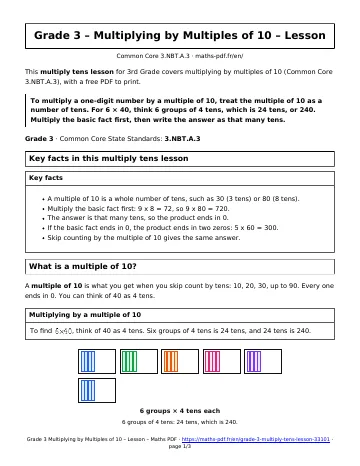
A multiple of 10 is what you get when you skip count by tens: 10, 20, 30, up to 90. Every one ends in 0. You can think of 40 as 4 tens.
Each box holds 4 rods. A rod is worth 10, so each box is worth 40. Six boxes make \(6 \times 40 = 240\).
How do you multiply a one-digit number by a multiple of 10?
- Look at the multiple of 10 and name its tens. For example, 40 is 4 tens.
- Multiply the two small numbers with a basic fact: \(6 \times 4 = 24\).
- The answer is that many tens. Write the product with a 0 on the end: 24 tens is 240.
Worked example: \(7 \times 50\). 50 is 5 tens. \(7 \times 5 = 35\), so the answer is 35 tens. 35 tens is \(350\). So \(7 \times 50 = 350\).
Why does the product get an extra zero?
Ten times any number moves its digits one place to the left, and a 0 fills the ones place. In \(6 \times 40\), the basic fact \(6 \times 4 = 24\) becomes 240. If the basic fact already ends in 0, the product ends in two zeros: \(5 \times 60 = 300\) because \(5 \times 6 = 30\).
| Basic fact | Same fact with tens |
|---|---|
| \(3 \times 2 = 6\) | \(3 \times 20 = 60\) |
| \(8 \times 5 = 40\) | \(8 \times 50 = 400\) |
| \(9 \times 7 = 63\) | \(9 \times 70 = 630\) |
What other ways show the same answer?
You can skip count by the multiple of 10. Six jumps of 40 is 40, 80, 120, 160, 200, 240.
You can also break the number apart: \(6 \times 40 = 6 \times 4 \times 10 = 24 \times 10 = 240\). In a tape diagram, five equal parts of 70 show \(5 \times 70 = 350\).
3rd grade multiplying by 10 lesson: questions and answers
How do you multiply 9 x 80?
Think of 80 as 8 tens. Multiply 9 x 8 = 72, so the answer is 72 tens, or 720. Write the basic fact answer and add a zero.
Why does 5 x 60 have two zeros?
The basic fact 5 x 6 = 30 already ends in 0. Then you write 30 tens, which is 300. The product 300 has two zeros.
What is a multiple of 10?
A multiple of 10 is a number you reach by counting by tens, such as 20, 50, or 90. Each one is a whole number of tens.
Can I just add a zero to the end?
Only after you multiply the basic fact. For 4 x 30, first find 4 x 3 = 12, then write 120. Adding a zero to the 30 first would give the wrong number.
How can I check my answer?
Skip count by the multiple of 10, or use estimating. For 7 x 40, seven jumps of 40 land on 280, and 7 x 4 = 28 tens matches.
Common mistakes with this 3rd grade multiplying by 10 lesson
- Students multiply and write only one zero when the basic fact already ends in zero. For example, 5 times 40 has a basic fact of 20, which ends in 0. The product is 200, with two zeros.
- Children add the digits instead of multiplying. As a result, 6 times 30 becomes 36. Say it as 6 times 3 tens, which is 18 tens, or 180.
- Some students think any number times a ten just gets a zero added. However, the zero shortcut works because the product is that many tens. Say the tens first.
How to study this chapter
- First, build the multiple of 10 with rods. Then count the rods in all the groups to see how many tens you have.
- Say the product in tens before writing it. For example, say 12 tens, then write 120. Also, saying the steps aloud helps you spot a slip.
- Parents can ask for a basic fact and then the matching ten fact. Pairs like 4 times 3 and 4 times 30 show the pattern.
Download the 3rd grade multiplying by 10 lesson as a PDF with the button below and keep it with your notes.
More questions about 3rd grade multiplying by 10 lesson
Why does multiplying by 10 make the number end in zero?
Multiplying by 10 means making 10 times as many, which moves each digit one place to the left. The ones place is then empty, so it holds a zero. For example, 3 times 10 is 3 tens, written 30.
How do you multiply when the basic fact has a zero?
Multiply the basic fact, then add the extra zero for the tens. For example, 6 times 50 is 6 times 5 tens, which is 30 tens, or 300. The product has two zeros because the basic fact ended in zero.
Can skip counting help with multiples of ten?
Yes. Skip count by the multiple of ten, as many times as the other factor. For example, 4 times 30 is four jumps of 30: 30, 60, 90, 120. Skip counting gives the same answer as using the basic fact.
All Grade 3 chapters: Grade 3 math.
More 3rd Grade math
Lessons
See all





Worksheets
See all




Tests
See all Quadrilaterals and Partitioning Shapes Test with Answer Key
- Two-Step Word Problems and Patterns Test with Answer Key
- Properties of Multiplication Test with Answer Key
- Adding and Subtracting Within 1,000 Test with Answer Key
- Understanding Multiplication Test with Answer Key
- Rounding to the Nearest 10 and 100 Test with Answer Key






Quizzes
See all- Perimeter Quiz: 10 Questions with Answers
- Understanding Multiplication Quiz: 10 Questions with Answers
- Time, Liquid Volume and Mass Quiz: 10 Questions with Answers
- Area Quiz: 10 Questions with Answers
- Properties of Multiplication Quiz: 10 Questions with Answers
- Two-Step Word Problems and Patterns Quiz: 10 Questions with Answers