3rd Grade Properties of Multiplication Worksheets with Answers (Free PDF)
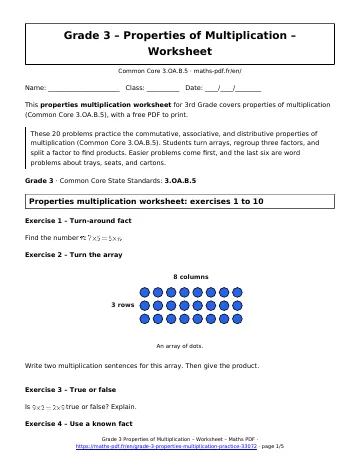
This 3rd grade properties of multiplication worksheet covers properties of multiplication (Common Core 3.OA.B.5), with a free PDF to print.
Key takeaway: This worksheet helps Grade 3 students practice the properties of multiplication.
- Topic: Properties of Multiplication (3rd grade)
- Content: 20 worksheet problems, from easy to challenging
- Standards: 3.OA.B.5
- Answers: On a separate page, so you can try every worksheet problem first
- Format: Free printable PDF, US Letter, black and white
This worksheet helps Grade 3 students practice the properties of multiplication. First, children use turn-around facts and arrays to see that order does not matter. Then they move parentheses and group factors in different ways.
The 15 problems also split arrays, break apart a factor, multiply by a sum, and double a fact. Next, children find easier orders for three factors and pick true sentences. Finally, they solve a story about muffin boxes. Plan about 25 minutes, and keep grid paper nearby to draw arrays. Also, a pencil and scratch paper help children show each step.
Key takeaway: This Grade 3 worksheet on Properties of Multiplication gives 20 problems, from warm-up questions to harder applications. The answer key is on a separate page; free printable PDF.
Grade 3 · Common Core State Standards: 3.OA.B.5
3rd grade properties of multiplication worksheet: worksheet problems 1 to 10
1 – Turn-around fact
2 – Turn the array
Next, write two multiplication sentences for this array. Then give the product.
3 – True or false
4 – Use a known fact
5 – Move the parentheses
6 – Group first
7 – Split the array
Next, write a number sentence for the blue and orange parts. Then find \(4 \times 7\).
8 – Break apart a factor
9 – Split a factor
10 – Multiply by a sum
Worksheet problems 11 and up
11 – Double a fact
Jamal knows \(7 \times 4 = 28\). Use it to find \(7 \times 8\).
12 – Easier order
13 – Two ways
14 – Pick the true sentence
- \(8 \times 5 + 8 \times 2\)
- \(8 \times 5 + 7 \times 2\)
- \(8 \times 5 + 2\)
15 – Muffin boxes
16 – Theater seats
First, a theater has 9 rows with 6 seats in each row. Ethan splits each row into 5 seats and 1 seat. How many seats are in the theater?
17 – Markers and crayons
18 – Cookie trays
Then, at the bake sale, Mei bakes 4 trays. Each tray has 3 rows of 4 cookies. How many cookies does she bake?
Worksheet problem 19 and after
19 – Orange bags
20 – Egg cartons

Key facts behind this 3rd grade properties of multiplication worksheet
- Commutative: \(3 \times 6 = 6 \times 3\). The order of two factors does not change the product.
- Associative: \((2 \times 3) \times 4 = 2 \times (3 \times 4)\). Regrouping three factors does not change the product.
- Distributive: \(6 \times 7 = 6 \times 5 + 6 \times 2\). Split a factor, multiply the parts, then add.
- Then, an array turned on its side shows the commutative property.
- Known facts help you find unknown facts, such as 5s and 2s for 7s and 8s.
Common mistakes with this 3rd grade properties of multiplication worksheet
- When filling a blank in a turn-around fact, students copy the number above. For example, 6 times 4 equals 4 times n needs n to be 6, the other factor.
- Also, when moving parentheses, students change the numbers. The numbers stay the same. Only the grouping changes. As a result, small mistakes are easier to catch.
- When breaking apart a factor, students split a factor into parts that do not add to it. Check that the parts add to the original number.
Tips before you start the worksheet problems
- Draw an array for each fact you do not know. Then split the array into two parts and find each part.
- For three factors, look for a pair that is easy to multiply. Also try two groupings and compare the results.
- Teachers can ask students to explain which property they used. Naming the property builds math language. Also, saying the steps aloud helps you spot a slip.
Download the 3rd grade properties of multiplication worksheet as a PDF with the button below and keep it with your notes.
3rd grade properties of multiplication worksheet: frequently asked questions
How can you tell which property a number sentence shows?
Look at what changes. If the order of two factors swaps, it is the commutative property. Also, if the parentheses move, it is the associative property. If a factor is split and the products are added, it is the distributive property.
How do you multiply a number by a sum in two ways?
You can add first, then multiply, or multiply each part and add. For example, 5 times the sum of 2 and 4 equals 5 times 2 plus 5 times 4. Both give 30, which shows the two ways match.
How can you double a fact to find a new fact?
Double the known product when one factor doubles. For example, if 6 times 3 is 18, then 6 times 6 is double, which is 36. Draw two equal arrays to see why.
All Grade 3 chapters: Grade 3 math.
More 3rd Grade math
Lessons
See all Understanding Multiplication Lesson: Notes and Examples
- Two-Step Word Problems and Patterns Lesson: Notes and Examples
- Time, Liquid Volume and Mass Lesson: Notes and Examples
- Understanding Fractions Lesson: Notes and Examples
- Rounding to the Nearest 10 and 100 Lesson: Notes and Examples
- Quadrilaterals and Partitioning Shapes Lesson: Notes and Examples


Worksheets
See all- Understanding Division Worksheets with Answers
- Scaled Graphs and Line Plots Worksheets with Answers
- Time, Liquid Volume and Mass Worksheets with Answers
- Multiplication and Division Facts Within 100 Worksheets with Answers
- Equivalent and Comparing Fractions Worksheets with Answers
- Area Worksheets with Answers

Tests
See all




Quizzes
See all- Area Quiz: 10 Questions with Answers
- Scaled Graphs and Line Plots Quiz: 10 Questions with Answers
- Perimeter Quiz: 10 Questions with Answers
- Time, Liquid Volume and Mass Quiz: 10 Questions with Answers
- Properties of Multiplication Quiz: 10 Questions with Answers
- Adding and Subtracting Within 1,000 Quiz: 10 Questions with Answers