3rd Grade Properties of Multiplication Worksheet Answer Key (PDF)

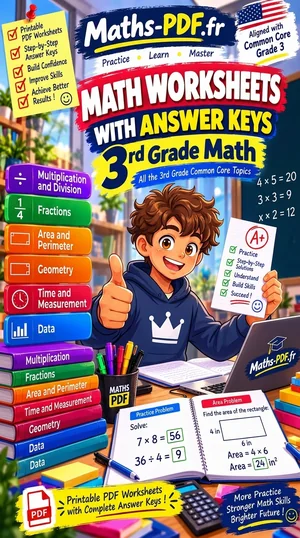
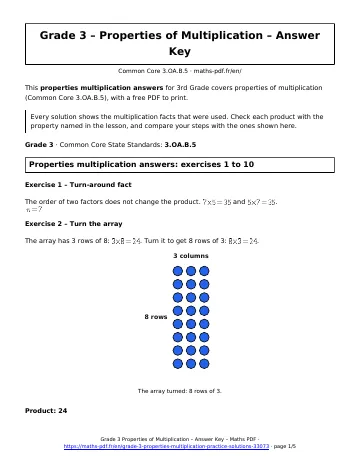
This 3rd grade properties of multiplication worksheet answers covers properties of multiplication (Common Core 3.OA.B.5), with a free PDF to print.
Key takeaway: This answer key helps Grade 3 teachers and parents check the properties of multiplication worksheet.
- Topic: Properties of Multiplication (3rd grade)
- Content: Step-by-step answers to 20 worksheet problems
- Standards: 3.OA.B.5
- Answers: Every step shown, with the method to review
- Format: Free printable PDF, US Letter, black and white
This answer key helps Grade 3 teachers and parents check the properties of multiplication worksheet. First, it gives the answer to each of the 15 problems. Then it names the property that each problem uses.
The notes cover turn-around facts, arrays, moving parentheses, splitting arrays, breaking apart factors, doubling, and choosing true sentences. Next, use the notes to talk about any missed problem. Checking the full page takes about 15 minutes, and grid paper helps the child redraw an array. Also, a pencil and scratch paper help children show each step.
Key takeaway: This answer key for the Grade 3 worksheet on Properties of Multiplication shows every step and the rule used. Check your work after trying the problems alone; free PDF.
Grade 3 · Common Core State Standards: 3.OA.B.5
3rd grade properties of multiplication worksheet answers: worksheet problems 1 to 10
1 – Turn-around fact
\(n = 7\)
2 – Turn the array
Product: 24
3 – True or false
True
4 – Use a known fact
\(9 \times 6 = 54\)
5 – Move the parentheses
\(n = 3\)
6 – Group first
24
7 – Split the array
\(4 \times 7 = 4 \times 5 + 4 \times 2 = 28\)
8 – Break apart a factor
\(n = 2\), product 42
Worksheet problem 9 and after
9 – Split a factor
48
10 – Multiply by a sum
Multiply each part: \(7 \times 4 = 28\) and \(7 \times 3 = 21\), then \(28 + 21 = 49\).
Both ways give 49
Worksheet problems 11 and up
11 – Double a fact
56
12 – Easier order
70
13 – Two ways
Way 2: \(2 \times (4 \times 5) = 2 \times 20 = 40\).
40
14 – Pick the true sentence
A
15 – Muffin boxes
24 muffins
16 – Theater seats
54 seats
17 – Markers and crayons
Way 2: Each pair of packs holds \(6 + 3 = 9\), so \(4 \times 9 = 36\).
36 items
18 – Cookie trays
(Check: each tray has \(3 \times 4 = 12\), and \(4 \times 12 = 48\).)
48 cookies
Worksheet problem 19 and after
19 – Orange bags
42 oranges
20 – Egg cartons
60 eggs
Key facts behind this 3rd grade properties of multiplication worksheet answers
- Commutative: \(3 \times 6 = 6 \times 3\). The order of two factors does not change the product.
- Associative: \((2 \times 3) \times 4 = 2 \times (3 \times 4)\). Regrouping three factors does not change the product.
- Distributive: \(6 \times 7 = 6 \times 5 + 6 \times 2\). Split a factor, multiply the parts, then add.
- Then, an array turned on its side shows the commutative property.
- Known facts help you find unknown facts, such as 5s and 2s for 7s and 8s.
Common mistakes with this 3rd grade properties of multiplication worksheet answers
- Marking only the number hides the thinking. Ask the child to name the property or describe the split. As a result, small mistakes are easier to catch.
- In problem 8, 6 times 7 equals 6 times 5 plus 6 times 2, so n is 2 and the product is 42. A child who writes 12 has added the numbers.
- In problem 14, the sentence equal to 8 times 7 splits 7 into two parts. Check that the child chose the sentence whose parts add to 7.
How to use these solutions
- First, ask the child to redraw a missed array. Then compare the picture with the equation. Also, saying the steps aloud helps you spot a slip.
- Also, ask the child to check a product with a second method. For example, check with a turn-around fact.
- Sort errors into turn-around facts, parentheses, splitting, and doubling. Then practice the type with the most misses. Then check the result once more before moving on.
Download the 3rd grade properties of multiplication worksheet answers as a PDF with the button below and keep it with your notes.
3rd grade properties of multiplication worksheet answers: frequently asked questions
What is the answer to 7 times 5 equals 5 times n?
The answer is 7. The commutative property says the order of two factors does not change the product. So 7 times 5 equals 5 times 7. Problem 1 asks for this. Then check the result once more before moving on.
How do I check the two ways in problem 10?
Add first: 4 plus 3 is 7, then 7 times 7 is 49. Or multiply the parts: 7 times 4 is 28, and 7 times 3 is 21, and 28 plus 21 is 49. Both ways should match.
What if a child uses a different split?
Accept any split that adds to the factor. For 9 times 6, splitting 6 as 4 plus 2 or 5 plus 1 both work. Check that both products are added. In other words, slow and careful work pays off here.
All Grade 3 chapters: Grade 3 math.
More 3rd Grade math
Lessons
See all Multiplying by Multiples of 10 Lesson: Notes and Examples
- Two-Step Word Problems and Patterns Lesson: Notes and Examples
- Properties of Multiplication Lesson: Notes and Examples
- Multiplication and Division Facts Within 100 Lesson: Notes and Examples
- Understanding Multiplication Lesson: Notes and Examples
- Understanding Division Lesson: Notes and Examples






Worksheets
See all




Tests
See all





Quizzes
See all- Time, Liquid Volume and Mass Quiz: 10 Questions with Answers
- Equivalent and Comparing Fractions Quiz: 10 Questions with Answers
- Multiplication and Division Facts Within 100 Quiz: 10 Questions with Answers
- Understanding Multiplication Quiz: 10 Questions with Answers
- Properties of Multiplication Quiz: 10 Questions with Answers
- Understanding Fractions Quiz: 10 Questions with Answers