3rd Grade Multiplication and Division Facts Within 100 Lesson: Notes and Examples (Free PDF)

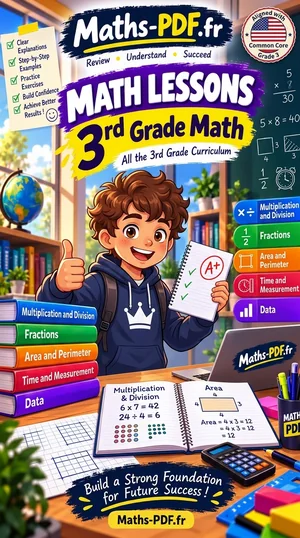
This 3rd grade multiplication facts lesson covers multiplication and division facts within 100 (Common Core 3.OA.C.7), with a free PDF to print.
Key takeaway: This lesson helps Grade 3 students learn multiplication and division facts within 100 with strategies and fact families.
- Topic: Multiplication and Division Facts Within 100 (3rd grade)
- Content: One-page lesson with a definition, a worked example and key facts
- Standards: 3.OA.C.7
- Answers: Explanations included
- Format: Free printable PDF, US Letter, black and white
Key takeaway: A clear Grade 3 lesson on Multiplication and Division Facts Within 100, with definitions, rules and worked examples: what are multiplication facts, what is a fact family and how is division connected to multiplication. Read it before the practice worksheet; free to print or download as a PDF.
Multiplication facts are the products of two one-digit numbers, such as 6 × 7 = 42. Each fact belongs to a fact family of three numbers that makes two multiplication facts and two division facts. Third graders use skip counting, doubles, and fives and nines patterns to know every product and quotient within 100 fluently.
This lesson helps Grade 3 students learn multiplication and division facts within 100 with strategies and fact families. First, children skip count and use patterns for 2s, 5s, 9s, and 10s. Then they use doubles and a known fact to find a harder fact.
Next, the lesson shows how division is a missing factor problem. Also, it explains fact families that use three numbers. Finally, it gives tips for building fluency, which means knowing facts from memory, quickly and correctly. Plan about 20 minutes, with a multiplication chart on the table.
Grade 3 · Common Core State Standards: 3.OA.C.7
Key facts in this 3rd grade multiplication facts lesson
- A fact family uses three numbers: \(6, 7, and 42\) make \(6 \times 7 = 42\), \(7 \times 6 = 42\), \(42 \div 6 = 7\), and \(42 \div 7 = 6\).
- Division is finding a missing factor: 42 ÷ 7 asks 7 times what number is 42.
- Products of 5 end in 0 or 5, and the digits of a product of 9 add to 9.
- Doubles help with 2s and 4s. Add one more group to move from a known fact to the next one.
- Fluency means knowing the facts from memory, quickly and correctly.
What are multiplication facts?
A multiplication fact is a product of two one-digit numbers, like \(6 \times 7 = 42\). Third graders learn all of them, up to \(9 \times 9 = 81\) and the 10s. A good goal is to know each fact right away, and the strategies below help you get there.
What is a fact family?
Three numbers can make a team. The numbers 6, 7, and 42 give four facts that all belong together.
| Multiplication | Division |
|---|---|
| \(6 \times 7 = 42\) | \(42 \div 6 = 7\) |
| \(7 \times 6 = 42\) | \(42 \div 7 = 6\) |
How is division connected to multiplication?
Division finds how many are in each group, or how many groups there are. Think of the missing factor. To solve \(42 \div 7\), ask, “7 times what number is 42?” Since \(7 \times 6 = 42\), the answer is 6.
What strategies help you remember the facts?
- Skip count. For the 4s, count 4, 8, 12, 16, and so on.
- Double it. The 2s are doubles: \(2 \times 9 = 9 + 9 = 18\). For the 4s, double twice.
- Fives. Products end in 0 or 5: \(5 \times 8 = 40\).
- Nines. Subtract 1 from the other factor to get the tens digit. The two digits add to 9. For \(9 \times 6\), the tens digit is 5 and the ones digit is 4, so the product is 54.
- Add one more group. Know \(7 \times 7 = 49\)? Then \(7 \times 8 = 49 + 7 = 56\).
How do you find a missing number?
- Write the fact with a letter for the unknown, like \(8 \times n = 24\).
- Think of the related division fact: \(24 \div 8\).
- Recall the multiplication fact: \(8 \times 3 = 24\).
- Check by multiplying: \(n = 3\).
3rd grade multiplication facts lesson: questions and answers
What is a multiplication fact?
It is the product of two one-digit numbers, like \(8 \times 4 = 32\). Third graders learn all the facts from \(0 \times 0\) to \(10 \times 10\) so they can multiply quickly.
What is a fact family?
A fact family is a group of related facts that use the same three numbers. The numbers 3, 8, and 24 make \(3 \times 8 = 24\), \(8 \times 3 = 24\), \(24 \div 3 = 8\), and \(24 \div 8 = 3\).
How do you divide using multiplication?
Think of a missing factor. To find \(36 \div 4\), ask what number times 4 is 36. Since \(4 \times 9 = 36\), the quotient is 9.
What is the trick for the 9s facts?
For \(9 \times 7\), subtract 1 from 7 to get 6 tens. The digits add to 9, so the ones digit is 3. The product is 63.
How can I learn the facts I forget?
Use a fact you know. If you forget 6 × 8, find 5 × 8 = 40 and add one more group of 8 to get 48. Practice a few facts each day and check with a multiplication chart.
Common mistakes with this 3rd grade multiplication facts lesson
- Students memorize a fact wrong and never check it. For example, they say 6 times 7 is 48. Use a strategy to check, such as 5 times 7 plus one more 7.
- Children mix up multiplication and addition. As a result, 4 times 8 becomes 12. Think of 4 groups of 8, or double 8 twice.
- When dividing, students look for a wrong factor. For example, 56 divided by 8 asks what times 8 makes 56. Check by multiplying the answer by 8.
How to study this chapter
- First, learn the easy facts, 2s, 5s, 10s, and 9s. Then use them to build the facts you find hard.
- Practice a few facts each day instead of many at once. Also, mix multiplication and division so that the two connect.
- Parents can use cards or a short quiz at dinner. Five facts a day add up over a month. Also, saying the steps aloud helps you spot a slip.
Download the 3rd grade multiplication facts lesson as a PDF with the button below and keep it with your notes.
More questions about 3rd grade multiplication facts lesson
What is a good way to learn the multiplication facts?
Start with patterns and easy facts, then build up. Use skip counting for 2s and 5s, doubles for 4s, and the digit pattern for 9s. Practice a few facts daily and mix in division facts that use the same three numbers.
How can I use a fact I know to find one I do not know?
Add or take away one group. If you know 5 times 7 is 35, then 6 times 7 is 35 plus 7, which is 42. You can also double a fact. This is called using a known fact.
How do squares like 6 times 6 help?
Square facts are anchors. Knowing 6 times 6 is 36 helps you find 6 times 7, which is 36 plus 6. Learn the squares from 1 times 1 to 10 times 10, then use them to find nearby facts.
All Grade 3 chapters: Grade 3 math.
Free printable PDF
3rd Grade Multiplication and Division Facts Within 100 Lesson: Notes and Examples
Download PDF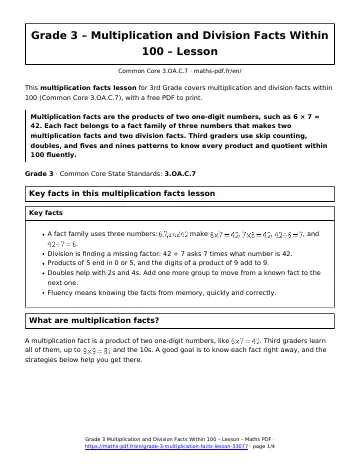
More 3rd Grade math
Lessons
See all Properties of Multiplication Lesson: Notes and Examples
- Rounding to the Nearest 10 and 100 Lesson: Notes and Examples
- Understanding Fractions Lesson: Notes and Examples
- Adding and Subtracting Within 1,000 Lesson: Notes and Examples
- Quadrilaterals and Partitioning Shapes Lesson: Notes and Examples
- Scaled Graphs and Line Plots Lesson: Notes and Examples





Worksheets
See all- Scaled Graphs and Line Plots Worksheets with Answers
- Equivalent and Comparing Fractions Worksheets with Answers
- Perimeter Worksheets with Answers
- Adding and Subtracting Within 1,000 Worksheets with Answers
- Multiplication and Division Facts Within 100 Worksheets with Answers
- Understanding Fractions Worksheets with Answers



Tests
See all




Quizzes
See all- Adding and Subtracting Within 1,000 Quiz: 10 Questions with Answers
- Understanding Division Quiz: 10 Questions with Answers
- Multiplying by Multiples of 10 Quiz: 10 Questions with Answers
- Properties of Multiplication Quiz: 10 Questions with Answers
- Area Quiz: 10 Questions with Answers
- Two-Step Word Problems and Patterns Quiz: 10 Questions with Answers