1st Grade Measuring Length Test Answer Key and Scoring Guide (PDF)
This 1st grade measuring length test answer key covers measuring length (Common Core 1.MD.A.1, 1.MD.A.2), with a free PDF to print.
Key takeaway: This answer key helps Grade 1 teachers score the measuring length test and decide what to teach next.
- Topic: Measuring Length (1st grade)
- Content: Worked solutions and a scoring guide for 8 questions
- Standards: 1.MD.A.1, 1.MD.A.2
- Answers: Every step shown, with the method to review
- Format: Free printable PDF, US Letter, black and white
This answer key helps Grade 1 teachers score the measuring length test and decide what to teach next. It gives the correct answer for each part and explains the reasoning behind it.
The test totals 20 points. Look for the idea of length in each answer. Students may use words like end to end, no gaps, or same size. Use the notes to tell a counting error from a misunderstanding about units or comparing. Scoring takes about ten minutes for a small class.
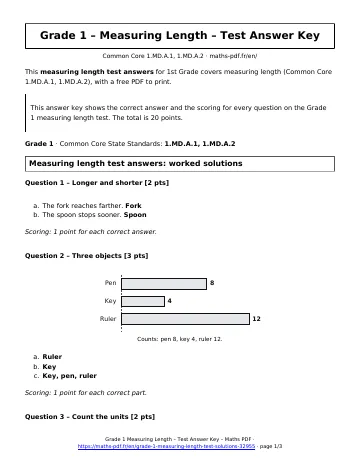
This answer key shows the correct answer and the scoring for every question on the Grade 1 measuring length test. The total is 20 points.
Key takeaway: Worked answers for the Grade 1 test on Measuring Length, with the scoring for each problem. Use it to grade yourself after a timed attempt; free PDF.
Grade 1 · Common Core State Standards: 1.MD.A.1, 1.MD.A.2
1st grade measuring length test answer key: worked solutions
1 – Longer and shorter [2 pts]
- The fork reaches farther. Fork
- The spoon stops sooner. Spoon
Scoring: 1 point for each correct answer.
2 – Three objects [3 pts]
- Ruler
- Key
- Key, pen, ruler
Scoring: 1 point for each correct part.
3 – Count the units [2 pts]
Count the cubes: 9. 9 cubes
Scoring: 2 points for 9 cubes. 1 point for a count that is off by one.
4 – Measuring mistake [2 pts]
There are gaps between her cubes. The cubes must touch end to end.
She left gaps.
Scoring: 2 points for naming the gaps. 1 point for saying only that the row is not correct.
5 – Long, longer, longest [2 pts]
- Ethan’s rope
- Omar’s rope
Scoring: 1 point for each answer.
6 – Compare two counts [3 pts]
- The car, because 13 is more than 9. The toy car
- \(13 > 9\)
Scoring: 1 point for the car. 2 points for a correct comparison; 1 point if the numbers are right but the sign is reversed.
7 – Rows of blocks [3 pts]
Add the green and yellow blocks: \(6 + 4 = 10\).
10 blocks
Scoring: 1 point for adding, 1 point for the sum 10, 1 point for the unit name.
Question 8 and after
8 – Different units [3 pts]
- The big cube
- Also, the small cubes are shorter, so more of them are needed. The units are different sizes.
Scoring: 1 point for the big cube. 2 points for explaining that the units differ in size; 1 point for a partial reason.
Total score
20 points
Key facts behind this 1st grade measuring length test answer key
- Length is how long an object is from one end to the other.
- Line up the left ends to tell which of two objects is longer.
- Units must be the same size, laid end to end, with no gaps and no overlaps.
- Then, the count of units is the length, and the unit name goes with the number.
- If A is longer than B and B is longer than C, then A is longer than C.
Common mistakes with this 1st grade measuring length test answer key
- Giving full credit to question 4 for saying the card is wrong without a reason misses the main idea. The reason should name the gap or the start.
- In question 6, the answer needs both numbers compared. 13 paper clips is more than the other count, but the key idea is that the units are the same.
- Also, in question 7, the total of the two rows is 6 + 4 = 10. A student who writes 10 without the unit blocks may lose part of the point.
How to learn from your test
- Sort errors into comparing, counting, measuring mistakes, and different units. Plan a short hands-on lesson for the most common type.
- Next, ask students to remeasure one missed question with cubes. Doing the measurement again shows the error in a way that a score cannot.
- Also, parents can look at the type of error. A child who gets counts right but misses explanations needs to practice saying the rule aloud.
Download the 1st grade measuring length test answer key as a PDF with the button below and keep it with your notes.
1st grade measuring length test answer key: frequently asked questions
How should the different units question be scored?
Give one point for stating that the ribbon is the same length and one for a reason about unit size. A good answer says the big cubes are longer than the small cubes, so fewer big cubes cover the same ribbon.
What if a student says about when counting cubes?
Accept about if the count is close and the answer makes sense. First graders sometimes see a cube that does not fit exactly. If the test uses whole cubes, the exact number is expected, so check the picture with the student.
What should I teach after this test?
If students missed measuring mistakes, practice with real cubes and a task of finding the error in a pretend classmate’s row. If they missed ordering, use three strings. Later lessons connect cube counts to rulers and inches in Grade 2.
All Grade 1 chapters: Grade 1 math.
More 1st Grade math
Lessons
See all Comparing Two-Digit Numbers Lesson: Notes and Examples
- Adding and Subtracting Tens Within 100 Lesson: Notes and Examples
- Subtraction Within 20 Lesson: Notes and Examples
- Counting to 120 Lesson: Notes and Examples
- Addition Within 20 Lesson: Notes and Examples
- Telling Time to the Hour and Half Hour Lesson: Notes and Examples


Worksheets
See all- Comparing Two-Digit Numbers Worksheets with Answers
- Measuring Length Worksheets with Answers
- Telling Time to the Hour and Half Hour Worksheets with Answers
- Subtraction Within 20 Worksheets with Answers
- Organizing and Reading Data Worksheets with Answers
- The Equal Sign and Word Problems Worksheets with Answers


Tests
See all




Quizzes
See all- Telling Time to the Hour and Half Hour Quiz: 10 Questions with Answers
- The Equal Sign and Word Problems Quiz: 10 Questions with Answers
- Measuring Length Quiz: 10 Questions with Answers
- Tens and Ones Quiz: 10 Questions with Answers
- 2D and 3D Shapes Quiz: 10 Questions with Answers
- Adding and Subtracting Tens Within 100 Quiz: 10 Questions with Answers