Algebra 1 Slope and Rate of Change Worksheet Answer Key (PDF)


This slope and rate of change worksheet answers for Algebra 1 covers slope and rate of change (Common Core F-IF.B.4, F-IF.B.6, F-LE.A.1b), with a free PDF to print.
Key takeaway: This answer key helps Algebra 1 students check their slope worksheet and see how each rate of change was found.
- Topic: Slope and Rate of Change (Algebra 1)
- Content: Step-by-step answers to 21 worksheet problems
- Standards: F-IF.B.4, F-IF.B.6, F-LE.A.1b
- Answers: Every step shown, with the method to review
- Format: Free printable PDF, US Letter, black and white
This answer key helps Algebra 1 students check their slope worksheet and see how each rate of change was found. All 21 solutions show the subtraction for the rise and the run, and a sentence of interpretation for every application.
Use it after finishing each group of worksheet problems. For points and tables, the key shows both differences in the same order. Also, for graphs, it lists the two points it used. For word problems, it names the unit of the rate. For average rate of change, it shows the function values at each endpoint and the division. Compare the setup first, then the arithmetic.
Key takeaway: This answer key for the Algebra 1 worksheet on Slope and Rate of Change shows every step and the rule used. Check your work after trying the problems alone; free PDF.
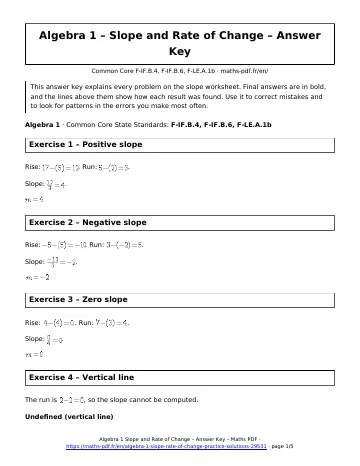
Algebra 1 · Common Core State Standards: F-IF.B.4, F-IF.B.6, F-LE.A.1b
Slope and rate of change worksheet answers: worksheet problems 1 to 10
1 – Positive slope
Rise: \(17 – (5) = 12\). Run: \(5 – (2) = 3\).
Slope: \(\frac{12}{3} = 4\).
\(m = 4\)
2 – Negative slope
Rise: \(-5 – (5) = -10\). Run: \(3 – (-2) = 5\).
Slope: \(\frac{-10}{5} = -2\).
\(m = -2\)
3 – Zero slope
Rise: \(4 – (4) = 0\). Run: \(7 – (3) = 4\).
Slope: \(\frac{0}{4} = 0\).
\(m = 0\)
4 – Vertical line
The run is \(2 – 2 = 0\), so the slope cannot be computed.
Undefined (vertical line)
5 – Slope from a graph
Read two points: \((-2, -3)\) and \((2, 3)\). Rise: \(3 – (-3) = 6\). Run: \(2 – (-2) = 4\).
Slope: \(\frac{6}{4} = \frac{3}{2}\).
\(m = \frac{3}{2}\)
6 – Slope from a table
Use two rows: \((0, 5)\) and \((2, 11)\). Rise: 6. Run: 2.
Check another pair: \((4, 17)\) to \((6, 23)\) also gives \(\frac{6}{2}\).
\(m = 3\)
7 – Classify the slope
(a) Same y-value: rise 0, slope 0. (b) Same x-value: run 0, undefined. (c) Rise \(-3\), run 3, slope \(-1\). (d) Rise 6, run 6, slope 1.
(a) zero; (b) undefined; (c) negative; (d) positive
8 – Ramp
Slope is rise over run: \(\frac{2}{24} = \frac{1}{12}\).
\(\frac{1}{12}\)
Worksheet problem 9 and after
9 – Missing coordinate
Set up \(\frac{y – 3}{6 – 2} = 2\), so \(\frac{y – 3}{4} = 2\).
Multiply by 4: \(y – 3 = 8\). Add 3.
\(y = 11\)
10 – Is it linear?
Rates between consecutive rows: \(\frac{7 – 3}{1} = 4\), \(\frac{12 – 7}{1} = 5\), \(\frac{18 – 12}{1} = 6\).
The rate is not constant.
Not linear
Worksheet problems 11 and up
11 – Fraction coordinates
Rise: \(5 – 1 = 4\). Run: \(\frac{3}{2} – \left(-\frac{1}{2}\right) = 2\).
Slope: \(\frac{4}{2} = 2\).
\(m = 2\)
12 – Savings rate
\(\frac{95 – 50}{5 – 2} = \frac{45}{3} = 15\).
$15 per week
13 – Road trip graph
Use \((2, 110)\) and \((4, 220)\): \(\frac{220 – 110}{4 – 2} = \frac{110}{2} = 55\).
For every hour, the car travels 55 more miles.
55 miles per hour
14 – Meaning of the intercept
The slope 8 means the cost increases by $8 for each additional hour.
Also, the y-intercept 15 is the cost when \(x = 0\): a $15 entry fee.
$8 per hour; $15 entry fee
15 – Average rate of change
\(h(2) = 2(4) – 2 = 6\) and \(h(5) = 2(25) – 5 = 45\).
\(\frac{45 – 6}{5 – 2} = \frac{39}{3} = 13\).
13 inches per foot
16 – Falling temperature
\(\frac{44 – 68}{6 – 2} = \frac{-24}{4} = -6\).
The temperature fell about 6°F each hour.
\(-6\) °F per hour
17 – Plant growth
From week 1 to week 4: \(\frac{9 – 3}{4 – 1} = \frac{6}{3} = 2\).
The plant grows 2 inches each week, and every pair of consecutive rows agrees.
2 inches per week
Worksheet problem 18 and after
18 – Compare speeds
Car A: \(\frac{150}{3} = 50\) mph. Car B: \(\frac{220}{5} = 44\) mph.
Car A, 50 mph versus 44 mph
19 – Hiker's trip
0 to 1: \(\frac{3 – 0}{1 – 0} = 3\) mi/h (walking away). 1 to 2: \(\frac{3 – 3}{1} = 0\) (resting). 2 to 3: \(\frac{0 – 3}{1} = -3\) mi/h (walking back).
3, 0, and -3 miles per hour
20 – Projectile
\(h(0) = 0\), \(h(2) = 64\): \(\frac{64 – 0}{2 – 0} = 32\) ft/s.
\(h(1) = 48\), \(h(3) = 48\): \(\frac{48 – 48}{3 – 1} = 0\) ft/s. The ball rises and falls back to the same height, so the average change is 0.
32 ft/s; 0 ft/s
21 – Not constant growth
\(\frac{4 – 2}{1} = 2\), \(\frac{8 – 4}{1} = 4\), \(\frac{16 – 8}{1} = 8\).
The rate doubles each step, so it is not constant and the function is not linear.
2, 4, 8; not constant
Key facts behind this slope and rate of change worksheet answers
- Slope = rise ÷ run = (y₂ – y₁)/(x₂ – x₁).
- Positive slope rises, negative slope falls, horizontal lines have slope 0, vertical lines are undefined.
- In a context, slope is a rate of change with units like dollars per hour.
- Then, a linear function has the same rate of change between any two points.
- Average rate of change over [a, b] is (f(b) – f(a))/(b – a).
Common mistakes with this slope and rate of change worksheet answers
- Students compare only the final fraction. A slope of one twelfth and 0.083 are close, so check whether the question asks for a fraction or a decimal.
- Students forget to include the unit in the rate. As a result, the key writes the unit as a quotient, such as dollars per week, in every application.
- Students use two points that are not exactly on the line. The key lists lattice points, so choose points that land on grid crossings.
How to use these solutions
- For each missed worksheet problem, redo the subtraction with the points in the opposite order. You should get the same slope.
- Check a slope from a graph by confirming that the sign matches the direction of the line.
- Parents can ask the student to explain what a rate means in one application in plain words.
Download the slope and rate of change worksheet answers as a PDF with the button below and keep it with your notes.
Slope and rate of change worksheet answers: frequently asked questions
Why does the key list the points it used?
Any two points on a line give the same slope, so there is more than one correct choice. Listing the points shows exactly how the answer was found, and it lets you check your own choice. If your points are different, the slope should still match.
How does the key decide that a table is not linear?
It computes the rate of change between each pair of consecutive rows. If any two rates differ, the function is not linear. The key writes each rate next to the rows, so you can see the first place where the rate changes.
What does a negative rate of change mean in the key?
It means the quantity is decreasing. As a result, a temperature that falls from 68 to 44 degrees in 4 hours has a rate of -6 degrees per hour. Also, the key states the unit and the direction in a short sentence.
All Algebra 1 chapters: Algebra 1 math.
More Algebra 1 math
Lessons
See all Exponent Rules and Radicals Lesson: Notes and Examples
- Solving Linear Equations in One Variable Lesson: Notes and Examples
- Structure of Algebraic Expressions Lesson: Notes and Examples
- Arithmetic and Geometric Sequences Lesson: Notes and Examples
- Linear Inequalities in One Variable Lesson: Notes and Examples
- Linear Inequalities in Two Variables and Systems Lesson: Notes and Examples






Worksheets
See all- Graphing Quadratic Functions and Transformations Worksheets with Answers
- Functions and Function Notation Worksheets with Answers
- Systems of Linear Equations Worksheets with Answers
- Writing Linear Equations and Functions Worksheets with Answers
- Solving Quadratic Equations Worksheets with Answers
- Structure of Algebraic Expressions Worksheets with Answers






Tests
See all- Arithmetic and Geometric Sequences Test with Answer Key
- Literal Equations and Formulas Test with Answer Key
- Graphing Linear Equations Test with Answer Key
- Data Distributions and Summary Statistics Test with Answer Key
- Exponential Functions and Growth Test with Answer Key
- Structure of Algebraic Expressions Test with Answer Key






Quizzes
See all- Structure of Algebraic Expressions Quiz: 10 Questions with Answers
- Factoring Polynomials Quiz: 10 Questions with Answers
- Graphing Linear Equations Quiz: 10 Questions with Answers
- Linear Inequalities in Two Variables and Systems Quiz: 10 Questions with Answers
- Systems of Linear Equations Quiz: 10 Questions with Answers
- Functions and Function Notation Quiz: 10 Questions with Answers