Algebra 1 Exponential Functions and Growth Worksheet Answer Key (PDF)


This algebra 1 exponential functions worksheet answers covers exponential functions and growth (Common Core F-LE.A.1, F-LE.A.2, F-LE.A.3, F-IF.C.7e, F-IF.C.8b), with a free PDF to print.
Key takeaway: Also, this answer key helps Algebra 1 students check their exponential function worksheet and see how each model and graph was built.
- Topic: Exponential Functions and Growth (Algebra 1)
- Content: Step-by-step answers to 21 worksheet problems
- Standards: F-LE.A.1, F-LE.A.2, F-LE.A.3, F-IF.C.7e, F-IF.C.8b
- Answers: Every step shown, with the method to review
- Format: Free printable PDF, US Letter, black and white
Also, this answer key helps Algebra 1 students check their exponential function worksheet and see how each model and graph was built. All 21 solutions show the method, not just the final value.
Then, use it once you finish, then compare each equation, table, and graph. In other words, the key explains how to find \(a\) and \(b\) from tables, how to convert a percent to a factor, how to evaluate with a calculator and round correctly, and how to solve by matching bases. Application answers include a sentence with units, such as people, dollars, or milligrams, so you can see what a complete answer looks like.
Key takeaway: This answer key for the Algebra 1 worksheet on Exponential Functions and Growth shows every step and the rule used. Check your work after trying the problems alone; free PDF.
Algebra 1 · Common Core State Standards: F-LE.A.1, F-LE.A.2, F-LE.A.3, F-IF.C.7e, F-IF.C.8b
Algebra 1 exponential functions worksheet answers: worksheet problems 1 to 10
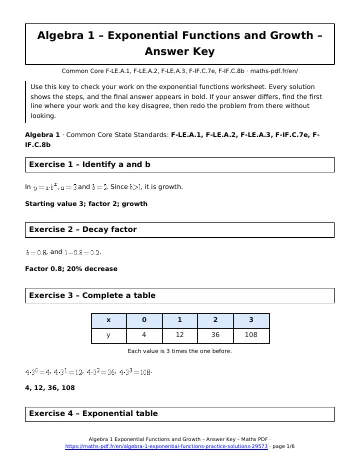
1 – Identify a and b
Next, in \(y = a \cdot b^{x}\), \(a = 3\) and \(b = 2\). Since \(b > 1\), it is growth.
Starting value 3; factor 2; growth
2 – Decay factor
\(b = 0.8\), and \(1 – 0.8 = 0.2\).
Factor 0.8; 20% decrease
3 – Complete a table
\(4 \cdot 3^{0} = 4\), \(4 \cdot 3^{1} = 12\), \(4 \cdot 3^{2} = 36\), \(4 \cdot 3^{3} = 108\).
4, 12, 36, 108
4 – Exponential table
Ratios: \(\frac{6}{2} = 3\), \(\frac{18}{6} = 3\), \(\frac{54}{18} = 3\).
Exponential with ratio 3
5 – Linear table
Now, Differences: \(9 – 5 = 4\), \(13 – 9 = 4\), \(17 – 13 = 4\). The ratios are not constant (\(\frac{9}{5}\), \(\frac{13}{9}\)).
Linear, adding 4 each step
Worksheet problem 6 and after
6 – Write from a table
So, the starting value is \(a = 5\) and each step doubles: \(b = 2\).
\(y = 5 \cdot 2^{x}\)
7 – Graph a growth function
Also, compute \(2^{-2} = \frac{1}{4}\), \(2^{-1} = \frac{1}{2}\), \(2^{0} = 1\), \(2^{1} = 2\), \(2^{2} = 4\), \(2^{3} = 8\).
Then, plot the points and draw a smooth curve that approaches the x-axis on the left.
Curve through (0, 1), (1, 2), (2, 4), (3, 8)
8 – Graph a decay function
Values: \(4, 2, 1, \frac{1}{2}, \frac{1}{4}, \frac{1}{8}\).
In addition, the curve falls from left to right and gets close to the x-axis.
Decreasing curve through (0, 1)
Worksheet problem 9 and after
9 – Rate to factor
(a) \(1 + 0.12 = 1.12\). (b) \(1 – 0.08 = 0.92\).
1.12 and 0.92
10 – Evaluate with a calculator
\(1.05^{10} \approx 1.62889\).
\(100(1.62889) \approx 162.89\).
162.89
Worksheet problems 11 and up
11 – Intercept and asymptote
Now, at \(x = 0\), \(y = 1\). Any real number can be an exponent, and the output is always positive. As \(x\) decreases, \(2^{x}\) gets closer to 0.
(0, 1); all real numbers; \(y > 0\); approaches the x-axis
12 – Solve an exponential equation
\(32 = 2^{5}\), so \(x = 5\).
\(81 = 3^{4}\), so \(x = 4\).
\(x = 5\) and \(x = 4\)
13 – Linear versus exponential
\(f(10) = 10(10) + 5 = 105\) and \(g(10) = 2^{10} = 1024\).
f(10) = 105; g(10) = 1024; g is larger
14 – Domain and range
So, any real number can be an exponent, so the domain is all real numbers.
Also, the output is always positive, so the range is \(y > 0\).
Domain: all real numbers; range: \(y > 0\)
Worksheet problem 15 and after
15 – Rewrite the base
\(2^{3t} = (2^{3})^{t} = 8^{t}\).
\(y = 8^{t}\); factor 8
16 – Town population
Growth factor \(1 + 0.04 = 1.04\): \(P = 20000(1.04)^{t}\).
\(P = 20000(1.04)^{5} \approx 20000(1.21665) \approx 24333\).
\(P = 20000(1.04)^{t}\); about 24,333 people
17 – Car value
Decay factor \(1 – 0.15 = 0.85\): \(V = 24000(0.85)^{t}\).
\(V = 24000(0.85)^{3} = 24000(0.614125) = 14739\).
\(V = 24000(0.85)^{t}\); $14,739
18 – Compound interest
\(A = 1500(1.06)^{8}\).
\(1.06^{8} \approx 1.593848\), so \(A \approx 1500(1.593848) = 2390.77\).
$2,390.77
19 – Medicine half-life
Substitute \(t = 18\): \(A = 80\left(\frac{1}{2}\right)^{3}\).
\(= 80 \cdot \frac{1}{8} = 10\).
10 mg
20 – Viral video
Now, Day 2: \(50 \cdot 3^{2} = 450\) and \(50 + 200(2) = 450\) (equal).
So, Day 3: \(50 \cdot 3^{3} = 1350\) and \(50 + 200(3) = 650\).
Also, from day 3 on, Video A is ahead and the gap grows.
Equal on day 2; A is larger from day 3
Worksheet problem 21 and after
21 – Doubling time
Then, solve \(2000 \cdot 2^{t/12} = 8000\): \(2^{t/12} = 4 = 2^{2}\).
\(\frac{t}{12} = 2\), so \(t = 24\).
24 years
Key facts behind this algebra 1 exponential functions worksheet answers
- Exponential form: f(x) = a·bˣ with a the starting value and b the factor.
- Growth: b = 1 + r. Decay: b = 1 – r.
- Now, Linear functions add a constant; exponential functions multiply by a constant.
- So, Compound interest: A = P(1 + r)ᵗ.
- Also, an exponential function eventually exceeds any linear function.
Common mistakes with this algebra 1 exponential functions worksheet answers
- Students round the growth factor before raising it to a power. Then, keep the full factor, such as 1.04, and round only the final population to the nearest person.
- Students graph only the points the key lists. Then, graph all of them and draw a smooth curve that approaches the x-axis without touching it.
- Students leave out units in the application answers. A final answer such as 24,334 should read 24,334 people so it answers the question asked.
How to use these solutions
- Now, when your table differs from the key, check the first two rows. Most mistakes start in the starting value or the first ratio.
- So, rewrite each missed model using the pattern starting value times factor to the time, then test it at two points from the problem.
- Parents can ask for the story behind a model. Why does 0.85 mean a car loses 15 percent each year?
Download the algebra 1 exponential functions worksheet answers as a PDF with the button below and keep it with your notes.
Algebra 1 exponential functions worksheet answers: frequently asked questions
How do I check a graph of an exponential function?
Next, check that the curve passes through \((0, a)\), that it rises for \(b > 1\) or falls for \(0 < b < 1\), and that it flattens toward the x-axis on one side. Also verify one extra point from the table lies on your curve.
Why does the key give two answers for the linear versus exponential comparison?
In addition, one answer compares the values at a chosen input, and the other explains the long-run trend. At \(x = 10\), \(10x + 5\) gives 105 while \(2^{10}\) gives 1,024. The exponential function wins because it multiplies, while the linear one only adds.
What should I do if my answer differs in the last decimal?
Now, check your rounding. Then, use the unrounded factor in each calculation and round once at the end. Also, a one-cent or one-person difference often comes from rounding the factor or an intermediate power too early.
Also, all Algebra 1 chapters: Algebra 1 math.
More Algebra 1 math
Lessons
See all Scatter Plots, Lines of Fit and Two-Way Tables Lesson: Notes and Examples
- Factoring Polynomials Lesson: Notes and Examples
- Structure of Algebraic Expressions Lesson: Notes and Examples
- Graphing Linear Equations Lesson: Notes and Examples
- Adding, Subtracting and Multiplying Polynomials Lesson: Notes and Examples
- Arithmetic and Geometric Sequences Lesson: Notes and Examples






Worksheets
See all- Systems of Linear Equations Worksheets with Answers
- Linear Inequalities in One Variable Worksheets with Answers
- Adding, Subtracting and Multiplying Polynomials Worksheets with Answers
- Factoring Polynomials Worksheets with Answers
- Graphing Quadratic Functions and Transformations Worksheets with Answers
- Arithmetic and Geometric Sequences Worksheets with Answers






Tests
See all- Graphing Linear Equations Test with Answer Key
- Adding, Subtracting and Multiplying Polynomials Test with Answer Key
- Linear Inequalities in Two Variables and Systems Test with Answer Key
- Graphing Quadratic Functions and Transformations Test with Answer Key
- Exponent Rules and Radicals Test with Answer Key
- Slope and Rate of Change Test with Answer Key






Quizzes
See all- Exponent Rules and Radicals Quiz: 10 Questions with Answers
- Slope and Rate of Change Quiz: 10 Questions with Answers
- Solving Quadratic Equations Quiz: 10 Questions with Answers
- Graphing Linear Equations Quiz: 10 Questions with Answers
- Linear Inequalities in One Variable Quiz: 10 Questions with Answers
- Graphing Quadratic Functions and Transformations Quiz: 10 Questions with Answers