Algebra 1 Arithmetic and Geometric Sequences Worksheet Answer Key (PDF)
This arithmetic and geometric sequences worksheet answers for Algebra 1 covers arithmetic and geometric sequences (Common Core F-IF.A.3, F-BF.A.1a, F-BF.A.2, F-LE.A.2), with a free PDF to print.
Key takeaway: This answer key helps Algebra 1 students check their sequences worksheet and see how each rule and term was found.
- Topic: Arithmetic and Geometric Sequences (Algebra 1)
- Content: Step-by-step answers to 21 worksheet problems
- Standards: F-IF.A.3, F-BF.A.1a, F-BF.A.2, F-LE.A.2
- Answers: Every step shown, with the method to review
- Format: Free printable PDF, US Letter, black and white
This answer key helps Algebra 1 students check their sequences worksheet and see how each rule and term was found. All 21 solutions show the difference or ratio and the substitution into the rule.
Use it after finishing a group of worksheet problems. For arithmetic problems, the key shows the common difference and the explicit rule. Also, for geometric problems, it shows the common ratio and the power. For recursive rules, it lists the first few terms. For the applications, it names the type of sequence, writes the rule, and gives a sentence with units such as dollars, feet, or bacteria.
Key takeaway: This answer key for the Algebra 1 worksheet on Arithmetic and Geometric Sequences shows every step and the rule used. Check your work after trying the problems alone; free PDF.
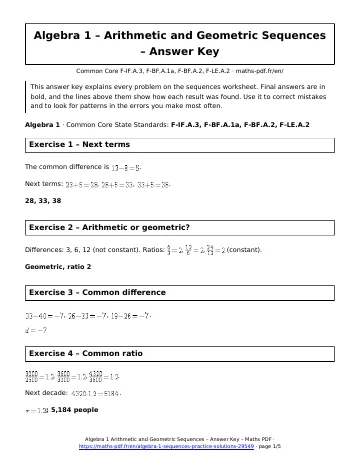
Algebra 1 · Common Core State Standards: F-IF.A.3, F-BF.A.1a, F-BF.A.2, F-LE.A.2
Arithmetic and geometric sequences worksheet answers: worksheet problems 1 to 10
1 – Next terms
The common difference is \(13 – 8 = 5\).
Next terms: \(23 + 5 = 28\), \(28 + 5 = 33\), \(33 + 5 = 38\).
28, 33, 38
2 – Arithmetic or geometric?
Differences: 3, 6, 12 (not constant). Ratios: \(\frac{6}{3} = 2\), \(\frac{12}{6} = 2\), \(\frac{24}{12} = 2\) (constant).
Geometric, ratio 2
3 – Common difference
\(33 – 40 = -7\), \(26 – 33 = -7\), \(19 – 26 = -7\).
\(d = -7\)
4 – Common ratio
\(\frac{3000}{2500} = 1.2\), \(\frac{3600}{3000} = 1.2\), \(\frac{4320}{3600} = 1.2\).
Next decade: \(4320 \cdot 1.2 = 5184\).
\(r = 1.2\); 5,184 people
5 – Explicit rule
The common difference is 5 and \(a_{1} = 7\).
\(a_{n} = 7 + (n – 1)(5) = 7 + 5n – 5 = 5n + 2\).
\(a_{n} = 5n + 2\)
6 – A distant term
Also, the rule is \(a_{n} = 4 + (n – 1)(3) = 3n + 1\).
\(a_{20} = 3(20) + 1 = 61\).
61
7 – Recursive rule
In addition, the common difference is \(6 – 10 = -4\).
\(a_{1} = 10\), \(a_{n} = a_{n-1} – 4\)
8 – Geometric explicit rule
In addition, the ratio is 2 and the first term is 3: \(a_{n} = 3 \cdot 2^{n-1}\).
\(a_{6} = 3 \cdot 2^{5} = 3 \cdot 32 = 96\).
\(a_{n} = 3 \cdot 2^{n-1}\); 96
Worksheet problem 9 and after
9 – Fractional ratio
Also, the ratio is \(\frac{27}{81} = \frac{1}{3}\).
\(a_{n} = 81\left(\frac{1}{3}\right)^{n-1}\).
\(a_{5} = 81 \cdot \frac{1}{81} = 1\).
\(a_{n} = 81\left(\frac{1}{3}\right)^{n-1}\); 1
10 – Which term?
The rule is \(a_{n} = 5n\). Solve \(5n = 95\): \(n = 19\).
The 19th term
Worksheet problems 11 and up
11 – Two terms given
From term 2 to term 6 is 4 steps: \(d = \frac{21 – 5}{4} = 4\).
Then \(a_{1} = 5 – 4 = 1\), so \(a_{n} = 1 + (n – 1)(4) = 4n – 3\).
\(d = 4\); \(a_{n} = 4n – 3\)
12 – Evaluate a recursive rule
\(a_{2} = 3(2) – 1 = 5\), \(a_{3} = 3(5) – 1 = 14\), \(a_{4} = 3(14) – 1 = 41\).
41
13 – Is 100 in the sequence?
The rule is \(a_{n} = 5n + 2\). Solve \(5n + 2 = 100\): \(5n = 98\), so \(n = 19.6\).
Also, the position must be a whole number.
No
14 – Graph of a sequence
Also, the terms are 5, 8, 11, 14, so \(d = 3\) and \(a_{1} = 5\).
\(a_{n} = 5 + (n – 1)(3) = 3n + 2\).
\(a_{n} = 3n + 2\)
15 – Pattern of squares
The differences are 2, so \(a_{n} = 5 + (n – 1)(2) = 2n + 3\).
\(a_{10} = 2(10) + 3 = 23\).
\(a_{n} = 2n + 3\); 23 squares
16 – Weekly savings
\(a_{n} = 15 + (n – 1)(5) = 5n + 10\).
Week 12: \(5(12) + 10 = 70\). Solve \(5n + 10 = 100\): \(n = 18\).
\(a_{n} = 5n + 10\); $70; week 18
17 – Bouncing ball
The ratio is \(\frac{1}{2}\).
\(a_{n} = 64\left(\frac{1}{2}\right)^{n-1}\). \(a_{5} = 64 \cdot \frac{1}{16} = 4\).
\(a_{n} = 64\left(\frac{1}{2}\right)^{n-1}\); 4 ft
Worksheet problem 18 and after
18 – Bacteria growth
\(a_{n} = 250 \cdot 2^{n-1}\). After 5 hours is term 6.
\(a_{6} = 250 \cdot 2^{5} = 250 \cdot 32 = 8000\).
\(a_{n} = 250 \cdot 2^{n-1}\); 8,000 bacteria
19 – Stadium seats
\(a_{n} = 20 + (n – 1)(2) = 2n + 18\).
Row 25: \(2(25) + 18 = 68\). Solve \(2n + 18 = 100\): \(n = 41\).
\(a_{n} = 2n + 18\); 68 seats; row 41
20 – Yearly raise
A 5% raise multiplies by 1.05: \(a_{n} = 40000(1.05)^{n-1}\).
\(a_{4} = 40000(1.05)^{3} = 40000(1.157625) = 46305\).
\(a_{n} = 40000(1.05)^{n-1}\); $46,305
21 – Two pay plans
Plan A is arithmetic: \(a_{n} = 3n – 1\). Plan B is geometric: \(b_{n} = 2^{n-1}\).
Compare: day 4 is $11 versus $8, day 5 is $14 versus $16.
\(a_{n} = 3n – 1\); \(b_{n} = 2^{n-1}\); day 5
Key facts behind this arithmetic and geometric sequences worksheet answers
- A sequence is a function whose inputs are the positions 1, 2, 3, and so on.
- Arithmetic: add d each time; aₙ = a₁ + (n – 1)d.
- Geometric: multiply by r each time; aₙ = a₁ · r^(n-1).
- Then, a recursive rule gives each term from the previous term; an explicit rule gives any term directly.
- Arithmetic sequences are linear; geometric sequences are exponential.
Common mistakes with this arithmetic and geometric sequences worksheet answers
- Students compare only the final term. A correct term from a wrong rule will fail on another term number, so check the rule at two values of n.
- Students reject an equivalent explicit rule. The rules \(a_{n} = 4 + 3(n – 1)\) and \(a_{n} = 3n + 1\) are the same, so expand to compare them.
- Students forget units in the applications. A bounce height is in feet and a population is a count, so include the unit.
How to use these solutions
- For each missed worksheet problem, write the first four terms of your rule and the first four terms of the key’s rule. As a result, a mismatch shows the error.
- Redo the missed applications with a different starting value to check that you understand the structure.
- Parents can ask the student to explain why a pay raise of a percent creates a geometric sequence.
Download the arithmetic and geometric sequences worksheet answers as a PDF with the button below and keep it with your notes.
Arithmetic and geometric sequences worksheet answers: frequently asked questions
Why does the key show both recursive and explicit rules?
The two rules describe the same sequence in different ways. As a result, a recursive rule builds each term from the one before it and is good for patterns. Also, an explicit rule gives any term at once and is good for finding the 20th or 100th term.
How can I check a geometric rule?
Substitute n = 1, 2, and 3 and compare with the first three terms. For \(a_{n} = 3 \cdot 2^{n-1}\), you get 3, 6, and 12. If any term is off, check the exponent, which is n minus 1, not n.
What does the key do when no term matches?
It solves for n and explains the result. If n is not a positive whole number, the number is not a term. The key states this in a sentence, such as n equals 19.6, so 100 is not in the sequence.
All Algebra 1 chapters: Algebra 1 math.
More Algebra 1 math
Lessons
See all Linear Inequalities in Two Variables and Systems Lesson: Notes and Examples
- Solving Quadratic Equations Lesson: Notes and Examples
- Graphing Quadratic Functions and Transformations Lesson: Notes and Examples
- Systems of Linear Equations Lesson: Notes and Examples
- Literal Equations and Formulas Lesson: Notes and Examples
- Exponential Functions and Growth Lesson: Notes and Examples



Worksheets
See all- Graphing Linear Equations Worksheets with Answers
- Solving Quadratic Equations Worksheets with Answers
- Arithmetic and Geometric Sequences Worksheets with Answers
- Graphing Quadratic Functions and Transformations Worksheets with Answers
- Exponential Functions and Growth Worksheets with Answers
- Scatter Plots, Lines of Fit and Two-Way Tables Worksheets with Answers






Tests
See all- Linear Inequalities in Two Variables and Systems Test with Answer Key
- Writing Linear Equations and Functions Test with Answer Key
- Factoring Polynomials Test with Answer Key
- Slope and Rate of Change Test with Answer Key
- Functions and Function Notation Test with Answer Key
- Scatter Plots, Lines of Fit and Two-Way Tables Test with Answer Key





Quizzes
See all- Systems of Linear Equations Quiz: 10 Questions with Answers
- Solving Quadratic Equations Quiz: 10 Questions with Answers
- Slope and Rate of Change Quiz: 10 Questions with Answers
- Graphing Linear Equations Quiz: 10 Questions with Answers
- Solving Linear Equations in One Variable Quiz: 10 Questions with Answers
- Arithmetic and Geometric Sequences Quiz: 10 Questions with Answers