Algebra 1 Linear Inequalities in Two Variables and Systems Worksheet Answer Key (PDF)

This graphing linear inequalities worksheet answers for Algebra 1 covers linear inequalities in two variables and systems (Common Core A-REI.D.12, A-CED.A.3), with a free PDF to print.
Key takeaway: This answer key helps Algebra 1 students check their inequality graphs and systems and understand the shading.
- Topic: Linear Inequalities in Two Variables and Systems (Algebra 1)
- Content: Step-by-step answers to 21 worksheet problems
- Standards: A-REI.D.12, A-CED.A.3
- Answers: Every step shown, with the method to review
- Format: Free printable PDF, US Letter, black and white
This answer key helps Algebra 1 students check their inequality graphs and systems and understand the shading. All 21 solutions describe the boundary line, the test point, and the shaded side.
Use it after you finish each group of worksheet problems. For single inequalities, the key states whether the line is solid or dashed and which side is shaded. Also, for systems, it describes the overlapping region and gives a point inside it. For the word problems, it writes the inequalities, lists constraints, and states a few valid combinations. Then, use it to compare your picture with a described correct graph.
Key takeaway: This answer key for the Algebra 1 worksheet on Linear Inequalities in Two Variables and Systems shows every step and the rule used. Check your work after trying the problems alone; free PDF.
Algebra 1 · Common Core State Standards: A-REI.D.12, A-CED.A.3
Graphing linear inequalities worksheet answers: worksheet problems 1 to 10
1 – Test a point
Substitute \(x = 2\), \(y = 1\): \(1 < 2 + 2\), which is \(1 < 4\).
Yes, it is a solution
2 – Not a solution
Substitute: \(-2 \ge 2(0) + 3\), which is \(-2 \ge 3\), false.
No, it is not a solution
3 – Solid or dashed
Strict inequalities (<, >) use dashed lines. Inequalities with ≤ or ≥ use solid lines.
(a) solid; (b) dashed; (c) dashed
4 – Graph y > x + 1
Boundary \(y = x + 1\) is dashed. Test \((0, 0)\): \(0 > 1\) is false, so shade the side without the origin, above the line.
Dashed line through (0, 1) with slope 1; shade above
5 – Graph with a solid line
Intercepts: \((1, 0)\) and \((0, 4)\). The line is solid. Test \((0, 0)\): \(0 \ge 4\) is false.
So shade the side that does not contain the origin.
Solid line through (1, 0) and (0, 4); shade above the line, away from the origin
6 – Vertical boundary
The boundary is the vertical line \(x = 2\), solid. Solutions have \(x\) at least 2, so shade to the right.
Solid vertical line at x = 2; shade right
Worksheet problem 7 and after
7 – Horizontal boundary
Also, the boundary \(y = 3\) is dashed. Solutions have \(y\) less than 3, so shade below.
Dashed horizontal line at y = 3; shade below
8 – Write from a graph
The boundary passes through \((0, -2)\) with slope 1, so it is \(y = x – 2\). It is dashed, and the shading is above.
\(y > x – 2\)
9 – Standard form inequality
Intercepts: \((6, 0)\) and \((0, 4)\). Draw a solid line. Test \((0, 0)\): \(0 \le 12\) is true, so shade the side with the origin.
Solid line through (6, 0) and (0, 4); shade toward the origin
10 – Negative coefficient
Solve for \(y\): \(-y > -3x + 3\), so \(y < 3x - 3\) (reverse the symbol).
Dashed line through \((0, -3)\) with slope 3. Shade below.
Dashed line \(y = 3x – 3\); shade below
Worksheet problems 11 and up
11 – Which points work?
\((0, 0): 0 \le 4\) true. \((3, 1): 3 + 2 = 5 \le 4\) false. \((-2, 5): -2 + 10 = 8 \le 4\) false.
\((0, 0)\) only
12 – System of two inequalities
Graph the solid line \(y = \frac{1}{2}x – 2\) and shade above. Graph the dashed line \(y = -x + 4\) and shade below. The solution is the overlap.
The lines meet where \(\frac{1}{2}x – 2 = -x + 4\), so \(1.5x = 6\), at \(x = 4\), \(y = 0\).
Overlap region with corner (4, 0)
13 – Triangular region
The region is the triangle with corners \((0, 0)\), \((5, 0)\), \((0, 5)\).
Check \((2, 2)\): \(2 \ge 0\), \(2 \ge 0\), \(2 + 2 = 4 \le 5\), all true.
Triangle with corners (0, 0), (5, 0), (0, 5); yes
14 – Check a system
First: \(2 > 3 – 2\), which is \(2 > 1\), true. Second: \(2 \le 2(3)\), which is \(2 \le 6\), true.
Yes
15 – Write a system from a graph
The solid boundary through \((0, -3)\) with slope 1 has shading above: \(y \ge x – 3\).
The dashed horizontal boundary has shading below: \(y < 2\).
\(y \ge x – 3\) and \(y < 2\)
Worksheet problem 16 and after
16 – Lunch budget
Total cost: \(5x + 3y \le 30\).
For \((3, 5)\): \(5(3) + 3(5) = 30 \le 30\), which is true.
\(5x + 3y \le 30\); yes, exactly $30
17 – Two jobs
Hours: \(x + y \le 12\). Pay: \(10x + 8y \ge 90\).
\((6, 5)\): \(11 \le 12\) and \(60 + 40 = 100 \ge 90\), so yes.
\((4, 4)\): \(40 + 32 = 72 \ge 90\) is false.
(6, 5) works; (4, 4) does not
18 – Whole-number combinations
For each \(x\) from 0 to 6, count the whole numbers \(y\) with \(3y \le 12 – 2x\).
- \(x = 0\): \(y = 0, 1, 2, 3, 4\) gives 5
- \(x = 1\): \(y \le 3.33\) gives 4
- \(x = 2\): \(y \le 2.67\) gives 3
- \(x = 3\): \(y \le 2\) gives 3
- \(x = 4\): \(y \le 1.33\) gives 2
- \(x = 5\): \(y \le 0.67\) gives 1
- \(x = 6\): \(y = 0\) gives 1
Total: \(5 + 4 + 3 + 3 + 2 + 1 + 1 = 19\).
19 pairs
19 – Truck load
\(25x + 40y \le 280\).
\((4, 4)\): \(100 + 160 = 260 \le 280\), yes.
\((6, 4)\): \(150 + 160 = 310 \le 280\) is false, no.
(4, 4) yes; (6, 4) no
20 – School store
\((6, 4)\): \(6 + 4 = 10 \ge 10\) true; \(6 + 12 = 18 \le 24\) true. Yes.
\((2, 8)\): \(2 + 8 = 10 \ge 10\) true; \(2 + 24 = 26 \le 24\) false. No.
(6, 4) yes; (2, 8) no
Worksheet problem 21 and after
21 – Corner of the region
Subtract the first equation from the second: \(2n = 14\), so \(n = 7\).
Then \(p = 10 – 7 = 3\).
\((3, 7)\): 3 pencils and 7 notebooks
Key facts behind this graphing linear inequalities worksheet answers
- A solution of an inequality in two variables is an ordered pair that makes it true.
- Next, the boundary line is solid for ≤ and ≥, and dashed for < and >.
- Test a point not on the line to decide which side to shade.
- Then, for y > mx + b, shade above; for y < mx + b, shade below.
- The solution of a system is the overlap of the shaded regions.
Common mistakes with this graphing linear inequalities worksheet answers
- Students compare only the final picture. Check the line type, the shading side, and the labeled axes, because each can be wrong alone.
- Students mark an answer wrong because the key writes the inequality in a different form. Then, rewrite both in the same form before you compare them.
- Students forget that a point on a dashed line is not a solution. As a result, the key lists such boundary points as not included.
How to use these solutions
- When your shading differs, substitute (0, 0) or another test point into the original inequality and see which side is true.
- Redo missed graphs on fresh graph paper with a ruler, and shade lightly so the overlap is clear.
- Parents can ask for one valid combination from a word problem and check it in each inequality.
Download the graphing linear inequalities worksheet answers as a PDF with the button below and keep it with your notes.
Graphing linear inequalities worksheet answers: frequently asked questions
How can I check my shaded region against the key?
Pick one point in your shaded region and substitute it into each inequality. If it makes them all true, your region is right. Then pick a point outside and confirm that at least one inequality fails. Also check the dashed or solid line.
What does the key mean by a feasible region?
It is the set of points that satisfy all the rules in a problem at once. For the school store, it is the area where the item count is at least 10 and the cost stays under the budget. Corner points describe the extremes.
Why does the key list several valid pairs?
A region holds many solutions, so there is no single correct pair. As a result, the key lists a few that work, such as 3 wraps and 4 juices, to show examples. In other words, any pair that satisfies all inequalities in the problem is acceptable.
All Algebra 1 chapters: Algebra 1 math.
Free printable PDF
Algebra 1 Linear Inequalities in Two Variables and Systems Worksheet Answer Key
Download PDF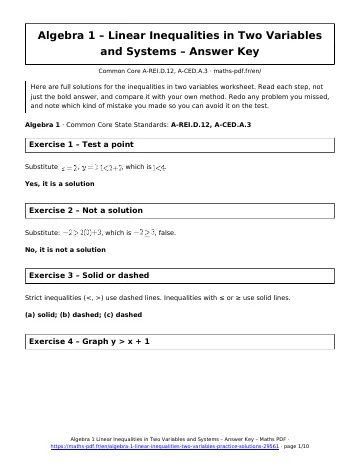
More Algebra 1 math
Lessons
See all Solving Linear Equations in One Variable Lesson: Notes and Examples
- Slope and Rate of Change Lesson: Notes and Examples
- Linear Inequalities in One Variable Lesson: Notes and Examples
- Solving Quadratic Equations Lesson: Notes and Examples
- Writing Linear Equations and Functions Lesson: Notes and Examples
- Adding, Subtracting and Multiplying Polynomials Lesson: Notes and Examples






Worksheets
See all- Structure of Algebraic Expressions Worksheets with Answers
- Writing Linear Equations and Functions Worksheets with Answers
- Exponent Rules and Radicals Worksheets with Answers
- Factoring Polynomials Worksheets with Answers
- Slope and Rate of Change Worksheets with Answers
- Exponential Functions and Growth Worksheets with Answers





Tests
See all- Solving Quadratic Equations Test with Answer Key
- Factoring Polynomials Test with Answer Key
- Linear Inequalities in Two Variables and Systems Test with Answer Key
- Writing Linear Equations and Functions Test with Answer Key
- Arithmetic and Geometric Sequences Test with Answer Key
- Graphing Linear Equations Test with Answer Key






Quizzes
See all- Graphing Quadratic Functions and Transformations Quiz: 10 Questions with Answers
- Arithmetic and Geometric Sequences Quiz: 10 Questions with Answers
- Data Distributions and Summary Statistics Quiz: 10 Questions with Answers
- Exponential Functions and Growth Quiz: 10 Questions with Answers
- Slope and Rate of Change Quiz: 10 Questions with Answers
- Solving Quadratic Equations Quiz: 10 Questions with Answers