Algebra 1 Linear Inequalities in One Variable Test Answer Key and Scoring Guide (PDF)


This linear inequalities test answer key for Algebra 1 covers linear inequalities in one variable (Common Core A-REI.B.3, A-CED.A.1), with a free PDF to print.
Key takeaway: This answer key helps Algebra 1 students and teachers grade the linear inequalities test and see each reason behind the points.
- Topic: Linear Inequalities in One Variable (Algebra 1)
- Content: Worked solutions and a scoring guide for 9 questions
- Standards: A-REI.B.3, A-CED.A.1
- Answers: Every step shown, with the method to review
- Format: Free printable PDF, US Letter, black and white
This answer key helps Algebra 1 students and teachers grade the linear inequalities test and see each reason behind the points. All 9 questions are solved with steps and a described graph.
Use it to find out whether a lost point came from the flipped symbol, from a circle type, from combining the parts of a compound inequality, or from a word problem. Also, the key covers graphs and reading, two-step and negative-coefficient inequalities, variables on both sides, compound and or inequalities, the savings goal, the error analysis, and the test values. Study every missed item before a retake.
Key takeaway: Worked answers for the Algebra 1 test on Linear Inequalities in One Variable, with the scoring for each problem. Use it to grade yourself after a timed attempt; free PDF.
Algebra 1 · Common Core State Standards: A-REI.B.3, A-CED.A.1
Linear inequalities test answer key: worked solutions
1 – Graphs and inequalities [2 pts]
So, a) The circle at -1 is open and the ray points left: \(x < -1\).
b) Closed circle at 2, ray to the right.
Scoring: 1 point for each correct part.
2 – Two-step inequality [2 pts]
Add 7: \(4x > 20\). Divide by 4.
\(x > 5\)
Scoring: 1 point for isolating the term; 1 point for the solution.
3 – Negative coefficient [2 pts]
Subtract 3: \(-5x \le 25\). Divide by \(-5\) and reverse the symbol.
\(x \ge -5\)
Scoring: 1 point for the correct first step; 1 point for reversing the symbol.
4 – Variables on both sides [2 pts]
Distribute: \(3x + 6 \ge 5x – 4\). Subtract \(3x\): \(6 \ge 2x – 4\). Add 4: \(10 \ge 2x\).
So, divide by 2: \(5 \ge x\), which is \(x \le 5\).
Scoring: 1 point for distributing and collecting terms; 1 point for the final inequality written correctly.
5 – And inequality [2 pts]
Add 5 to all parts: \(6 < 3x < 15\). So, divide by 3: \(2 < x < 5\).
Scoring: 1 point for the solution; 1 point for the graph with open circles.
6 – Or inequality [2 pts]
First: \(2x \le -4\), so \(x \le -2\). Second: \(x > 5\).
\(x \le -2 \text{ or } x > 5\)
Scoring: 1 point for each correct inequality.
Question 7 and after
7 – Savings goal [3 pts]
a) \(35 + 8w \ge 120\).
b) \(8w \ge 85\), so \(w \ge 10.625\).
c) Weeks are whole numbers, so round up. Check: 10 weeks give $115, which is not enough; 11 weeks give $123.
11 weeks
Scoring: 1 point per part.
8 – Find the error [3 pts]
a) The student divided by \(-4\) but did not reverse the symbol.
b) \(x > -5\).
c) Test \(x = 0\): \(-4(0) = 0 < 20\) is true, and 0 is in the solution set \(x > -5\). Test \(x = -6\): \(-4(-6) = 24 < 20\) is false.
Scoring: 1 point per part.
9 – Test values [2 pts]
Substitute each value: \(x = -1:\quad -5 < 7\) true; \(x = 4: 5 < 7\) true; \(x = 5: 7 < 7\) false; \(x = 8: 13 < 7\) false.
\(x = -1\) and \(x = 4\)
Scoring: 1 point for substituting all four values; 1 point for the correct two values.
Total score
20 points
Key facts behind this linear inequalities test answer key
- Use an open circle for < and >, and a closed circle for ≤ and ≥.
- Adding or subtracting the same number never changes the inequality symbol.
- Multiplying or dividing both sides by a negative number reverses the symbol.
- Then, an and inequality is true between endpoints; an or inequality is true on two rays.
- “At least” means ≥ and “at most” means ≤.
Common mistakes with this linear inequalities test answer key
- Students award credit for a correct inequality with a wrong graph. In question 1 the written inequality and the graph are separate parts.
- Students accept a solution without checking the symbol after division. Then, look at the line where the key divides by a negative.
- Students forget the sentence in question 7. As a result, the answer should say how many weeks, with the rounding rule.
How to learn from your test
- Mark each lost point as symbol, circle, or setup. Practice the biggest group with five new problems.
- Teachers can use the point split in questions 1, 5, 8, and 9 to give fair partial credit.
- Redo each missed problem on a fresh page the next day, and check it against the key at the end.
Download the linear inequalities test answer key as a PDF with the button below and keep it with your notes.
Linear inequalities test answer key: frequently asked questions
How does the key explain the flipped symbol?
It points to the exact line where both sides are divided or multiplied by a negative number and adds a short note. For \(-5x + 3 \le 28\), dividing by -5 reverses the order, so the result is \(x \ge -5\). Then, look for the note on that line.
What does a full-credit answer to an error question look like?
Also, it identifies the incorrect step, explains the rule that was broken, and writes the corrected solution. Then it checks the answer with a test value. In other words, a correct final answer without the explanation usually earns only part of the credit.
How does the key check the test values in question 9?
It substitutes each marked value into the inequality and writes true or false. Values that give a true statement are solutions. The key then states which values were solutions, so you can compare with the solved inequality.
All Algebra 1 chapters: Algebra 1 math.
Free printable PDF
Algebra 1 Linear Inequalities in One Variable Test Answer Key and Scoring Guide
Download PDF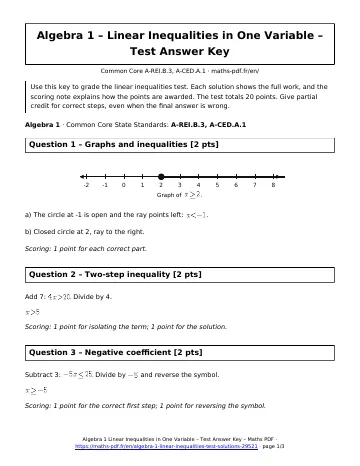
More Algebra 1 math
Lessons
See all Exponential Functions and Growth Lesson: Notes and Examples
- Systems of Linear Equations Lesson: Notes and Examples
- Graphing Quadratic Functions and Transformations Lesson: Notes and Examples
- Adding, Subtracting and Multiplying Polynomials Lesson: Notes and Examples
- Data Distributions and Summary Statistics Lesson: Notes and Examples
- Slope and Rate of Change Lesson: Notes and Examples





Worksheets
See all- Linear Inequalities in One Variable Worksheets with Answers
- Slope and Rate of Change Worksheets with Answers
- Exponential Functions and Growth Worksheets with Answers
- Structure of Algebraic Expressions Worksheets with Answers
- Scatter Plots, Lines of Fit and Two-Way Tables Worksheets with Answers
- Factoring Polynomials Worksheets with Answers






Tests
See all- Functions and Function Notation Test with Answer Key
- Scatter Plots, Lines of Fit and Two-Way Tables Test with Answer Key
- Arithmetic and Geometric Sequences Test with Answer Key
- Exponential Functions and Growth Test with Answer Key
- Structure of Algebraic Expressions Test with Answer Key
- Graphing Quadratic Functions and Transformations Test with Answer Key






Quizzes
See all- Structure of Algebraic Expressions Quiz: 10 Questions with Answers
- Graphing Quadratic Functions and Transformations Quiz: 10 Questions with Answers
- Writing Linear Equations and Functions Quiz: 10 Questions with Answers
- Data Distributions and Summary Statistics Quiz: 10 Questions with Answers
- Graphing Linear Equations Quiz: 10 Questions with Answers
- Adding, Subtracting and Multiplying Polynomials Quiz: 10 Questions with Answers