Algebra 1 Functions and Function Notation Test Answer Key and Scoring Guide (PDF)


This function notation test answer key for Algebra 1 covers functions and function notation (Common Core F-IF.A.1, F-IF.A.2, F-IF.B.5), with a free PDF to print.
Key takeaway: This answer key helps Algebra 1 students and teachers grade the functions test and see where each point was gained or lost.
- Topic: Functions and Function Notation (Algebra 1)
- Content: Worked solutions and a scoring guide for 9 questions
- Standards: F-IF.A.1, F-IF.A.2, F-IF.B.5
- Answers: Every step shown, with the method to review
- Format: Free printable PDF, US Letter, black and white
This answer key helps Algebra 1 students and teachers grade the functions test and see where each point was gained or lost. All 9 questions are solved with reasons and the point split.
Use it to find out whether a mistake was in deciding what a function is, in the substitution, or in reading the graph. Also, the key covers sets of pairs, a mapping diagram, the vertical line test, evaluating a quadratic and a linear function, solving for x, domain and range of a set and a segment, the phone plan, and the rule from a table. Study every missed item before a retake.
Key takeaway: Worked answers for the Algebra 1 test on Functions and Function Notation, with the scoring for each problem. Use it to grade yourself after a timed attempt; free PDF.
Algebra 1 · Common Core State Standards: F-IF.A.1, F-IF.A.2, F-IF.B.5
Function notation test answer key: worked solutions
1 – Function or not [2 pts]
So, a) Every input is different, so it is a function.
b) The input 2 has outputs 1 and 4, so it is not a function.
Scoring: 1 point for each correct decision with a reason.
2 – Mapping diagram [2 pts]
Each input has one arrow, so it is a function. The inputs 1 and 2 may share the output 3.
Function; domain \(\{1, 2, 4\}\); range \(\{3, 6\}\)
Scoring: 1 point for the decision; 1 point for the domain and range.
3 – Vertical line test [2 pts]
The vertical line \(x = 4\) meets the graph at \((4, 2)\) and \((4, -2)\).
Not a function
Scoring: 1 point for the decision; 1 point for the explanation.
4 – Evaluate a function [2 pts]
a) \(2(-2)^{2} – 3(-2) + 1 = 8 + 6 + 1 = 15\).
b) \(2(3)^{2} – 3(3) + 1 = 18 – 9 + 1 = 10\).
\(f(-2) = 15\); \(f(3) = 10\)
Scoring: 1 point for each correct value.
5 – Input and output [2 pts]
a) \(4(6) – 5 = 19\).
b) \(4x – 5 = 11\), so \(4x = 16\) and \(x = 4\).
\(f(6) = 19\); \(x = 4\)
Scoring: 1 point for each part.
Question 6 and after
6 – Domain and range [2 pts]
Domain: the inputs. Range: the outputs, writing 2 only once.
Domain \(\{-1, 0, 1, 4\}\); range \(\{-3, 2, 5\}\)
Scoring: 1 point for the domain; 1 point for the range.
7 – Phone plan function [3 pts]
a) \(20(6) + 15 = 135\).
b) \(20m + 15 = 215\), so \(20m = 200\) and \(m = 10\).
c) Months are counted in whole numbers starting at 0: \(m = 0, 1, 2, 3, and so on\).
$135; 10 months; whole numbers \(m \ge 0\)
Scoring: 1 point per part.
8 – Graph of a segment [3 pts]
a) The x-values run from -2 to 4: \(-2 \le x \le 4\).
b) The y-values run from -1 to 5: \(-1 \le y \le 5\).
c) The graph passes through \((1, 2)\).
\(-2 \le x \le 4\); \(-1 \le y \le 5\); 2
Scoring: 1 point per part.
9 – Rule from a table [2 pts]
The outputs increase by 2 each time the input increases by 1, and \(f(1) = 3\). So \(f(x) = 2x + 1\).
\(f(10) = 2(10) + 1 = 21\).
\(f(x) = 2x + 1\); \(f(10) = 21\)
Scoring: 1 point for the rule; 1 point for f(10).
Total score
20 points
Key facts behind this function notation test answer key
- A function assigns exactly one output to each input.
- Next, the domain is the set of inputs; the range is the set of outputs.
- The vertical line test: a graph is a function if no vertical line meets it twice.
- f(x) is read “f of x” and means the output when the input is x.
- In context, the domain is limited to the inputs that make sense.
Common mistakes with this function notation test answer key
- Students give credit for a correct yes or no without the reason. As a result, the explanation parts of questions 1 and 3 have separate points in the key.
- Students forget the units in question 7. The cost is in dollars and the number of months is a count, so the answers need to say so.
- Students read the range of the segment from the x-axis. As a result, the key shows the range comes from the y-values, which is a common slip.
How to learn from your test
- Go through each missed question and mark the first line that was wrong. That is the step to practice.
- Teachers can use the point split in questions 1, 4, 5, and 8 to give fair partial credit for parts answered correctly.
- Before a retake, make up a similar table and write its rule. Then check it with a different row.
Download the function notation test answer key as a PDF with the button below and keep it with your notes.
Function notation test answer key: frequently asked questions
How does the key explain the vertical line test answer?
It names a vertical line, such as x = 2, and says how many times it crosses the graph. If it crosses more than once, one input has two outputs, so it is not a function. If every vertical line crosses at most once, it is.
Why does the key give the output for input 1 from the graph?
Because reading an output means moving up from the input to the graph, then across to the y-axis. For the segment in question 8, the key shows the point at x = 1 and its y-value. Also, this is the same as finding f(1).
What does a full-credit rule from a table look like?
It shows the rate of change, the starting value, and the check with f(10). If outputs rise by 4 per input step and f(0) is 3, the rule is \(f(x) = 4x + 3\), and f(10) is 43. Also, a check on one more row is a good habit.
All Algebra 1 chapters: Algebra 1 math.
Free printable PDF
Algebra 1 Functions and Function Notation Test Answer Key and Scoring Guide
Download PDF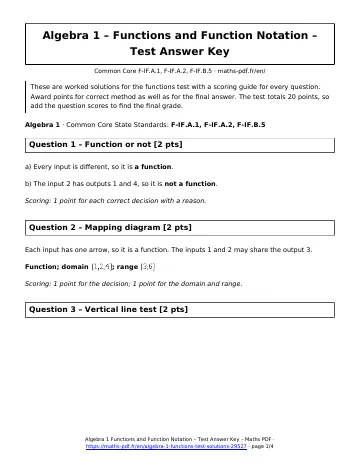
More Algebra 1 math
Lessons
See all Arithmetic and Geometric Sequences Lesson: Notes and Examples
- Factoring Polynomials Lesson: Notes and Examples
- Linear Inequalities in Two Variables and Systems Lesson: Notes and Examples
- Systems of Linear Equations Lesson: Notes and Examples
- Slope and Rate of Change Lesson: Notes and Examples
- Graphing Linear Equations Lesson: Notes and Examples





Worksheets
See all- Literal Equations and Formulas Worksheets with Answers
- Linear Inequalities in Two Variables and Systems Worksheets with Answers
- Solving Quadratic Equations Worksheets with Answers
- Scatter Plots, Lines of Fit and Two-Way Tables Worksheets with Answers
- Adding, Subtracting and Multiplying Polynomials Worksheets with Answers
- Functions and Function Notation Worksheets with Answers





Tests
See all- Graphing Linear Equations Test with Answer Key
- Adding, Subtracting and Multiplying Polynomials Test with Answer Key
- Graphing Quadratic Functions and Transformations Test with Answer Key
- Literal Equations and Formulas Test with Answer Key
- Structure of Algebraic Expressions Test with Answer Key
- Linear Inequalities in Two Variables and Systems Test with Answer Key





Quizzes
See all- Adding, Subtracting and Multiplying Polynomials Quiz: 10 Questions with Answers
- Arithmetic and Geometric Sequences Quiz: 10 Questions with Answers
- Exponential Functions and Growth Quiz: 10 Questions with Answers
- Exponent Rules and Radicals Quiz: 10 Questions with Answers
- Functions and Function Notation Quiz: 10 Questions with Answers
- Solving Quadratic Equations Quiz: 10 Questions with Answers