3rd Grade Understanding Fractions Worksheet Answer Key (PDF)
This 3rd grade fractions worksheet answers covers understanding fractions (Common Core 3.NF.A.1, 3.NF.A.2), with a free PDF to print.
Key takeaway: This answer key helps Grade 3 teachers and parents check the understanding fractions worksheet.
- Topic: Understanding Fractions (3rd grade)
- Content: Step-by-step answers to 20 worksheet problems
- Standards: 3.NF.A.1, 3.NF.A.2
- Answers: Every step shown, with the method to review
- Format: Free printable PDF, US Letter, black and white
This answer key helps Grade 3 teachers and parents check the understanding fractions worksheet. First, it gives the answer to each of the 15 problems. Then it explains how the numerator and denominator come from the picture or number line.
The notes cover naming shaded parts, unit fractions, equal parts, words to fractions, copies of a unit fraction, and number lines. Next, use the notes to talk about any missed problem. Checking the full page takes about 15 minutes, and paper strips on the table help settle disagreements. Also, a pencil and scratch paper help children show each step.
Each answer shows the count of equal parts first, then the numerator. Check your work by saying the fraction aloud as copies of a unit fraction. Models in the answers match the ones in the worksheet.
Key takeaway: This answer key for the Grade 3 worksheet on Understanding Fractions shows every step and the rule used. Check your work after trying the problems alone; free PDF.
Grade 3 · Common Core State Standards: 3.NF.A.1, 3.NF.A.2
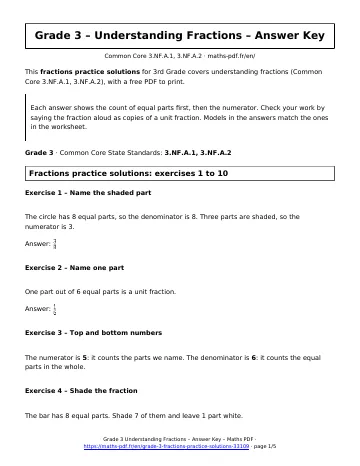
3rd grade fractions worksheet answers: worksheet problems 1 to 10
1 – Name the shaded part
The circle has 8 equal parts, so the denominator is 8. Three parts are shaded, so the numerator is 3.
Answer: \(\frac{3}{8}\)
2 – Name one part
One part out of 6 equal parts is a unit fraction.
Answer: \(\frac{1}{6}\)
3 – Top and bottom numbers
So, the numerator is 5: it counts the parts we name. The denominator is 6: it counts the equal parts in the whole.
4 – Shade the fraction
The bar has 8 equal parts. Shade 7 of them and leave 1 part white.
Answer: 7 parts shaded
5 – Equal parts?
The three parts are not the same size, so they are not thirds.
Answer: No. Thirds must be 3 equal parts.
6 – Words to fractions
- \(\frac{3}{4}\)
- \(\frac{1}{6}\)
- \(\frac{7}{8}\)
- \(\frac{2}{3}\)
7 – Count the copies
- 5 copies, because the numerator is 5.
- 3 pieces, because the numerator is 3.
- Four copies of one sixth make \(\frac{4}{6}\).
8 – Grid fraction
There are 2 rows of 3 squares, so 6 equal squares in all. Four squares are shaded.
Answer: \(\frac{4}{6}\)
9 – Read the number line
Each length is \(\frac{1}{3}\). Point A is 2 lengths from 0.
Answer: \(\frac{2}{3}\)
Worksheet problem 10 and after
10 – Mark the number line
Each length is \(\frac{1}{6}\). Count 5 lengths from 0.
Answer: the fifth tick mark after 0
Worksheet problems 11 and up
11 – Pick the unit fractions
A unit fraction has numerator 1.
Answer: \(\frac{1}{8}\), \(\frac{1}{2}\), \(\frac{1}{3}\)
12 – First tick mark
Each length is \(\frac{1}{8}\).
- \(\frac{1}{8}\)
- \(\frac{5}{8}\)
13 – The part not shaded
5 of the 6 parts are shaded. One part is not shaded.
Answer: \(\frac{1}{6}\)
14 – Hops of one sixth
Four hops of \(\frac{1}{6}\) reach the fourth tick mark after 0.
Answer: \(\frac{4}{6}\) yard
15 – Ribbon for a bow
- \(\frac{1}{8}\)
- \(\frac{3}{8}\)
- 8 – 3 = 5 pieces are left: \(\frac{5}{8}\)
16 – Garden bed
- \(\frac{5}{6}\)
- \(\frac{1}{6}\)
17 – Loaf of bread
- \(\frac{3}{8}\)
- 3 + 2 = 5 slices were used: \(\frac{5}{8}\)
18 – Pancake pieces
The name one sixth only fits when all 6 pieces are the same size. Ethan’s pieces are not equal.
Answer: No. The pieces are not equal, so they are not sixths.
19 – Bake sale pan
- 2 + 3 = 5 pieces: \(\frac{5}{6}\)
- 6 – 5 = 1 piece: \(\frac{1}{6}\)
- Yes, because the numerator is 1.
20 – Bike path signs
The signs are \(\frac{1}{6}\) mile apart.
- 4 signs: \(\frac{4}{6}\) mile
- 6 – 4 = 2 signs
Key facts behind this 3rd grade fractions worksheet answers
- A fraction describes equal parts of one whole.
- Next, the denominator (bottom) counts the equal parts in the whole; the numerator (top) counts the parts named.
- A unit fraction has numerator 1 and shows one equal part, such as 1/8.
- Then, the fraction a/b is a copies of the unit fraction 1/b.
- On a number line from 0 to 1, a/b is the point reached after a hops of length 1/b.
Common mistakes with this 3rd grade fractions worksheet answers
- Marking a fraction wrong for swapped numbers hides what the child knows. Ask the child to say the fraction in words and check which number is the numerator.
- In problem 7, 5/8 is five copies of 1/8. A child who writes 8 has counted the denominator instead of the numerator.
- In problem 13, the circle is cut into 6 equal parts. The fraction not shaded depends on the number of shaded parts, so check the child’s count.
How to use these solutions
- First, ask the child to shade the answer on a blank bar. Then compare it with the picture in the problem.
- Also, ask the child to explain each numerator and denominator. A clear explanation shows understanding. Then check the result once more before moving on.
- Sort errors into naming, unit fractions, equal parts, words to fractions, and number lines. Then practice the type with the most misses.
Download the 3rd grade fractions worksheet answers as a PDF with the button below and keep it with your notes.
3rd grade fractions worksheet answers: frequently asked questions
What is the answer when a rectangle has three unequal parts?
The rectangle does not show thirds. In problem 5, the parts must be equal to use the name thirds. A child should explain that the parts are different sizes, so the fraction name does not apply.
How do I check a number line answer?
Count the spaces from zero to the point. The number of spaces is the numerator. Count the spaces from 0 to 1 for the denominator. For example, 4 hops of 1/6 land at 4/6.
What if a child shades a different set of parts than the key?
Accept it if the child shaded the right number of equal parts. For 7/8 of a bar, any 7 of the 8 parts are correct. The fraction counts parts, not their position. Also, saying the steps aloud helps you spot a slip.
All Grade 3 chapters: Grade 3 math.
More 3rd Grade math
Lessons
See all Multiplication and Division Facts Within 100 Lesson: Notes and Examples
- Equivalent and Comparing Fractions Lesson: Notes and Examples
- Scaled Graphs and Line Plots Lesson: Notes and Examples
- Two-Step Word Problems and Patterns Lesson: Notes and Examples
- Understanding Division Lesson: Notes and Examples
- Multiplying by Multiples of 10 Lesson: Notes and Examples
Worksheets
See all- Multiplying by Multiples of 10 Worksheets with Answers
- Time, Liquid Volume and Mass Worksheets with Answers
- Properties of Multiplication Worksheets with Answers
- Multiplication and Division Facts Within 100 Worksheets with Answers
- Equivalent and Comparing Fractions Worksheets with Answers
- Quadrilaterals and Partitioning Shapes Worksheets with Answers
Tests
See all



Quizzes
See all- Adding and Subtracting Within 1,000 Quiz: 10 Questions with Answers
- Understanding Fractions Quiz: 10 Questions with Answers
- Quadrilaterals and Partitioning Shapes Quiz: 10 Questions with Answers
- Understanding Multiplication Quiz: 10 Questions with Answers
- Rounding to the Nearest 10 and 100 Quiz: 10 Questions with Answers
- Time, Liquid Volume and Mass Quiz: 10 Questions with Answers