Algebra 1 Linear Inequalities in Two Variables and Systems Test Answer Key and Scoring Guide (PDF)


This graphing linear inequalities test answer key for Algebra 1 covers linear inequalities in two variables and systems (Common Core A-REI.D.12, A-CED.A.3), with a free PDF to print.
Key takeaway: This answer key helps Algebra 1 students and teachers grade the two-variable inequalities test and understand each lost point.
- Topic: Linear Inequalities in Two Variables and Systems (Algebra 1)
- Content: Worked solutions and a scoring guide for 9 questions
- Standards: A-REI.D.12, A-CED.A.3
- Answers: Every step shown, with the method to review
- Format: Free printable PDF, US Letter, black and white
This answer key helps Algebra 1 students and teachers grade the two-variable inequalities test and understand each lost point. All 9 questions are worked with the boundary, test point, and shading described.
Use it to find out whether a mistake came from the line type, the side shaded, the algebra when rewriting, or from the setup of a word problem. Also, the key covers test points, boundary and shading, graphing a single inequality, standard form, writing from a graph, a system check, a system graph, the lemonade stand, and the time constraints for soccer and chess. Review each missed item before a retake.
Key takeaway: Worked answers for the Algebra 1 test on Linear Inequalities in Two Variables and Systems, with the scoring for each problem. Use it to grade yourself after a timed attempt; free PDF.
Algebra 1 · Common Core State Standards: A-REI.D.12, A-CED.A.3
Graphing linear inequalities test answer key: worked solutions
1 – Test points [2 pts]
So, a) \(1 \le -1 + 3 = 2\) true: yes.
b) \(1 \le -3 + 3 = 0\) false: no.
Scoring: 1 point for each part.
2 – Boundary and shading [2 pts]
The symbol > is strict, so the line is dashed. Since \(y\) is greater than the expression, shade above the line.
Dashed; shade above
Scoring: 1 point for the line type; 1 point for the shaded side.
3 – Graph an inequality [2 pts]
Graph the solid line through \((0, 1)\) with slope \(\frac{1}{2}\). Shade above.
Scoring: 1 point for the correct solid line; 1 point for shading the correct side.
4 – Standard form [2 pts]
Subtract \(2x\): \(-y < -2x + 4\). Divide by \(-1\) and reverse the symbol: \(y > 2x – 4\).
\(y > 2x – 4\); dashed line through (0, -4) with slope 2, shade above
Scoring: 1 point for reversing the symbol correctly; 1 point for the description.
5 – Write from a graph [2 pts]
The solid line passes through \((0, 2)\) with slope \(-1\), so it is \(y = -x + 2\). Shading is below, and the line is solid.
\(y \le -x + 2\)
Scoring: 1 point for the boundary line; 1 point for the correct symbol.
Question 6 and after
6 – Check a system [2 pts]
First: \(3 > 2\) true. Second: \(3 \le -2 + 6 = 4\) true.
Yes
Scoring: 1 point for each inequality checked.
7 – Graph a system [3 pts]
The boundary \(y = x – 2\) is solid with shading above. Also, the boundary \(y = -x + 4\) is dashed with shading below.
The lines meet where \(x – 2 = -x + 4\): \(x = 3\), \(y = 1\).
Overlap region with corner \((3, 1)\)
Scoring: 1 point for each correct boundary and shading; 1 point for the corner.
8 – Lemonade stand [3 pts]
a) \(4x + 3y \ge 80\).
b) \(4(10) + 3(15) = 85 \ge 80\), so yes.
c) \(4(8) + 3(12) = 68 \ge 80\) is false, so no.
\(4x + 3y \ge 80\); yes; no
Scoring: 1 point per part.
9 – Time constraints [2 pts]
\(x \ge 2\), \(y \ge 1\), \(x + y \le 10\).
One solution is \((4, 3)\): \(4 \ge 2\), \(3 \ge 1\), \(7 \le 10\).
System above; for example (4, 3)
Scoring: 1 point for the system; 1 point for a valid solution.
Total score
20 points
Key facts behind this graphing linear inequalities test answer key
- A solution of an inequality in two variables is an ordered pair that makes it true.
- Next, the boundary line is solid for ≤ and ≥, and dashed for < and >.
- Test a point not on the line to decide which side to shade.
- Then, for y > mx + b, shade above; for y < mx + b, shade below.
- The solution of a system is the overlap of the shaded regions.
Common mistakes with this graphing linear inequalities test answer key
- Students award credit for the correct shading with the wrong line type. As a result, the key lists the line type as its own scoring point.
- Students accept a point as a solution if it works in one inequality. As a result, the key requires every inequality in the system.
- Students leave out the meaning of x and y in the word problem answers. As a result, the key defines each variable first.
How to learn from your test
- Mark each lost point as line, shading, or setup. Practice the biggest group with three new problems.
- Teachers can use the point split in questions 1, 2, and 8 to give fair partial credit.
- Redo each missed graph on fresh graph paper, and compare it with the key’s description only after you finish.
Download the graphing linear inequalities test answer key as a PDF with the button below and keep it with your notes.
Graphing linear inequalities test answer key: frequently asked questions
How does the key check whether a point is a solution?
It substitutes the coordinates into the inequality and compares the two sides. For \(y \le -x + 3\) and (1, 1), the right side is 2 and the left is 1, so 1 is at most 2, which is true. For (3, 1), the right side is 0, so it fails.
Why does the key rewrite 2x minus y in slope-intercept form?
Rewriting makes the shading direction easy to see. Solving for y often requires dividing by a negative number, which flips the symbol. The key shows that step explicitly so you can see why a greater-than becomes a less-than.
What does a complete word problem answer include?
It defines the variables, writes the inequality with the right symbol, and lists any extra limits such as x at least 2. It may also give a sample pair that works. Also, the graph, if requested, must show the shaded region.
All Algebra 1 chapters: Algebra 1 math.
Free printable PDF
Algebra 1 Linear Inequalities in Two Variables and Systems Test Answer Key and Scoring Guide
Download PDF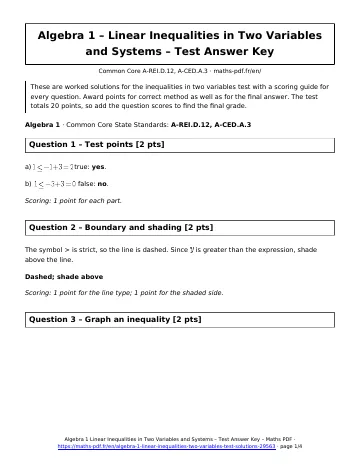
More Algebra 1 math
Lessons
See all Adding, Subtracting and Multiplying Polynomials Lesson: Notes and Examples
- Graphing Quadratic Functions and Transformations Lesson: Notes and Examples
- Solving Quadratic Equations Lesson: Notes and Examples
- Linear Inequalities in Two Variables and Systems Lesson: Notes and Examples
- Systems of Linear Equations Lesson: Notes and Examples
- Exponent Rules and Radicals Lesson: Notes and Examples





Worksheets
See all- Linear Inequalities in Two Variables and Systems Worksheets with Answers
- Solving Quadratic Equations Worksheets with Answers
- Slope and Rate of Change Worksheets with Answers
- Writing Linear Equations and Functions Worksheets with Answers
- Exponential Functions and Growth Worksheets with Answers
- Arithmetic and Geometric Sequences Worksheets with Answers





Tests
See all- Graphing Quadratic Functions and Transformations Test with Answer Key
- Functions and Function Notation Test with Answer Key
- Adding, Subtracting and Multiplying Polynomials Test with Answer Key
- Solving Quadratic Equations Test with Answer Key
- Slope and Rate of Change Test with Answer Key
- Literal Equations and Formulas Test with Answer Key






Quizzes
See all- Exponential Functions and Growth Quiz: 10 Questions with Answers
- Factoring Polynomials Quiz: 10 Questions with Answers
- Graphing Linear Equations Quiz: 10 Questions with Answers
- Exponent Rules and Radicals Quiz: 10 Questions with Answers
- Scatter Plots, Lines of Fit and Two-Way Tables Quiz: 10 Questions with Answers
- Graphing Quadratic Functions and Transformations Quiz: 10 Questions with Answers