Algebra 1 Linear Inequalities in One Variable Worksheet Answer Key (PDF)
This linear inequalities worksheet answers for Algebra 1 covers linear inequalities in one variable (Common Core A-REI.B.3, A-CED.A.1), with a free PDF to print.
Key takeaway: This answer key helps Algebra 1 students check their linear inequalities worksheet and see why each solution is written the way it is.
- Topic: Linear Inequalities in One Variable (Algebra 1)
- Content: Step-by-step answers to 21 worksheet problems
- Standards: A-REI.B.3, A-CED.A.1
- Answers: Every step shown, with the method to review
- Format: Free printable PDF, US Letter, black and white
This answer key helps Algebra 1 students check their linear inequalities worksheet and see why each solution is written the way it is. All 21 solutions show the steps, the graph description, and a test value.
Use it after finishing a group of worksheet problems. In other words, the key shows where the symbol flips and why, whether each circle is open or closed, and how compound inequalities are shaded. For the word problems, it defines the variable, writes the inequality, solves, and gives a sentence that applies the rounding rule. A test value is listed for most problems, so you can verify your own solution.
Key takeaway: This answer key for the Algebra 1 worksheet on Linear Inequalities in One Variable shows every step and the rule used. Check your work after trying the problems alone; free PDF.
Algebra 1 · Common Core State Standards: A-REI.B.3, A-CED.A.1
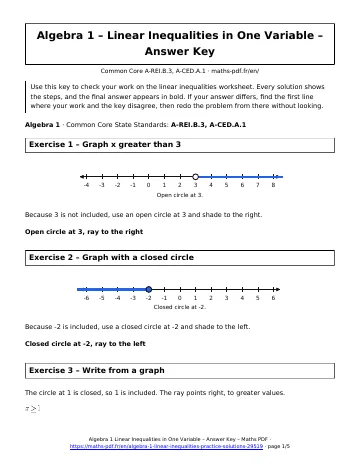
Linear inequalities worksheet answers: worksheet problems 1 to 10
1 – Graph x greater than 3
Because 3 is not included, use an open circle at 3 and shade to the right.
Open circle at 3, ray to the right
2 – Graph with a closed circle
Because -2 is included, use a closed circle at -2 and shade to the left.
Closed circle at -2, ray to the left
3 – Write from a graph
The circle at 1 is closed, so 1 is included. The ray points right, to greater values.
\(x \ge 1\)
4 – Add and compare
Subtract 5 from both sides: \(x < 7\).
\(x < 7\)
5 – Subtract on both sides
Add 4 to both sides: \(x \ge 3\).
\(x \ge 3\)
6 – Divide by a positive
Divide both sides by 3. The symbol stays the same: \(x > 6\).
\(x > 6\)
7 – Divide by a negative
Divide both sides by \(-2\) and reverse the symbol: \(x \ge -5\).
\(x \ge -5\)
8 – Divide by a negative fraction form
Multiply both sides by \(-3\) and reverse the symbol: \(x > -12\).
\(x > -12\)
9 – Two-step
Add 5: \(2x \ge 14\). Divide by 2: \(x \ge 7\).
\(x \ge 7\)
Worksheet problem 10 and after
10 – Two-step with a negative
Subtract 4: \(-3x > 15\).
Divide by \(-3\) and reverse the symbol: \(x < -5\).
\(x < -5\)
Worksheet problems 11 and up
11 – Variables on both sides
Subtract \(3x\): \(2x + 2 \le 12\). Subtract 2: \(2x \le 10\).
Divide by 2: \(x \le 5\).
\(x \le 5\)
12 – Distribute
Distribute: \(4x – 8 < 2x + 6\). Subtract \(2x\): \(2x - 8 < 6\).
Add 8: \(2x < 14\). Divide by 2: \(x < 7\).
\(x < 7\)
13 – Fraction coefficient
Add 1: \(\frac{2}{3}x \ge 6\).
Multiply by \(\frac{3}{2}\) (positive, so the symbol stays): \(x \ge 9\).
\(x \ge 9\)
14 – And compound
Add 2 to all three parts: \(-3 \le 3x < 9\).
Divide all parts by 3: \(-1 \le x < 3\).
\(-1 \le x < 3\)
15 – Or compound
First inequality: \(x < -2\). Second inequality: \(x \ge 4\).
\(x < -2 \text{ or } x \ge 4\)
16 – Smoothies
Total cost cannot exceed $60: \(4.50s \le 60\).
Divide by 4.50: \(s \le 13.\overline{3}\).
She can buy only a whole number of smoothies, and the table shows 13 cost $58.50 while 14 cost $63.
13 smoothies
17 – Saving for a bike
At least $200: \(44 + 12n \ge 200\).
Subtract 44: \(12n \ge 156\). Divide by 12: \(n \ge 13\).
13 lawns
18 – Elevator limit
Total weight: \(180 + 45b \le 1000\).
Subtract 180: \(45b \le 820\). Divide by 45: \(b \le 18.\overline{2}\).
Check: 18 boxes weigh \(180 + 810 = 990\) pounds, but 19 boxes weigh 1,035 pounds.
18 boxes
Worksheet problem 19 and after
19 – Phone plans
\(30 + 0.10t < 45\). Subtract 30: \(0.10t < 15\). Divide by 0.10: \(t < 150\).
Fewer than 150 texts
20 – Average score
\( rac{82 + 90 + 78 + x}{4} \ge 85\). Multiply by 4: \(250 + x \ge 340\).
Subtract 250: \(x \ge 90\).
At least 90
21 – Cooler temperature
\(34 \le 34 + 1.5h \le 40\). Subtract 34 from every part: \(0 \le 1.5h \le 6\).
Divide by 1.5: \(0 \le h \le 4\).
0 to 4 hours
Key facts behind this linear inequalities worksheet answers
- Use an open circle for < and >, and a closed circle for ≤ and ≥.
- Adding or subtracting the same number never changes the inequality symbol.
- Multiplying or dividing both sides by a negative number reverses the symbol.
- Then, an and inequality is true between endpoints; an or inequality is true on two rays.
- “At least” means ≥ and “at most” means ≤.
Common mistakes with this linear inequalities worksheet answers
- Students compare only the final inequality. Then, check the direction of the symbol and the type of circle, since both can be wrong while the number is right.
- Students treat \(x \ge 4\) and \(4 \le x\) as different. They are the same statement, written in two orders, so both answers are correct.
- Students skip the sentence in word problems. As a result, a statement such as at most 6 smoothies finishes the answer and usually earns a point.
How to use these solutions
- When the key flips a symbol, find the line where you divided by a negative. Then, mark those lines and review them.
- Check your graph by testing a value from each region. One value in the shaded part must work, and one outside must fail.
- Parents can ask the student to explain why the circle is open or closed for two of the answers.
Download the linear inequalities worksheet answers as a PDF with the button below and keep it with your notes.
Linear inequalities worksheet answers: frequently asked questions
How can I test my inequality solution?
Pick a number from the solution set and substitute it into the original inequality. Also, it should give a true statement. Then pick a number outside the set and confirm it gives a false one. Also test the endpoint if the circle is closed.
Why does the key show some answers as intervals?
Interval notation is a short way to write a set. In other words, the set \(-1 \le x < 3\) is written as the interval from -1 to 3, with a bracket at -1 and a parenthesis at 3. The key shows both forms so you can match what your class uses.
How does the key decide whether to round up or down?
It reads the condition in the problem. If the question asks for the most you can do under a limit, the key rounds down. If it asks for the fewest needed to reach a goal, it rounds up. Also, the sentence explains the choice.
All Algebra 1 chapters: Algebra 1 math.
More Algebra 1 math
Lessons
See all Graphing Linear Equations Lesson: Notes and Examples
- Adding, Subtracting and Multiplying Polynomials Lesson: Notes and Examples
- Literal Equations and Formulas Lesson: Notes and Examples
- Data Distributions and Summary Statistics Lesson: Notes and Examples
- Systems of Linear Equations Lesson: Notes and Examples
- Solving Linear Equations in One Variable Lesson: Notes and Examples

Worksheets
See all- Graphing Quadratic Functions and Transformations Worksheets with Answers
- Scatter Plots, Lines of Fit and Two-Way Tables Worksheets with Answers
- Functions and Function Notation Worksheets with Answers
- Systems of Linear Equations Worksheets with Answers
- Linear Inequalities in Two Variables and Systems Worksheets with Answers
- Structure of Algebraic Expressions Worksheets with Answers

Tests
See all- Linear Inequalities in Two Variables and Systems Test with Answer Key
- Exponent Rules and Radicals Test with Answer Key
- Factoring Polynomials Test with Answer Key
- Graphing Quadratic Functions and Transformations Test with Answer Key
- Exponential Functions and Growth Test with Answer Key
- Arithmetic and Geometric Sequences Test with Answer Key





Quizzes
See all- Arithmetic and Geometric Sequences Quiz: 10 Questions with Answers
- Writing Linear Equations and Functions Quiz: 10 Questions with Answers
- Solving Quadratic Equations Quiz: 10 Questions with Answers
- Literal Equations and Formulas Quiz: 10 Questions with Answers
- Solving Linear Equations in One Variable Quiz: 10 Questions with Answers
- Graphing Quadratic Functions and Transformations Quiz: 10 Questions with Answers