Algebra 1 Exponent Rules and Radicals Test Answer Key and Scoring Guide (PDF)


This exponent rules test answer key for Algebra 1 covers exponent rules and radicals (Common Core N-RN.A.1, N-RN.A.2, N-RN.B.3), with a free PDF to print.
Key takeaway: This answer key helps Algebra 1 students and teachers grade the exponent rules and radicals test and understand every lost point.
- Topic: Exponent Rules and Radicals (Algebra 1)
- Content: Worked solutions and a scoring guide for 9 questions
- Standards: N-RN.A.1, N-RN.A.2, N-RN.B.3
- Answers: Every step shown, with the method to review
- Format: Free printable PDF, US Letter, black and white
This answer key helps Algebra 1 students and teachers grade the exponent rules and radicals test and understand every lost point. All 9 questions are solved with the rule named at each step.
Use it to see whether a missed question came from a rule, from arithmetic, or from the wording. In other words, the key covers evaluating powers, simplifying a product of powers, negative exponents, the radical for a side of a square with area 98, rational exponents, rational versus irrational numbers, the population model, and the error analysis in question 9. Next, read the explanations before you try a retake.
Key takeaway: Worked answers for the Algebra 1 test on Exponent Rules and Radicals, with the scoring for each problem. Use it to grade yourself after a timed attempt; free PDF.
Algebra 1 · Common Core State Standards: N-RN.A.1, N-RN.A.2, N-RN.B.3
Exponent rules test answer key: worked solutions
1 – Evaluate with exponent rules [2 pts]
a) \(2^{5 + (-2)} = 2^{3} = 8\).
b) \(\frac{3^{6}}{3^{4}} = 3^{2} = 9\).
8; 9
Scoring: 1 point for each part.
2 – Power of a product [2 pts]
Square every factor: \(4^{2} = 16\), \((x^{3})^{2} = x^{6}\), \((y^{2})^{2} = y^{4}\).
\(16x^{6}y^{4}\)
Scoring: 1 point for the coefficient 16; 1 point for the exponents.
3 – Negative exponents [2 pts]
Subtract exponents: \(x^{-3-2} = x^{-5}\) and \(y^{4-1} = y^{3}\).
\(x^{-5}\) belongs in the denominator.
\(\frac{y^{3}}{x^{5}}\)
Scoring: 1 point for the exponents; 1 point for positive exponents.
4 – Simplify a radical [2 pts]
\(\sqrt{98} = \sqrt{49 \cdot 2} = 7\sqrt{2}\).
\(7\sqrt{2}\) inches
Scoring: 1 point for factoring out 49; 1 point for the simplified form.
5 – Rational exponents [2 pts]
a) \(\sqrt[3]{64} = 4\).
b) \((\sqrt{9})^{3} = 3^{3} = 27\).
4; 27
Scoring: 1 point for each part.
6 – Radicals and exponents [2 pts]
So, a) \(\sqrt[4]{x^{3}}\).
b) \(y^{2/5}\).
Scoring: 1 point for each part.
7 – Rational or irrational [3 pts]
a) \(\sqrt{81} = 9\) is rational.
b) 11 is not a perfect square, so \(\sqrt{11}\) is irrational.
c) If \(3 + \sqrt{5}\) were rational, subtracting 3 would make \(\sqrt{5}\) rational, which is false.
rational; irrational; irrational
Scoring: 1 point per part.
Question 8 and after
8 – Population model [3 pts]
a) \(50 \cdot 3^{0} = 50\).
b) \(50 \cdot 3^{4} = 50 \cdot 81 = 4050\).
c) \(50 \cdot 3^{t} = 1350\), so \(3^{t} = 27 = 3^{3}\) and \(t = 3\).
50; 4,050; 3 hours
Scoring: 1 point per part.
9 – Find the error [2 pts]
The power applies to both factors, 2 and \(x\). The student cubed only \(x\).
\((2x)^{3} = 2^{3}x^{3} = 8x^{3}\).
\(8x^{3}\)
Scoring: 1 point for the explanation; 1 point for the correct result.
Total score
20 points
Key facts behind this exponent rules test answer key
- Product rule: aᵐ · aⁿ = aᵐ⁺ⁿ; quotient rule: aᵐ / aⁿ = aᵐ⁻ⁿ.
- Power rule: (aᵐ)ⁿ = aᵐⁿ.
- a⁰ = 1 and a⁻ⁿ = 1/aⁿ for a ≠ 0.
- Then, a^(1/2) = √a, and a^(m/n) is the n-th root of a raised to the m.
- A rational plus an irrational number is irrational.
Common mistakes with this exponent rules test answer key
- Students count a partly correct simplification as right. In question 2 the coefficient and the powers each earn separate points, so check both.
- Students accept a decimal for question 4 when the problem asks for simplest radical form. As a result, a square with area 98 has side \(7\sqrt{2}\), not 9.9.
- Students skip the explanation in question 9. As a result, a correct final result with no statement about why the original was wrong usually earns only part of the credit.
How to learn from your test
- Sort each missed question into rule, arithmetic, or reading. Fix the biggest group first with five fresh practice problems.
- Teachers can split the points in questions 1, 5, 6, and 7 across their parts, as the key shows, to give fair partial credit.
- Keep the corrected test beside the worksheet. Before the next quiz, redo the three questions you found hardest.
Download the exponent rules test answer key as a PDF with the button below and keep it with your notes.
Exponent rules test answer key: frequently asked questions
How do I know my radical is fully simplified?
Check that the number under the root has no perfect square factor greater than 1. For 98, the factor 49 divides it, so \(\sqrt{98} = 7\sqrt{2}\). The 2 left inside has no square factor, so the work is finished.
Why is the error in question 9 an exponent error and not an arithmetic one?
The student applied the exponent to only one of two factors. Also, the rule for a power of a product says each factor gets the exponent. So \((2x)^{3}\) means 2 cubed times \(x\) cubed, which is \(8x^{3}\). Also, the slip is in the rule, not in the multiplication.
What does a full-credit answer to a classification question include?
It names the type, rational or irrational, and gives the reason. For example, \(\sqrt{11}\) is irrational because 11 is not a perfect square, so its decimal never ends or repeats. In other words, the reason is what earns the second point.
All Algebra 1 chapters: Algebra 1 math.
Free printable PDF
Algebra 1 Exponent Rules and Radicals Test Answer Key and Scoring Guide
Download PDF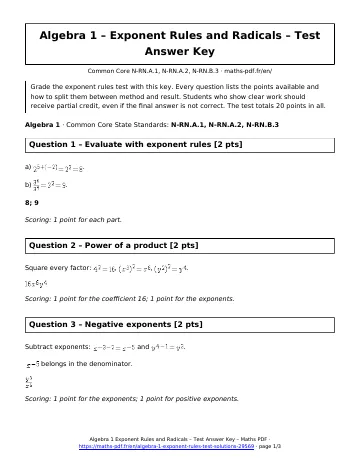
More Algebra 1 math
Lessons
See all Functions and Function Notation Lesson: Notes and Examples
- Data Distributions and Summary Statistics Lesson: Notes and Examples
- Exponential Functions and Growth Lesson: Notes and Examples
- Writing Linear Equations and Functions Lesson: Notes and Examples
- Arithmetic and Geometric Sequences Lesson: Notes and Examples
- Structure of Algebraic Expressions Lesson: Notes and Examples




Worksheets
See all- Scatter Plots, Lines of Fit and Two-Way Tables Worksheets with Answers
- Arithmetic and Geometric Sequences Worksheets with Answers
- Writing Linear Equations and Functions Worksheets with Answers
- Graphing Linear Equations Worksheets with Answers
- Systems of Linear Equations Worksheets with Answers
- Literal Equations and Formulas Worksheets with Answers



Tests
See all- Graphing Linear Equations Test with Answer Key
- Slope and Rate of Change Test with Answer Key
- Linear Inequalities in Two Variables and Systems Test with Answer Key
- Exponent Rules and Radicals Test with Answer Key
- Linear Inequalities in One Variable Test with Answer Key
- Systems of Linear Equations Test with Answer Key




Quizzes
See all- Literal Equations and Formulas Quiz: 10 Questions with Answers
- Solving Linear Equations in One Variable Quiz: 10 Questions with Answers
- Graphing Linear Equations Quiz: 10 Questions with Answers
- Linear Inequalities in Two Variables and Systems Quiz: 10 Questions with Answers
- Slope and Rate of Change Quiz: 10 Questions with Answers
- Writing Linear Equations and Functions Quiz: 10 Questions with Answers