3rd Grade Perimeter Worksheet Answer Key (PDF)

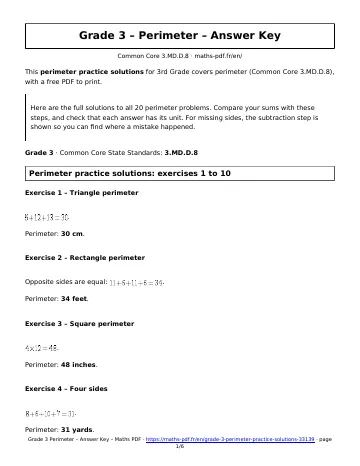
This 3rd grade perimeter worksheet answers covers perimeter (Common Core 3.MD.D.8), with a free PDF to print.
Key takeaway: This answer key helps Grade 3 teachers and parents check the perimeter worksheet.
- Topic: Perimeter (3rd grade)
- Content: Step-by-step answers to 20 worksheet problems
- Standards: 3.MD.D.8
- Answers: Every step shown, with the method to review
- Format: Free printable PDF, US Letter, black and white
This answer key helps Grade 3 teachers and parents check the perimeter worksheet. First, it gives the answer to each of the 15 problems. Then it shows the addition or the subtraction that leads to the answer.
The notes cover triangles, rectangles, squares, regular polygons, figures with right angles, missing sides, and unlabeled sides. Next, use the notes to talk about any missed problem. Checking the full page takes about 15 minutes, and a ruler and string help settle disagreements. Also, a pencil and scratch paper help children show each step.
Here are the full solutions to all 20 perimeter problems. Compare your sums with these steps, and check that each answer has its unit. For missing sides, the subtraction step is shown so you can find where a mistake happened.
Key takeaway: This answer key for the Grade 3 worksheet on Perimeter shows every step and the rule used. Check your work after trying the problems alone; free PDF.
Grade 3 · Common Core State Standards: 3.MD.D.8
3rd grade perimeter worksheet answers: worksheet problems 1 to 10
1 – Triangle perimeter
\(5 + 12 + 13 = 30\).
Perimeter: 30 cm.
2 – Rectangle perimeter
Opposite sides are equal: \(11 + 6 + 11 + 6 = 34\).
Perimeter: 34 feet.
3 – Square perimeter
\(4 \times 12 = 48\).
Perimeter: 48 inches.
4 – Four sides
\(8 + 6 + 10 + 7 = 31\).
Perimeter: 31 yards.
5 – Regular pentagon
\(5 \times 7 = 35\).
Perimeter: 35 meters.
6 – Regular hexagon
\(6 \times 9 = 54\).
Perimeter: 54 centimeters.
7 – Figure with right angles
\(8 + 2 + 3 + 2 + 5 + 4 = 24\).
Perimeter: 24 cm.
8 – Missing width
Two lengths: \(9 + 9 = 18\). Two widths make \(30 – 18 = 12\). One width is \(12 \div 2 = 6\).
Width: 6 feet.
9 – Missing triangle side
\(13 + 15 = 28\) and \(40 – 28 = 12\).
Third side: 12 inches.
10 – Side of a square
\(36 \div 4 = 9\).
So, each side: 9 centimeters.
Worksheet problems 11 and up
11 – Equilateral triangle
\(51 \div 3 = 17\).
So, one side: 17 feet.
12 – Missing side of a quadrilateral
\(10 + 7 + 8 = 25\) and \(34 – 25 = 9\).
Missing side: 9 inches.
13 – Unlabeled sides
The top step is \(10 – 6 = 4\) meters and the vertical step is \(7 – 3 = 4\) meters.
\(10 + 3 + 4 + 4 + 6 + 7 = 34\).
Perimeter: 34 meters.
14 – Same perimeter
A: perimeter \(2 \times (2 + 8) = 20\), area \(2 \times 8 = 16\). B: perimeter \(2 \times (4 + 6) = 20\), area \(4 \times 6 = 24\).
Both perimeters are 20 units. The areas are 16 and 24 square units.
15 – Walking around the park
\(120 + 80 + 120 + 80 = 400\).
So, she walks 400 yards.
16 – Fence for a dog pen
Perimeter: \(2 \times (7 + 5) = 24\) feet.
Cost: \(24 \times \$3 = \$72\).
So, the fence costs $72.
17 – Ribbon around a frame
Perimeter: \(2 \times (14 + 10) = 48\) inches.
Left over: \(60 – 48 = 12\).
12 inches of ribbon are left.
18 – Garden with fencing
Two lengths: \(11 + 11 = 22\). Two widths: \(36 – 22 = 14\). One width: \(14 \div 2 = 7\).
Area: \(11 \times 7 = 77\).
Width: 7 feet. Area: 77 square feet.
Worksheet problem 19 and after
19 – Twelve square tiles
1 by 12: \(2 \times (1 + 12) = 26\). 2 by 6: \(2 \times (2 + 6) = 16\). 3 by 4: \(2 \times (3 + 4) = 14\).
Perimeters: 26 ft, 16 ft, 14 ft. The 3 by 4 rectangle has the smallest perimeter.
20 – Poster border
Two widths: \(7 + 7 = 14\). Two lengths: \(38 – 14 = 24\). One length: \(24 \div 2 = 12\).
Length: 12 inches.
Key facts behind this 3rd grade perimeter worksheet answers
- Perimeter is the sum of the lengths of all the sides of a polygon.
- Next, it is measured in plain units, such as inches, feet, or centimeters.
- A rectangle has two lengths and two widths: P = 2 × (length + width).
- Then, to find a missing side, subtract the known sides from the perimeter.
- Rectangles with the same perimeter can have different areas.
Common mistakes with this 3rd grade perimeter worksheet answers
- Marking only the number hides the thinking. Check that the child wrote the units and showed the sides added. As a result, small mistakes are easier to catch.
- In problem 10, a square has perimeter 36 centimeters, so each side is 9 centimeters. A child who writes 4 subtracted instead of dividing.
- In problem 11, an equilateral triangle with perimeter 51 feet has sides of 17 feet. Check that the child divided by 3.
How to use these solutions
- First, ask the child to trace the figure and name each side added. Then compare with the written work. Also, saying the steps aloud helps you spot a slip.
- Also, ask the child to check a missing side by adding all the sides. The sum should equal the perimeter.
- Sort errors into adding sides, missing sides, unlabeled sides, and stories. Then practice the type with the most misses. Then check the result once more before moving on.
Download the 3rd grade perimeter worksheet answers as a PDF with the button below and keep it with your notes.
3rd grade perimeter worksheet answers: frequently asked questions
What is the answer to problem 8 about the missing width?
A rectangle with perimeter 30 feet and length 9 feet has width 6 feet. Half of 30 is 15, and 15 minus 9 is 6. Check by adding 9 + 6 + 9 + 6, which is 30. Also, saying the steps aloud helps you spot a slip.
How should a regular hexagon be answered?
A regular hexagon has 6 equal sides. For sides of 9 centimeters, the perimeter is 6 times 9, which is 54 centimeters. Accept repeated addition too. Then check the result once more before moving on.
What if the child uses the formula for rectangles?
Accept it if the answer is correct. Doubling the sum of the length and width is a valid shortcut. Ask the child to explain why it works. In other words, slow and careful work pays off here.
All Grade 3 chapters: Grade 3 math.
More 3rd Grade math
Lessons
See all Understanding Multiplication Lesson: Notes and Examples
- Quadrilaterals and Partitioning Shapes Lesson: Notes and Examples
- Scaled Graphs and Line Plots Lesson: Notes and Examples
- Multiplying by Multiples of 10 Lesson: Notes and Examples
- Understanding Fractions Lesson: Notes and Examples
- Adding and Subtracting Within 1,000 Lesson: Notes and Examples




Worksheets
See all- Understanding Division Worksheets with Answers
- Multiplying by Multiples of 10 Worksheets with Answers
- Understanding Fractions Worksheets with Answers
- Two-Step Word Problems and Patterns Worksheets with Answers
- Multiplication and Division Facts Within 100 Worksheets with Answers
- Area Worksheets with Answers


Tests
See all- Properties of Multiplication Test with Answer Key
- Time, Liquid Volume and Mass Test with Answer Key
- Quadrilaterals and Partitioning Shapes Test with Answer Key
- Scaled Graphs and Line Plots Test with Answer Key
- Understanding Multiplication Test with Answer Key
- Multiplying by Multiples of 10 Test with Answer Key






Quizzes
See all- Perimeter Quiz: 10 Questions with Answers
- Scaled Graphs and Line Plots Quiz: 10 Questions with Answers
- Understanding Division Quiz: 10 Questions with Answers
- Multiplying by Multiples of 10 Quiz: 10 Questions with Answers
- Properties of Multiplication Quiz: 10 Questions with Answers
- Area Quiz: 10 Questions with Answers