Algebra 1 Solving Linear Equations in One Variable Test Answer Key and Scoring Guide (PDF)


This algebra 1 solving linear equations test answer key covers solving linear equations in one variable (Common Core A-REI.A.1, A-REI.B.3, A-CED.A.1), with a free PDF to print.
Key takeaway: This answer key helps Algebra 1 students and teachers grade the linear equations test and understand every lost point.
- Topic: Solving Linear Equations in One Variable (Algebra 1)
- Content: Worked solutions and a scoring guide for 9 questions
- Standards: A-REI.A.1, A-REI.B.3, A-CED.A.1
- Answers: Every step shown, with the method to review
- Format: Free printable PDF, US Letter, black and white
This answer key helps Algebra 1 students and teachers grade the linear equations test and understand every lost point. All 9 questions are solved line by line with the points for each part.
Use it to decide whether a mistake came from a sign, from the order of operations, or from the setup of a word problem. In other words, the key covers a one-step and a two-step equation, variables on both sides, distributing, a fraction coefficient, the three types of solutions, a tape diagram, a rectangle, the savings comparison, and the error analysis. Review each missed question before a retake.
Key takeaway: Worked answers for the Algebra 1 test on Solving Linear Equations in One Variable, with the scoring for each problem. Use it to grade yourself after a timed attempt; free PDF.
Algebra 1 · Common Core State Standards: A-REI.A.1, A-REI.B.3, A-CED.A.1
Algebra 1 solving linear equations test answer key: worked solutions
1 – One-step and two-step [2 pts]
So, a) Add 9: \(x = 23\).
b) Subtract 8: \(5x = -25\). Divide by 5: \(x = -5\).
Scoring: 1 point for each correct solution.
2 – Both sides [2 pts]
Subtract \(3x\): \(4x – 4 = 20\). Add 4: \(4x = 24\). Divide by 4.
\(x = 6\)
Scoring: 1 point for collecting variable terms and constants correctly; 1 point for the solution.
3 – Distribute [2 pts]
Distribute: \(8x – 12 = 3x + 13\). Subtract \(3x\): \(5x – 12 = 13\). Add 12: \(5x = 25\).
\(x = 5\)
Scoring: 1 point for distributing correctly; 1 point for the solution.
4 – Fraction coefficient [2 pts]
Subtract 2: \(\frac{3}{4}x = 9\). Multiply by \(\frac{4}{3}\): \(x = 9 \cdot \frac{4}{3} = 12\).
\(x = 12\)
Scoring: 1 point for isolating the term with x; 1 point for the solution.
5 – Types of solutions [2 pts]
So, a) Distribute: \(5x – 5 = 5x – 5\), always true: infinitely many solutions.
b) Subtract \(2x\): \(3 = -4\), always false: no solution.
Scoring: 1 point for each correct classification with support.
6 – Tape diagram [2 pts]
Equation: \(3x + 8 = 29\). Subtract 8: \(3x = 21\). Divide by 3.
\(x = 7\)
Scoring: 1 point for the equation; 1 point for the solution.
Question 7 and after
7 – Rectangle perimeter [3 pts]
a) \(2x + 2(x + 6) = 44\).
b) \(4x + 12 = 44\), so \(4x = 32\) and \(x = 8\).
c) Width 8 in, length \(8 + 6 = 14\) in. Check: \(2(8) + 2(14) = 44\).
Width 8 inches, length 14 inches
Scoring: 1 point per part.
8 – Equal savings [3 pts]
a) \(120 + 15w = 45 + 20w\).
b) Subtract \(15w\): \(120 = 45 + 5w\). Subtract 45: \(75 = 5w\), so \(w = 15\).
c) \(120 + 15(15) = 345\) and \(45 + 20(15) = 345\).
15 weeks; $345 each
Scoring: 1 point per part.
9 – Find the error [2 pts]
The student multiplied only the first term. Correct distribution: \(3x + 12 = 21\).
Subtract 12: \(3x = 9\). Divide by 3.
\(x = 3\) (the 4 must also be multiplied by 3)
Scoring: 1 point for identifying the error; 1 point for the correct solution.
Total score
20 points
Key facts behind this algebra 1 solving linear equations test answer key
- Do the same operation to both sides of an equation to keep it balanced.
- Undo addition and subtraction first, then multiplication and division.
- With variables on both sides, collect variable terms on one side and constants on the other.
- Then, a false statement such as 6 = 5 means no solution; a true statement such as 8 = 8 means infinitely many.
- Check a solution by substituting it into the original equation.
Common mistakes with this algebra 1 solving linear equations test answer key
- Students mark an answer right because the number matches, and ignore missing work. As a result, the key gives separate points for setup and solution in questions 6 to 8.
- Students accept an error analysis that names the wrong line. In question 9 the key points to the exact line where the distribution was done incorrectly.
- Students forget to include a check. Substituting the value into the original equation is part of the full solution.
How to learn from your test
- Mark each lost point as sign, setup, or arithmetic. Practice the largest group with five new problems.
- Teachers can use the point split in questions 1, 5, and 7 to give fair partial credit.
- Redo missed questions after two days with changed numbers, and compare your steps with the key only at the end.
Download the algebra 1 solving linear equations test answer key as a PDF with the button below and keep it with your notes.
Algebra 1 solving linear equations test answer key: frequently asked questions
How does the key classify the type of solution?
It simplifies both sides and compares. If the variable ends up alone with a number, there is one solution. Also, if the variable cancels and the statement is false, such as 5 = 3, there is no solution. If the statement is true, there are infinitely many.
Why does the key write the perimeter equation with parentheses?
Parentheses show that the whole length is doubled. For width x and length x + 6, the perimeter is \(2x + 2(x + 6)\). Distributing gives \(4x + 12 = 44\), so x = 8. Without parentheses the length would only be added once.
What does a full-credit error analysis include?
It names the step that is wrong, explains why in words, and gives the correct solution. Here the student failed to multiply 4 by 3, so the correct line is \(3x + 12 = 21\) and x equals 3. Also, a correct result alone earns less.
All Algebra 1 chapters: Algebra 1 math.
Free printable PDF
Algebra 1 Solving Linear Equations in One Variable Test Answer Key and Scoring Guide
Download PDF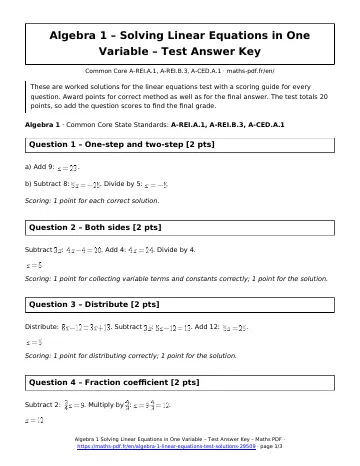
More Algebra 1 math
Lessons
See all Exponential Functions and Growth Lesson: Notes and Examples
- Scatter Plots, Lines of Fit and Two-Way Tables Lesson: Notes and Examples
- Exponent Rules and Radicals Lesson: Notes and Examples
- Factoring Polynomials Lesson: Notes and Examples
- Graphing Linear Equations Lesson: Notes and Examples
- Slope and Rate of Change Lesson: Notes and Examples






Worksheets
See all- Writing Linear Equations and Functions Worksheets with Answers
- Graphing Quadratic Functions and Transformations Worksheets with Answers
- Arithmetic and Geometric Sequences Worksheets with Answers
- Functions and Function Notation Worksheets with Answers
- Literal Equations and Formulas Worksheets with Answers
- Exponential Functions and Growth Worksheets with Answers





Tests
See all- Structure of Algebraic Expressions Test with Answer Key
- Functions and Function Notation Test with Answer Key
- Literal Equations and Formulas Test with Answer Key
- Arithmetic and Geometric Sequences Test with Answer Key
- Writing Linear Equations and Functions Test with Answer Key
- Graphing Quadratic Functions and Transformations Test with Answer Key





Quizzes
See all- Literal Equations and Formulas Quiz: 10 Questions with Answers
- Writing Linear Equations and Functions Quiz: 10 Questions with Answers
- Systems of Linear Equations Quiz: 10 Questions with Answers
- Exponential Functions and Growth Quiz: 10 Questions with Answers
- Linear Inequalities in Two Variables and Systems Quiz: 10 Questions with Answers
- Data Distributions and Summary Statistics Quiz: 10 Questions with Answers