Algebra 1 Graphing Linear Equations Test Answer Key and Scoring Guide (PDF)


This graphing linear equations test answer key for Algebra 1 covers graphing linear equations (Common Core A-REI.D.10, F-IF.C.7a, A-CED.A.2), with a free PDF to print.
Key takeaway: This answer key helps Algebra 1 students and teachers grade the graphing linear equations test and understand every lost point.
- Topic: Graphing Linear Equations (Algebra 1)
- Content: Worked solutions and a scoring guide for 9 questions
- Standards: A-REI.D.10, F-IF.C.7a, A-CED.A.2
- Answers: Every step shown, with the method to review
- Format: Free printable PDF, US Letter, black and white
This answer key helps Algebra 1 students and teachers grade the graphing linear equations test and understand every lost point. All 9 questions are solved in full with the points for each part.
Use it to find out whether a mistake was in the slope, in the intercept, in the algebra of rewriting, or in reading a graph. Also, the key covers slope and intercept, the line \(y = \frac{3}{4}x – 1\), intercepts, slope-intercept conversion, point-slope form, equations from graphs, points on a line, and horizontal and vertical lines. Study every missed item before a retake.
Key takeaway: Worked answers for the Algebra 1 test on Graphing Linear Equations, with the scoring for each problem. Use it to grade yourself after a timed attempt; free PDF.
Algebra 1 · Common Core State Standards: A-REI.D.10, F-IF.C.7a, A-CED.A.2
Graphing linear equations test answer key: worked solutions
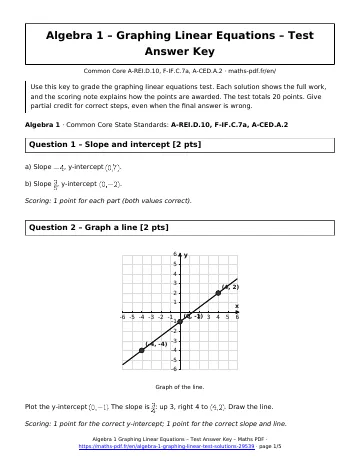
1 – Slope and intercept [2 pts]
a) Slope \(-4\), y-intercept \((0, 7)\).
b) Slope \(\frac{3}{5}\), y-intercept \((0, -2)\).
Scoring: 1 point for each part (both values correct).
2 – Graph a line [2 pts]
Plot the y-intercept \((0, -1)\). The slope is \(\frac{3}{4}\): up 3, right 4 to \((4, 2)\). Draw the line.
Scoring: 1 point for the correct y-intercept; 1 point for the correct slope and line.
3 – Find intercepts [2 pts]
Let \(y = 0\): \(5x = 20\), so \(x = 4\).
Let \(x = 0\): \(-2y = 20\), so \(y = -10\).
(4, 0) and (0, -10)
Scoring: 1 point for each intercept.
4 – Rewrite an equation [2 pts]
Subtract \(4x\): \(2y = -4x + 10\). Divide by 2.
\(y = -2x + 5\)
Scoring: 1 point for isolating the y-term; 1 point for dividing every term.
5 – Point-slope form [2 pts]
Point-slope: \(y – 5 = -3(x – 2)\).
Distribute: \(y – 5 = -3x + 6\), so \(y = -3x + 11\).
\(y – 5 = -3(x – 2)\); \(y = -3x + 11\)
Scoring: 1 point for each form.
6 – Equation from a graph [2 pts]
The y-intercept is 6. From \((0, 6)\) to \((2, 3)\), the level changes by -3 in 2 hours.
\(y = -\frac{3}{2}x + 6\)
Scoring: 1 point for the slope; 1 point for the equation.
Question 7 and after
7 – Data plan [3 pts]
a) Slope \(\frac{0 – 12}{8 – 0} = -1.5\), so \(y = -1.5x + 12\).
b) The x-intercept \((8, 0)\) means all the data is used after 8 days.
c) \(y = -1.5(4) + 12 = 6\) GB.
\(y = -1.5x + 12\); 8 days; 6 GB
Scoring: 1 point per part.
8 – Points on a line [3 pts]
a) \(2(6) – 3(0) = 12\) true. \(2(0) – 3(4) = -12\) false. \(2(-3) – 3(-6) = -6 + 18 = 12\) true. \(2(5) – 3(1) = 7\) false.
b) \(18 – 3y = 12\), so \(-3y = -6\) and \(y = 2\).
\((6, 0)\) and \((-3, -6)\); \(y = 2\)
Scoring: part a, 1 point for testing all points and 1 point for the correct two; part b, 1 point.
9 – Horizontal and vertical [2 pts]
Every point on the horizontal line has y-coordinate -3. Every point on the vertical line has x-coordinate 4.
\(y = -3\) and \(x = 4\)
Scoring: 1 point for each equation.
Total score
20 points
Key facts behind this graphing linear equations test answer key
- Every point on the line is a solution of the equation, and every solution is on the line.
- Next, in y = mx + b, m is the slope and b is the y-intercept.
- Find intercepts by setting x = 0 for the y-intercept and y = 0 for the x-intercept.
- Point-slope form y – y₁ = m(x – x₁) uses a known point and the slope.
- y = k is horizontal with slope 0; x = h is vertical with undefined slope.
Common mistakes with this graphing linear equations test answer key
- Students award credit for a correct equation with the wrong graph. In question 2 the plotted points and the line are separate marks.
- Students accept an unsimplified answer in question 5. As a result, the key shows both point-slope and slope-intercept form, and the problem asks for each.
- Students forget that the word problem answers need units. As a result, a statement such as 12 GB left at the start has a unit and a time.
How to learn from your test
- For each missed question, write the first wrong line and the correct line next to it. That makes the correction specific.
- Teachers can use the point split in questions 1, 5, and 8 to give fair partial credit.
- Redo missed graphs on fresh graph paper the next day, and compare with the key only after you finish.
Download the graphing linear equations test answer key as a PDF with the button below and keep it with your notes.
Graphing linear equations test answer key: frequently asked questions
How does the key find the intercepts of a standard form line?
It sets one variable to zero at a time. For \(5x – 2y = 20\), setting y to 0 gives x = 4, and setting x to 0 gives y = -10. Also, the intercepts are (4, 0) and (0, -10), and they are enough to draw the line.
How does the key decide which points are on the line?
Also, it substitutes each point into the equation and checks whether both sides are equal. For \(2x – 3y = 12\), the point (6, 0) gives 12, which is true, so it is on the line. In other words, a point that gives another value is not.
What does a complete point-slope answer include?
It includes the equation in point-slope form with the correct signs, and then the same line in slope-intercept form. For slope -3 through (2, 5), the forms are \(y – 5 = -3(x – 2)\) and \(y = -3x + 11\).
All Algebra 1 chapters: Algebra 1 math.
More Algebra 1 math
Lessons
See all Linear Inequalities in Two Variables and Systems Lesson: Notes and Examples
- Systems of Linear Equations Lesson: Notes and Examples
- Graphing Quadratic Functions and Transformations Lesson: Notes and Examples
- Scatter Plots, Lines of Fit and Two-Way Tables Lesson: Notes and Examples
- Graphing Linear Equations Lesson: Notes and Examples
- Data Distributions and Summary Statistics Lesson: Notes and Examples






Worksheets
See all- Adding, Subtracting and Multiplying Polynomials Worksheets with Answers
- Solving Linear Equations in One Variable Worksheets with Answers
- Exponent Rules and Radicals Worksheets with Answers
- Literal Equations and Formulas Worksheets with Answers
- Factoring Polynomials Worksheets with Answers
- Linear Inequalities in One Variable Worksheets with Answers






Tests
See all- Solving Linear Equations in One Variable Test with Answer Key
- Linear Inequalities in Two Variables and Systems Test with Answer Key
- Scatter Plots, Lines of Fit and Two-Way Tables Test with Answer Key
- Writing Linear Equations and Functions Test with Answer Key
- Functions and Function Notation Test with Answer Key
- Structure of Algebraic Expressions Test with Answer Key






Quizzes
See all- Linear Inequalities in One Variable Quiz: 10 Questions with Answers
- Adding, Subtracting and Multiplying Polynomials Quiz: 10 Questions with Answers
- Exponent Rules and Radicals Quiz: 10 Questions with Answers
- Factoring Polynomials Quiz: 10 Questions with Answers
- Solving Quadratic Equations Quiz: 10 Questions with Answers
- Functions and Function Notation Quiz: 10 Questions with Answers