3rd Grade Quadrilaterals and Partitioning Shapes Worksheet Answer Key (PDF)
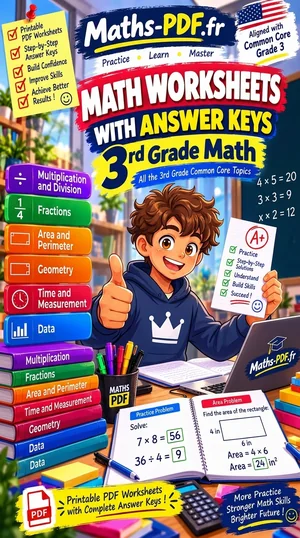
This 3rd grade quadrilaterals worksheet answers covers quadrilaterals and partitioning shapes (Common Core 3.G.A.1, 3.G.A.2), with a free PDF to print.
Key takeaway: This answer key helps Grade 3 teachers and parents check the quadrilaterals worksheet.
- Topic: Quadrilaterals and Partitioning Shapes (3rd grade)
- Content: Step-by-step answers to 24 worksheet problems
- Standards: 3.G.A.1, 3.G.A.2
- Answers: Every step shown, with the method to review
- Format: Free printable PDF, US Letter, black and white
This answer key helps Grade 3 teachers and parents check the quadrilaterals worksheet. First, it gives the answer to each of the 14 problems. Then it names the attribute that supports each answer.
The notes cover counting sides and corners, finding quadrilaterals, mystery shapes, right angles, true or false claims, drawing, tables, and partitioning. Next, use the notes to talk about any missed problem. Drawing problems can have many correct pictures, so the key tells what to look for. Checking the full page takes about 15 minutes. Also, a pencil and scratch paper help children show each step.
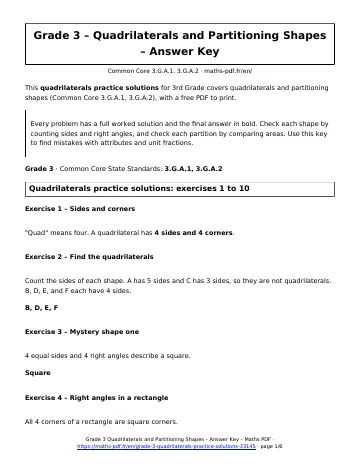
Every problem has a full worked solution and the final answer in bold. Check each shape by counting sides and right angles, and check each partition by comparing areas. Use this key to find mistakes with attributes and unit fractions.
Key takeaway: This answer key for the Grade 3 worksheet on Quadrilaterals and Partitioning Shapes shows every step and the rule used. Check your work after trying the problems alone; free PDF.
Grade 3 · Common Core State Standards: 3.G.A.1, 3.G.A.2
3rd grade quadrilaterals worksheet answers: worksheet problems 1 to 10
1 – Sides and corners
“Quad” means four. So, a quadrilateral has 4 sides and 4 corners.
2 – Find the quadrilaterals
Count the sides of each shape. A has 5 sides and C has 3 sides, so they are not quadrilaterals. B, D, E, and F each have 4 sides.
B, D, E, F
3 – Mystery shape one
4 equal sides and 4 right angles describe a square.
Square
4 – Right angles in a rectangle
All 4 corners of a rectangle are square corners.
4 right angles
5 – Name the tick-mark shape
All 4 sides have a tick mark, so they are equal. A quadrilateral with 4 equal sides and no right angles is a rhombus.
Rhombus
6 – Square and rectangle
A rectangle is a quadrilateral with 4 right angles. Every square has 4 right angles.
True
7 – Rhombus and square
A rhombus has 4 equal sides, but its corners do not have to be right angles. A rhombus that leans over has no right angles, so it is not a square.
False
8 – Mystery shape two
4 right angles make it a rectangle. The sides are not all equal, so it is not a square.
Rectangle
9 – Draw a different quadrilateral
Join 4 points with straight sides so that the sides are not all equal and there are no 4 right angles. A kite works. Many other drawings are correct too.
Worksheet problem 10 and after
10 – A shared attribute
Each one has 4 sides, so each is a quadrilateral. Each one also has two pairs of parallel sides. Either answer is correct.
4 sides (or 2 pairs of parallel sides)
Worksheet problems 11 and up
11 – Rhombus but not square
G has unequal sides. I has only one pair of parallel sides. J is a square. H has 4 equal sides and no right angles.
H
12 – Complete the table
| Shape | 4 equal sides? | 4 right angles? |
|---|---|---|
| Square | yes | yes |
| Rectangle that is not a square | no | yes |
| Rhombus that is not a square | yes | no |
A rectangle that is not a square has long and short sides. A rhombus is not required to have right angles.
13 – Fix the claim
Having 4 sides only makes a shape a quadrilateral. A rectangle must also have 4 right angles. A trapezoid has just one pair of parallel sides and does not have 4 right angles.
4 sides is not enough to be a rectangle.
14 – One part of six
One of 6 equal parts is 1 over 6.
\(\frac{1}{6}\)
15 – Shaded part
There are 4 equal parts and 1 is shaded.
\(\frac{1}{4}\)
16 – Is it a third?
One third of 12 squares is \(12 \div 3 = 4\) squares. The shaded part has 5 squares, which is more than 4.
No
17 – Cracker pieces
The cracker is cut into 8 equal parts, so each part is 1 over 8.
\(\frac{1}{8}\)
Worksheet problem 18 and after
18 – Quilt block
4 triangles with equal area means each is 1 over 4 of the block.
\(\frac{1}{4}\)
19 – Brownie pan
6 equal pieces means each piece is 1 over 6 of the pan.
\(\frac{1}{6}\)
20 – Two ways to halve
Cut 1 makes 2 triangles. Each has area \(200 \times 100 \div 2 = 10{,}000\) square units. Cut 2 makes 2 trapezoids. Each has area \((60 + 140) \div 2 \times 100 = 10{,}000\) square units. Both cuts make two parts with equal area, so each part is \(\frac{1}{2}\).
Yes, both cuts make halves.
21 – Garden beds
\(12 \div 3 = 4\), so each bed has 4 squares. Each bed is 1 of 3 equal parts.
4 squares; \(\frac{1}{3}\) of the garden
22 – Cut the shape
4 equal sides and 4 right angles make a square. Four equal parts are fourths. Cutting down the middle both ways makes 4 small squares. Cutting along both diagonals makes 4 triangles.
Square; \(\frac{1}{4}\); small squares (or triangles)
23 – Comparing pieces
Priya’s pieces are halves: \(\frac{1}{2}\). Jamal’s pieces are fourths: \(\frac{1}{4}\). The same napkin is shared by more pieces, so each piece is smaller.
Jamal’s pieces are smaller.
Worksheet problem 24 and after
24 – Folded strip
The strip has 5 equal parts, so the unit fraction uses 5 in the bottom. Carlos used 6, which is the wrong number of parts.
Each part is \(\frac{1}{5}\) of the strip.
Key facts behind this 3rd grade quadrilaterals worksheet answers
- A quadrilateral has exactly 4 straight sides and 4 corners.
- Also, a rhombus has 4 equal sides; a rectangle has 4 right angles.
- A square is a rhombus and a rectangle at the same time.
- Then, some quadrilaterals are not rhombuses, rectangles, or squares.
- Equal parts have equal area, and each of n equal parts is 1/n of the whole.
Common mistakes with this 3rd grade quadrilaterals worksheet answers
- Marking a drawing wrong because it does not look like the key is unfair. In problem 9, any quadrilateral that is not a rhombus, rectangle, or square is correct.
- In problem 7, every rhombus is not a square, since a rhombus may have no right angles. A child who writes true has mixed up the groups.
- In problem 6, every square is a rectangle, because a square has 4 right angles. Then, check that the child gave the reason.
How to use these solutions
- First, ask the child to name the attribute that decides each answer. Then check that the attribute matches the shape.
- Also, have the child redraw a missed shape on grid paper. Seeing the sides and angles fixes many mistakes. Then check the result once more before moving on.
- Sort errors into counting, naming, true or false, drawing, and partitioning. Then practice the type with the most misses. In other words, slow and careful work pays off here.
Download the 3rd grade quadrilaterals worksheet answers as a PDF with the button below and keep it with your notes.
3rd grade quadrilaterals worksheet answers: frequently asked questions
How should the trapezoid claim in problem 13 be fixed?
Noah says a trapezoid is a rectangle because it has 4 sides. The fix is that a rectangle needs 4 right angles, and a trapezoid does not have them. Having 4 sides only makes it a quadrilateral.
What is the answer to the table in problem 12?
A square has 4 equal sides and 4 right angles, so both answers are yes. A rectangle has 4 right angles but not always equal sides, and a rhombus has equal sides but not always right angles.
What if a child partitions a shape in a different but equal way?
Accept it if the parts have equal area. Next, count the squares to check. Different cuts can make the same fraction, and equal area is what matters. Also, saying the steps aloud helps you spot a slip.
All Grade 3 chapters: Grade 3 math.
More 3rd Grade math
Lessons
See all Time, Liquid Volume and Mass Lesson: Notes and Examples
- Understanding Multiplication Lesson: Notes and Examples
- Understanding Division Lesson: Notes and Examples
- Multiplying by Multiples of 10 Lesson: Notes and Examples
- Two-Step Word Problems and Patterns Lesson: Notes and Examples
- Multiplication and Division Facts Within 100 Lesson: Notes and Examples

Worksheets
See all- Area Worksheets with Answers
- Rounding to the Nearest 10 and 100 Worksheets with Answers
- Equivalent and Comparing Fractions Worksheets with Answers
- Quadrilaterals and Partitioning Shapes Worksheets with Answers
- Understanding Division Worksheets with Answers
- Multiplying by Multiples of 10 Worksheets with Answers


Tests
See all




Quizzes
See all- Two-Step Word Problems and Patterns Quiz: 10 Questions with Answers
- Understanding Division Quiz: 10 Questions with Answers
- Scaled Graphs and Line Plots Quiz: 10 Questions with Answers
- Equivalent and Comparing Fractions Quiz: 10 Questions with Answers
- Perimeter Quiz: 10 Questions with Answers
- Quadrilaterals and Partitioning Shapes Quiz: 10 Questions with Answers