2nd Grade Skip Counting and Comparing Numbers Lesson: Notes and Examples (Free PDF)

This 2nd grade skip counting lesson covers skip counting and comparing numbers (Common Core 2.NBT.A.2, 2.NBT.A.4), with a free PDF to print.
Key takeaway: This lesson helps Grade 2 students count by 5s, 10s, and 100s and compare three-digit numbers.
- Topic: Skip Counting and Comparing Numbers (2nd grade)
- Content: One-page lesson with a definition, a worked example and key facts
- Standards: 2.NBT.A.2, 2.NBT.A.4
- Answers: Explanations included
- Format: Free printable PDF, US Letter, black and white
Key takeaway: A clear Grade 2 lesson on Skip Counting and Comparing Numbers, with definitions, rules and worked examples: what is skip counting, how do you count by 10s and 100s and how do you compare three-digit numbers. Read it before the practice worksheet; free to print or download as a PDF.
Skip counting means counting by 5s, 10s or 100s instead of by 1s. To compare three-digit numbers, check the hundreds first, then the tens, then the ones. Use the signs greater than, less than and equal to. For example, 538 is less than 583 because 3 tens is less than 8 tens.
This lesson helps Grade 2 students count by 5s, 10s, and 100s and compare three-digit numbers. First, children learn that skip counting adds the same amount each time. Then they see how the digits change when they count by 5s, 10s, or 100s.
Next, the lesson shows how to compare numbers by looking at hundreds first, then tens, then ones. Also, it explains the signs greater than, less than, and equal to. Finally, it uses number lines and base-ten blocks. Plan about 15 minutes, with a number line to 1,000 on the table.
Grade 2 · Common Core State Standards: 2.NBT.A.2, 2.NBT.A.4
Key facts in this 2nd grade skip counting lesson
- Skip counting adds the same amount each time.
- Counting by 5s makes the ones digit 0 or 5.
- Counting by 10s changes the tens digit; counting by 100s changes the hundreds digit.
- Then, compare hundreds first, then tens, then ones.
- The signs are > (greater than), < (less than) and = (equal to).
What is skip counting?
Skip counting means counting by the same number each time. Instead of 1, 2, 3, you jump ahead. You can count by 5s, by 10s or by 100s.
Look at the jumps. Each jump adds 5. Count by 5s and the ones digit is always 0 or 5.
How do you count by 10s and 100s?
When you count by 10s, only the tens digit changes. When you count by 100s, only the hundreds digit changes. You can also count backward by taking away.
Here the numbers go 120, 130, 140 and on to 200. The ones digit stays 0.
Now the hundreds digit goes up by 1 each jump: 300, 400, 500, 600, 700, 800. Counting by 10s past a hundred works the same way: 280, 290, 300, 310.
How do you compare three-digit numbers?
To compare, start with the hundreds. If the hundreds are the same, look at the tens. If the tens are also the same, look at the ones. Use these signs.
| Sign | Meaning | Example |
|---|---|---|
| \(>\) | is greater than | \(625 > 618\) |
| \(< \) | Also, is less than | \(234 < 241\) |
| \(=\) | is equal to | \(300 = 300\) |
Here is a method. Compare 538 and 583.
- Line up the digits by place. 538 has 5 hundreds, 3 tens and 8 ones. 583 has 5 hundreds, 8 tens and 3 ones.
- Compare the hundreds. Both have 5, so they are the same.
- Compare the tens. 3 tens is less than 8 tens.
- Write the answer: \(538 < 583\).
The sign always opens toward the greater number, like a mouth that wants the bigger one.
2nd grade skip counting lesson: questions and answers
What is skip counting by 5s?
It means adding 5 each time: 5, 10, 15, 20, 25 and so on. The ones digit is always 0 or 5.
How do you count by 100s from 300?
Add 100 each time: 300, 400, 500, 600. Only the hundreds digit changes.
How do you compare two three-digit numbers?
Compare the hundreds first. If they match, compare the tens, then the ones. The first place that differs decides which number is greater.
What do the signs > and < mean?
The sign > means greater than and the sign < means less than. The small point of the sign faces the smaller number.
Can two different-looking numbers be equal?
Only if every digit matches. 245 and 245 are equal, but 245 and 254 are not.
Common mistakes with this 2nd grade skip counting lesson
- Students count by 10s from 275 and write 285, 295, 305 but then slip to 3005. Instead, say the numbers aloud. After 295 comes 305 because the tens roll over to the next hundred.
- Children compare 245 and 254 by looking at the biggest digit anywhere. However, the hundreds are the same, so compare the tens. 5 tens is more than 4 tens, so 254 is greater.
- When counting by 5s, students miss the pattern in the ones digit. First, notice that the ones digit is always 0 or 5. Then use that clue to check the next number.
How to study this chapter
- First, practice counting by 5s on a number line with big jumps. Then count nickels, because each nickel is 5 cents and the count is the same skill.
- Cover one digit of each number and compare the other. Also, start at the hundreds place, then the tens, and finally the ones.
- Parents can count steps, stairs, or coins by 5s and 10s. Short counts of 20 or 30 numbers build speed and confidence.
Download the 2nd grade skip counting lesson as a PDF with the button below and keep it with your notes.
More questions about 2nd grade skip counting lesson
Why does skip counting by 10 change only the tens digit?
Adding 10 means adding one ten. So the tens digit goes up by 1 and the ones digit stays the same. For example, 120, 130, 140 all end in 0. When the tens digit passes 9, the hundreds digit goes up by 1.
What is the rule for a number pattern like 115, 120, 125, 130?
The rule is to add 5 each time. First, subtract any number from the next number to find the jump. Then check that the same jump works for every pair. Here, 120 minus 115 is 5, and 125 minus 120 is also 5.
How do you find a missing digit to make a comparison true?
Compare the places from left to right. For 5_9 greater than 540, the hundreds match. Then the tens digit must be greater than 4. So the least digit that works is 5, and 559 is greater than 540.
All Grade 2 chapters: Grade 2 math.
Free printable PDF
2nd Grade Skip Counting and Comparing Numbers Lesson: Notes and Examples
Download PDF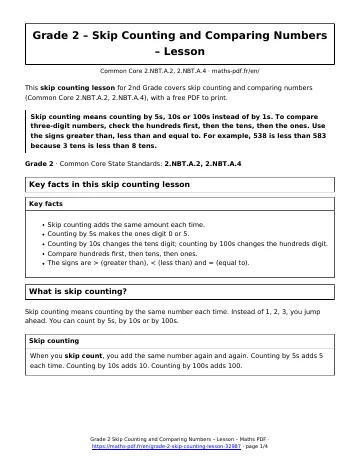
More 2nd Grade math
Lessons
See all Measuring Length Lesson: Notes and Examples
- Money: Dollars and Coins Lesson: Notes and Examples
- Arrays and Equal Groups Lesson: Notes and Examples
- Fluency Within 20, Even and Odd Numbers Lesson: Notes and Examples
- Subtracting Within 100 Lesson: Notes and Examples
- Adding and Subtracting Within 1,000 Lesson: Notes and Examples





Worksheets
See all- Skip Counting and Comparing Numbers Worksheets with Answers
- Telling Time to Five Minutes Worksheets with Answers
- Adding and Subtracting Within 1,000 Worksheets with Answers
- Place Value to 1,000 Worksheets with Answers
- Picture Graphs, Bar Graphs and Line Plots Worksheets with Answers
- Arrays and Equal Groups Worksheets with Answers




Tests
See all- Picture Graphs, Bar Graphs and Line Plots Test with Answer Key
- Measuring Length Test with Answer Key
- Skip Counting and Comparing Numbers Test with Answer Key
- Shapes and Equal Shares Test with Answer Key
- Money: Dollars and Coins Test with Answer Key
- Fluency Within 20, Even and Odd Numbers Test with Answer Key





Quizzes
See all- Place Value to 1,000 Quiz: 10 Questions with Answers
- Shapes and Equal Shares Quiz: 10 Questions with Answers
- Adding and Subtracting Within 1,000 Quiz: 10 Questions with Answers
- Subtracting Within 100 Quiz: 10 Questions with Answers
- Skip Counting and Comparing Numbers Quiz: 10 Questions with Answers
- Money: Dollars and Coins Quiz: 10 Questions with Answers