2nd Grade Arrays and Equal Groups Lesson: Notes and Examples (Free PDF)

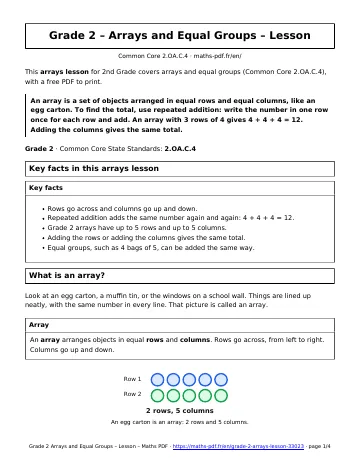
This 2nd grade arrays lesson covers arrays and equal groups (Common Core 2.OA.C.4), with a free PDF to print.
Key takeaway: This lesson helps Grade 2 students understand arrays and equal groups as a first step toward multiplication.
- Topic: Arrays and Equal Groups (2nd grade)
- Content: One-page lesson with a definition, a worked example and key facts
- Standards: 2.OA.C.4
- Answers: Explanations included
- Format: Free printable PDF, US Letter, black and white
Key takeaway: A clear Grade 2 lesson on Arrays and Equal Groups, with definitions, rules and worked examples: what is an array, how do you find the total with repeated addition and can you add the columns instead. Read it before the practice worksheet; free to print or download as a PDF.
An array is a set of objects arranged in equal rows and equal columns, like an egg carton. To find the total, use repeated addition: write the number in one row once for each row and add. An array with 3 rows of 4 gives 4 + 4 + 4 = 12. Adding the columns gives the same total.
This lesson helps Grade 2 students understand arrays and equal groups as a first step toward multiplication. Children learn to describe an array by its rows and columns and to write an addition sentence with equal addends.
The lesson shows arrays with up to 5 rows and 5 columns, such as a muffin tin or an egg carton. It explains repeated addition like 4 + 4 + 4 = 12, why adding rows or columns gives the same total, and how bags of equal size make the same kind of sum. Plan about 15 minutes, with counters or small squares to build arrays.
Grade 2 · Common Core State Standards: 2.OA.C.4
Key facts in this 2nd grade arrays lesson
- Rows go across and columns go up and down.
- Repeated addition adds the same number again and again: 4 + 4 + 4 = 12.
- Grade 2 arrays have up to 5 rows and up to 5 columns.
- Adding the rows or adding the columns gives the same total.
- Equal groups, such as 4 bags of 5, can be added the same way.
What is an array?
Look at an egg carton, a muffin tin, or the windows on a school wall. Things are lined up neatly, with the same number in every line. That picture is called an array.
This array has 2 rows. Each row has 5 circles, so it also has 5 columns.
How do you find the total with repeated addition?
Add the number in each row. Every row has the same number, so the numbers you add are equal. These are called equal addends.
The array has 3 rows with 4 in each row. Write the sentence \(4 + 4 + 4 = 12\). There are 12 circles in all.
| Rows | Columns | Add the rows |
|---|---|---|
| 2 | 3 | \(3 + 3 = 6\) |
| 3 | 3 | \(3 + 3 + 3 = 9\) |
| 4 | 5 | \(5 + 5 + 5 + 5 = 20\) |
| 5 | 2 | \(2 + 2 + 2 + 2 + 2 = 10\) |
Can you add the columns instead?
Yes. Count the columns, and add the number in each column. You get the same total.
Now there are 4 columns with 3 in each: \(3 + 3 + 3 + 3 = 12\). Adding rows or columns gives 12 both times.
The bags give \(5 + 5 + 5 + 5 = 20\). There are 20 counters.
- Count the rows.
- Count how many are in one row.
- Write that number once for each row, with plus signs between.
- Add to find the total.
Worked example. A bus has 4 rows of seats with 2 seats in each row. Write \(2 + 2 + 2 + 2\). Two and two make 4, 4 and 2 make 6, and 6 and 2 make 8. The bus has 8 seats.
2nd grade arrays lesson: questions and answers
What is the difference between a row and a column?
A row goes across, from left to right. A column goes up and down. In a 3 by 4 array there are 3 rows and 4 columns.
How do I write an equation for an array?
Count the objects in one row, then write that number once for each row with plus signs. For 2 rows of 5, write \(5 + 5 = 10\).
What are equal addends?
Equal addends are the numbers you add that are all the same. In \(3 + 3 + 3 = 9\) every addend is 3.
Does it matter if I add rows or columns?
No, the total is the same. A 3 row by 5 column array gives \(5 + 5 + 5 = 15\) by rows and \(3 + 3 + 3 + 3 + 3 = 15\) by columns.
How big can an array be in Grade 2?
Second graders work with up to 5 rows and up to 5 columns. The biggest array has 25 objects, shown by \(5 + 5 + 5 + 5 + 5 = 25\).
Common mistakes with this 2nd grade arrays lesson
- Students count the rows and the columns and say the total is their sum. A 3 by 4 array does not have 3 + 4 objects. Then, add the row size three times: 4 + 4 + 4 = 12.
- Children write an addition sentence with different addends, like 4 + 3 + 4. In an array every row has the same number, so every addend must match.
- Also, when asked for columns, students still add the rows. Both give the same total, but the sentence changes. For 3 rows of 5, rows give 5 + 5 + 5 and columns give 3 + 3 + 3 + 3 + 3.
How to study this chapter
- Build arrays with counters on a table, then turn the array a quarter turn. Rows become columns, and the total stays the same.
- Next, look for arrays at home, such as a waffle, a window, or a tray of ice cubes. Next, say the number of rows and columns and write the sentence.
- Also, teachers can ask students to draw two different arrays with the same total, such as 2 rows of 6 and 3 rows of 4, to show many ways to make 12.
Download the 2nd grade arrays lesson as a PDF with the button below and keep it with your notes.
More questions about 2nd grade arrays lesson
What is an array in second grade math?
An array is a set of objects arranged in equal rows and equal columns, like squares on a chocolate bar. It shows how many are in each row and how many rows there are. Arrays help children see repeated addition, which leads to multiplication.
How is an array connected to multiplication?
An array with 3 rows of 5 can be written as 5 + 5 + 5 = 15. In Grade 3, the same picture is written as 3 times 5 equals 15. Grade 2 prepares for that by using addition sentences with equal addends.
How do you find the number of objects in each row if you know the total?
Divide the total into equal rows by sharing or drawing. If 12 objects are in 4 equal rows, put one in each row at a time until all are placed. Each row ends up with 3. You can check by adding 3 + 3 + 3 + 3.
All Grade 2 chapters: Grade 2 math.
More 2nd Grade math
Lessons
See all Adding Within 100 Lesson: Notes and Examples
- Money: Dollars and Coins Lesson: Notes and Examples
- Fluency Within 20, Even and Odd Numbers Lesson: Notes and Examples
- Adding and Subtracting Within 1,000 Lesson: Notes and Examples
- Picture Graphs, Bar Graphs and Line Plots Lesson: Notes and Examples
- One- and Two-Step Word Problems Lesson: Notes and Examples



Worksheets
See all- Fluency Within 20, Even and Odd Numbers Worksheets with Answers
- Adding and Subtracting Within 1,000 Worksheets with Answers
- Picture Graphs, Bar Graphs and Line Plots Worksheets with Answers
- Arrays and Equal Groups Worksheets with Answers
- Adding Within 100 Worksheets with Answers
- Subtracting Within 100 Worksheets with Answers


Tests
See all


Quizzes
See all- Adding Within 100 Quiz: 10 Questions with Answers
- One- and Two-Step Word Problems Quiz: 10 Questions with Answers
- Telling Time to Five Minutes Quiz: 10 Questions with Answers
- Adding and Subtracting Within 1,000 Quiz: 10 Questions with Answers
- Fluency Within 20, Even and Odd Numbers Quiz: 10 Questions with Answers
- Arrays and Equal Groups Quiz: 10 Questions with Answers