2nd Grade Fluency Within 20, Even and Odd Numbers Lesson: Notes and Examples (Free PDF)
This 2nd grade even and odd numbers lesson covers fluency within 20, even and odd numbers (Common Core 2.OA.B.2, 2.OA.C.3), with a free PDF to print.
Key takeaway: This lesson helps Grade 2 students add and subtract fluently within 20 and sort numbers into even and odd.
- Topic: Fluency Within 20, Even and Odd Numbers (2nd grade)
- Content: One-page lesson with a definition, a worked example and key facts
- Standards: 2.OA.B.2, 2.OA.C.3
- Answers: Explanations included
- Format: Free printable PDF, US Letter, black and white
Key takeaway: A clear Grade 2 lesson on Fluency Within 20, Even and Odd Numbers, with definitions, rules and worked examples: how can you add and subtract quickly within 20, what is the make-a-ten strategy and how do doubles and near doubles help. Read it before the practice worksheet; free to print or download as a PDF.
Fluency within 20 means adding and subtracting numbers up to 20 quickly and correctly with strategies such as doubles, making a ten, and thinking addition. An even number can be split into two equal groups or paired with none left over. An odd number always has one object left over.
This lesson helps Grade 2 students add and subtract fluently within 20 and sort numbers into even and odd. Children learn strategies such as doubles, near doubles, and making a ten, and see that even numbers split into two equal groups.
The lesson shows how to count on, fill a ten frame, use doubles like 8 + 8, and think of subtraction as a missing addend. It then explains pairs of dots and equal addends to decide if a number is even or odd. Plan about 15 minutes, with counters and a ten frame.
Grade 2 · Common Core State Standards: 2.OA.B.2, 2.OA.C.3
Key facts in this 2nd grade even and odd numbers lesson
- Doubles add a number to itself: \(8 + 8 = 16\).
- Next, make a ten by moving dots to fill a ten frame, then add the rest.
- Subtraction is a missing addend: \(15 – 8\) asks \(8 + ? = 15\).
- Even numbers end in 0, 2, 4, 6, or 8. Odd numbers end in 1, 3, 5, 7, or 9.
- Every even number up to 20 is a sum of two equal addends.
How can you add and subtract quickly within 20?
Fast math is not magic. Your brain uses helpers so you do not have to count every single one. Here are the helpers you will use in this chapter.
What is the make-a-ten strategy?
A full ten frame is easy to see. If one number is close to 10, give it some dots from the other number. Then add the leftover dots to 10.
How do doubles and near doubles help?
Doubles are easy to remember: \(6 + 6 = 12\). A near double is one away from a double. Since \(6 + 6 = 12\), then \(6 + 7 = 13\), which is one more.
How do you subtract within 20?
Think of the missing part. To solve \(15 – 8\), ask: \(8 + ? = 15\). Since \(8 + 7 = 15\), the answer is 7.
What are even and odd numbers?
How do you write an even number as two equal addends?
An even number splits into two equal groups. Write the groups as an addition sentence. For example, \(14 = 7 + 7\) and \(20 = 10 + 10\). An odd number cannot do this.
How do you use make a ten? Try this method.
- Pick the number that is closer to 10. Here it is 9.
- Find how much it needs to reach 10: \(9 + 1 = 10\).
- Break the other number into that piece and the rest: \(6 = 1 + 5\).
- Add the ten and the rest: \(10 + 5 = 15\).
So \(9 + 6 = 15\).
2nd grade even and odd numbers lesson: questions and answers
What is a doubles fact?
A doubles fact adds the same number twice, like \(7 + 7 = 14\). Doubles are easy to remember and help you solve near doubles.
How can I tell if a number is even?
Look at the ones digit. If it is 0, 2, 4, 6, or 8, the number is even. You can also make pairs and see that no object is left over.
Can an odd number be written as two equal addends?
No. When you split an odd number into two groups, one group always has one more. For example, 9 splits into 4 and 5, which are not equal.
Why does making a ten help?
Adding to 10 is easy because the ones digit becomes 0. After you reach 10, you only add what is left over.
How can I check a subtraction answer?
Add the answer to the number you subtracted. If you get the starting number, it is right. For example, \(15 – 8 = 7\) because \(8 + 7 = 15\).
Common mistakes with this 2nd grade even and odd numbers lesson
- Students add 7 + 8 by counting from 1 and lose track. Use the near double instead: 7 + 7 is 14, and one more is 15.
- Children decide that a number is even if it is big. Evenness depends on pairing. Draw 11 dots in pairs and one dot is left over, so 11 is odd.
- Also, in 9 + 5 = 10 + ?, students write 5. Moving 1 from the 5 to the 9 leaves 4, so the missing number is 4.
How to study this chapter
- Practice the doubles up to 10 + 10 until they are quick. Near doubles, such as 6 + 7, are then one more than a double.
- Next, to test a number, draw dots in pairs. If every dot has a partner, the number is even. If one dot is left, it is odd.
- Also, parents can use a deck of cards with the faces removed. Flip two cards, find the sum, and say whether it is even or odd.
Download the 2nd grade even and odd numbers lesson as a PDF with the button below and keep it with your notes.
More questions about 2nd grade even and odd numbers lesson
What is the fastest way to add 9 + 6?
Make a ten by moving 1 from the 6 to the 9. The problem becomes 10 + 5 = 15. A ten frame shows this clearly: nine dots with one empty box, so one dot from the six fills it, leaving five dots. Then add the ten and the five.
What is a missing addend?
A missing addend is the number you must add to reach a total, like 8 + ? = 15. Subtraction finds it: 15 – 8 = 7. This is why thinking addition helps with subtraction facts. Children can check by adding 8 + 7 to see if the total is 15.
Why do all even numbers up to 20 split into two equal groups?
Even numbers can be shared evenly between two people with nothing left. 14 splits into 7 and 7, so 14 = 7 + 7. Odd numbers always leave one extra. Pairs of dots show this: even numbers use all dots in pairs, and odd numbers do not.
All Grade 2 chapters: Grade 2 math.
Free printable PDF
2nd Grade Fluency Within 20, Even and Odd Numbers Lesson: Notes and Examples
Download PDF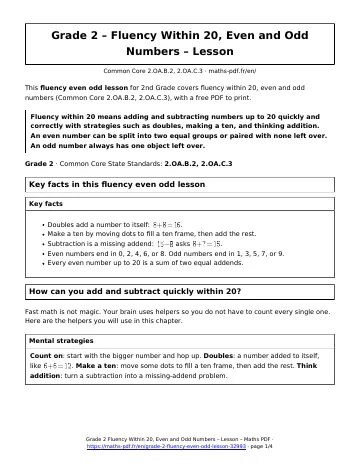
More 2nd Grade math
Lessons
See all Place Value to 1,000 Lesson: Notes and Examples
- Adding and Subtracting Within 1,000 Lesson: Notes and Examples
- Telling Time to Five Minutes Lesson: Notes and Examples
- Shapes and Equal Shares Lesson: Notes and Examples
- One- and Two-Step Word Problems Lesson: Notes and Examples
- Subtracting Within 100 Lesson: Notes and Examples




Worksheets
See all- Picture Graphs, Bar Graphs and Line Plots Worksheets with Answers
- Subtracting Within 100 Worksheets with Answers
- Arrays and Equal Groups Worksheets with Answers
- Shapes and Equal Shares Worksheets with Answers
- Telling Time to Five Minutes Worksheets with Answers
- Fluency Within 20, Even and Odd Numbers Worksheets with Answers




Tests
See all





Quizzes
See all- Place Value to 1,000 Quiz: 10 Questions with Answers
- Money: Dollars and Coins Quiz: 10 Questions with Answers
- Picture Graphs, Bar Graphs and Line Plots Quiz: 10 Questions with Answers
- One- and Two-Step Word Problems Quiz: 10 Questions with Answers
- Adding Within 100 Quiz: 10 Questions with Answers
- Skip Counting and Comparing Numbers Quiz: 10 Questions with Answers