2nd Grade Shapes and Equal Shares Lesson: Notes and Examples (Free PDF)
This 2nd grade shapes lesson covers shapes and equal shares (Common Core 2.G.A.1, 2.G.A.2, 2.G.A.3), with a free PDF to print.
Key takeaway: This lesson helps Grade 2 students name shapes by their sides and angles, describe cubes, and split shapes into equal shares.
- Topic: Shapes and Equal Shares (2nd grade)
- Content: One-page lesson with a definition, a worked example and key facts
- Standards: 2.G.A.1, 2.G.A.2, 2.G.A.3
- Answers: Explanations included
- Format: Free printable PDF, US Letter, black and white
Key takeaway: A clear Grade 2 lesson on Shapes and Equal Shares, with definitions, rules and worked examples: what are the names of shapes with straight sides, what is a cube and how do you split a rectangle into rows and columns. Read it before the practice worksheet; free to print or download as a PDF.
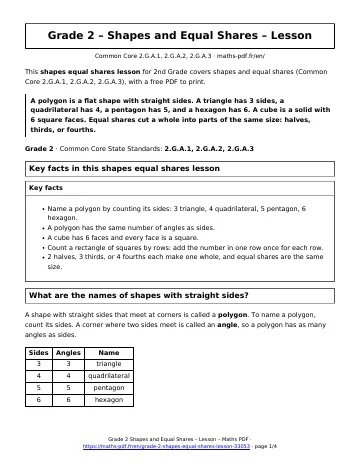
A polygon is a flat shape with straight sides. Also, a triangle has 3 sides, a quadrilateral has 4, a pentagon has 5, and a hexagon has 6. A cube is a solid with 6 square faces. Equal shares cut a whole into parts of the same size: halves, thirds, or fourths.
This lesson helps Grade 2 students name shapes by their sides and angles, describe cubes, and split shapes into equal shares. First, children count sides to name a triangle, quadrilateral, pentagon, or hexagon. Then they look at the faces of a cube.
Next, the lesson shows how to count squares in a rectangle by rows and columns. Finally, it teaches halves, thirds, and fourths as equal shares of a whole. Also, it explains why equal shares may look different but must be the same size. Plan about 15 minutes, with paper to fold and cut.
Grade 2 · Common Core State Standards: 2.G.A.1, 2.G.A.2, 2.G.A.3
Key facts in this 2nd grade shapes lesson
- Name a polygon by counting its sides: 3 triangle, 4 quadrilateral, 5 pentagon, 6 hexagon.
- Next, a polygon has the same number of angles as sides.
- A cube has 6 faces and every face is a square.
- Then, count a rectangle of squares by rows: add the number in one row once for each row.
- 2 halves, 3 thirds, or 4 fourths each make one whole, and equal shares are the same size.
What are the names of shapes with straight sides?
A shape with straight sides that meet at corners is called a polygon. To name a polygon, count its sides. A corner where two sides meet is called an angle, so a polygon has as many angles as sides.
| Sides | Angles | Name |
|---|---|---|
| 3 | 3 | triangle |
| 4 | 4 | quadrilateral |
| 5 | 5 | pentagon |
| 6 | 6 | hexagon |
Shapes can look different and still have the same name. A tall, skinny triangle and a short, wide triangle both have 3 sides.
What is a cube?
A cube is a solid shape, like a game die. Every flat side of a solid is called a face. All the faces of a cube are squares, and a cube has 6 of them. In a drawing you see only 3 faces. The other 3 are hidden behind.
How do you split a rectangle into rows and columns?
Rows go across, from left to right. Columns go up and down. When equal squares fill a rectangle with no gaps and no overlaps, you can count them by rows.
- Count the rows. Here there are 3.
- Count the squares in one row. Here there are 4.
- Add that number once for every row: \(4 + 4 + 4 = 12\).
The rectangle has 12 equal squares.
What are halves, thirds, and fourths?
Put all the shares back together and you get the whole: 2 halves, 3 thirds or 4 fourths make one whole. The more shares you cut, the smaller each share is. A half is bigger than a third, and a third is bigger than a fourth.
Equal shares must be the same size, but they do not have to be the same shape.
2nd grade shapes lesson: questions and answers
How do you name a shape by its sides?
Count the straight sides. Three sides is a triangle, four is a quadrilateral, five is a pentagon, and six is a hexagon. Mark each corner with a dot as you count so you do not skip one.
How many faces does a cube have?
A cube has 6 faces, and every face is a square. In a picture only 3 faces show. The other 3 are hidden at the back, the bottom, and the left side.
What is the difference between a row and a column?
A row goes across from left to right. Also, a column goes up and down. A rectangle with 3 rows and 4 columns has 12 squares.
Can halves look different from each other?
Yes. Halves must be the same size, but they can be different shapes. A square cut straight down the middle and a square cut corner to corner both make two equal halves.
Which is bigger, a third or a fourth?
A third is bigger. When a whole is cut into 3 equal shares, each share is larger than when the same whole is cut into 4 equal shares.
Common mistakes with this 2nd grade shapes lesson
- Students call every four-sided shape a square. However, a quadrilateral only needs 4 sides and 4 angles. Count the sides first, then check if all sides are equal before saying square.
- Children say a rectangle cut into 3 parts shows thirds, even when the parts are different sizes. Instead, check that all 3 parts are equal. Equal shares must be the same size.
- When counting squares in a rectangle, students count only the squares they can see and skip some. First, count the squares in one row. Then add that number once for each row.
How to study this chapter
- First, cut paper rectangles and fold them in halves, thirds, and fourths. Then open them and check that each part matches, because folding proves the parts are equal.
- Hold a small box or a die and count its faces. Also, trace one face on paper, which shows every face of a cube is a square.
- Parents can ask about shapes at home. For example, a stop sign has 8 sides and a window often has 4, so children name them by counting sides.
Download the 2nd grade shapes lesson as a PDF with the button below and keep it with your notes.
More questions about 2nd grade shapes lesson
What is a polygon?
A polygon is a flat shape with straight sides that are closed. It has the same number of angles as sides. A triangle, a rectangle, and a hexagon are all polygons. A circle is not a polygon because it has no straight sides.
Why do 4 fourths make one whole?
Also, a whole cut into 4 equal parts has 4 fourths. If you put all the parts back together, you get the whole again. The same idea works for halves and thirds. Two halves make a whole, and three thirds make a whole.
How can two equal halves be different shapes?
A square can be cut straight down the middle or corner to corner. First, both cuts make two equal parts. Then each part covers half of the square, even though one pair looks like rectangles and the other like triangles.
All Grade 2 chapters: Grade 2 math.
More 2nd Grade math
Lessons
See all Money: Dollars and Coins Lesson: Notes and Examples
- Place Value to 1,000 Lesson: Notes and Examples
- One- and Two-Step Word Problems Lesson: Notes and Examples
- Arrays and Equal Groups Lesson: Notes and Examples
- Fluency Within 20, Even and Odd Numbers Lesson: Notes and Examples
- Measuring Length Lesson: Notes and Examples





Worksheets
See all- Subtracting Within 100 Worksheets with Answers
- Skip Counting and Comparing Numbers Worksheets with Answers
- Adding Within 100 Worksheets with Answers
- Adding and Subtracting Within 1,000 Worksheets with Answers
- Arrays and Equal Groups Worksheets with Answers
- Telling Time to Five Minutes Worksheets with Answers




Tests
See all





Quizzes
See all- Shapes and Equal Shares Quiz: 10 Questions with Answers
- One- and Two-Step Word Problems Quiz: 10 Questions with Answers
- Adding Within 100 Quiz: 10 Questions with Answers
- Telling Time to Five Minutes Quiz: 10 Questions with Answers
- Picture Graphs, Bar Graphs and Line Plots Quiz: 10 Questions with Answers
- Subtracting Within 100 Quiz: 10 Questions with Answers