2nd Grade Money: Dollars and Coins Lesson: Notes and Examples (Free PDF)

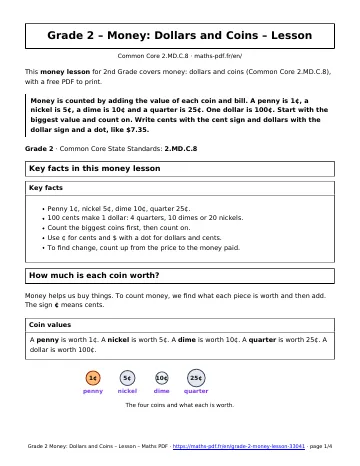
This 2nd grade money lesson covers money: dollars and coins (Common Core 2.MD.C.8), with a free PDF to print.
Key takeaway: This lesson helps Grade 2 students find the value of coins and bills and solve money problems.
- Topic: Money: Dollars and Coins (2nd grade)
- Content: One-page lesson with a definition, a worked example and key facts
- Standards: 2.MD.C.8
- Answers: Explanations included
- Format: Free printable PDF, US Letter, black and white
Key takeaway: A clear Grade 2 lesson on Money, with definitions, rules and worked examples: how much is each coin worth, how do you count a pile of coins and how many cents make a dollar. Read it before the practice worksheet; free to print or download as a PDF.
Money is counted by adding the value of each coin and bill. A penny is 1¢, a nickel is 5¢, a dime is 10¢ and a quarter is 25¢. One dollar is 100¢. Start with the biggest value and count on. Write cents with the cent sign and dollars with the dollar sign and a dot, like $7.35.
This lesson helps Grade 2 students find the value of coins and bills and solve money problems. First, children learn the value of a penny, nickel, dime, and quarter. Then they count mixed groups of coins and write amounts in dollars and cents.
Next, the lesson shows that 100 cents make one dollar, so four quarters, ten dimes, or twenty nickels each make a dollar. Finally, it teaches change by counting up from the price. Plan about 15 minutes, and keep real or play coins on the table so children can build each amount.
Grade 2 · Common Core State Standards: 2.MD.C.8
Key facts in this 2nd grade money lesson
- Penny 1¢, nickel 5¢, dime 10¢, quarter 25¢.
- 100 cents make 1 dollar: 4 quarters, 10 dimes or 20 nickels.
- Next, count the biggest coins first, then count on.
- Use ¢ for cents and $ with a dot for dollars and cents.
- Then, to find change, count up from the price to the money paid.
How much is each coin worth?
Money helps us buy things. To count money, we find what each piece is worth and then add. The sign ¢ means cents.
How do you count a pile of coins?
- Put the coins in order from the biggest value to the smallest.
- Say the value of the first coin. Then count on, adding the value of each next coin.
- The last number is the total. Write it with the ¢ sign.
Example: two quarters, a dime, a nickel and two pennies. We count \(25, 50, 60, 65, 66, 67\). The total is 67¢.
How many cents make a dollar?
One dollar is 100 cents. You can make a dollar with many different coins.
| Coin | Value | How many make $1? |
|---|---|---|
| Penny | 1¢ | 100 |
| Nickel | 5¢ | 20 |
| Dime | 10¢ | 10 |
| Quarter | 25¢ | 4 |
How do you count bills and coins together?
Count the dollar bills first. Then add the coins. We write dollars with the dollar sign and a dot. The dot separates dollars from cents.
Example: one \(\$5\) bill, two \(\$1\) bills, a quarter and a dime. The bills make \(\$7\). The coins make \(25 + 10 = 35\) cents. Together: $7.35.
How do you solve money word problems?
Read the story and decide: are we putting money together, or finding what is left? Then add or subtract. To find change, count up from the price to the money paid.
Example: A sticker costs 45¢. Hannah pays with one dollar. Count up: \(45 + 5 = 50\) and \(50 + 50 = 100\). The change is \(5 + 50 = 55\) cents.
2nd grade money lesson: questions and answers
How many cents are in a dollar?
There are 100 cents in one dollar. Four quarters, ten dimes, twenty nickels or one hundred pennies each make exactly $1.
What is each coin worth?
A quarter is 25¢, a dime is 10¢, a nickel is 5¢ and a penny is 1¢. A dime is smaller than a nickel, but it is worth more.
What is the easiest way to count mixed coins?
Start with the coin worth the most and count on. Say 25, 50, 60, 65, 66 and so on. Quarters first, then dimes, nickels and pennies keeps the work neat.
When do I use the dollar sign and when do I use the cent sign?
Use the cent sign when you count only cents, like 67¢. Use the dollar sign with a dot when you count dollars, like $7.35. Never use both signs for the same amount.
How do I find change?
Count up from the price to the amount paid and add the jumps. You can also subtract: the amount paid minus the price equals the change.
Common mistakes with this 2nd grade money lesson
- Students count every coin as one cent, so a dime looks like 1. Instead, say the value out loud as you touch each coin: ten, twenty, thirty for three dimes.
- Children start counting with the penny and lose track. First, line up the coins from greatest to least value. Then count on, so quarter, dime, nickel, penny gives 25, 35, 40, 41.
- When finding change, students subtract in the wrong order. Instead, count up from the price to the money paid, because the jumps you make are the change.
How to study this chapter
- First, sort a handful of real coins by type. Then count each pile by its value, because counting by 5s, 10s, and 25s is the same skill as skip counting.
- Practice with a pretend store. Also, give each item a price under one dollar, so children pay with coins and count their change.
- Parents can ask for two different ways to make the same amount. For example, 30 cents is three dimes or one quarter and one nickel.
Download the 2nd grade money lesson as a PDF with the button below and keep it with your notes.
More questions about 2nd grade money lesson
Why is a dime worth more than a nickel when it is smaller?
Coins are not valued by their size. A dime is worth 10 cents and a nickel is worth 5 cents, even though the nickel is larger. That is why children must learn each coin by name and value. Looking at the picture and the words on the coin helps.
How can you make exactly one dollar with different coins?
Many groups work. Four quarters make 100 cents. Ten dimes make 100 cents. Twenty nickels make 100 cents. You can also mix them, for example two quarters, two dimes, and six nickels. Always count up to 100 to check.
How do you write 275 cents as dollars?
First, find the whole dollars. Every 100 cents is one dollar, so 275 cents has 2 dollars and 75 cents left. Then say it as 2 dollars and 75 cents. In symbols, a dollar sign and a decimal point show the same amount.
All Grade 2 chapters: Grade 2 math.
More 2nd Grade math
Lessons
See all Shapes and Equal Shares Lesson: Notes and Examples
- Arrays and Equal Groups Lesson: Notes and Examples
- One- and Two-Step Word Problems Lesson: Notes and Examples
- Adding and Subtracting Within 1,000 Lesson: Notes and Examples
- Measuring Length Lesson: Notes and Examples
- Picture Graphs, Bar Graphs and Line Plots Lesson: Notes and Examples






Worksheets
See all- Fluency Within 20, Even and Odd Numbers Worksheets with Answers
- Shapes and Equal Shares Worksheets with Answers
- Money: Dollars and Coins Worksheets with Answers
- Subtracting Within 100 Worksheets with Answers
- Adding Within 100 Worksheets with Answers
- Adding and Subtracting Within 1,000 Worksheets with Answers






Tests
See all





Quizzes
See all- Place Value to 1,000 Quiz: 10 Questions with Answers
- One- and Two-Step Word Problems Quiz: 10 Questions with Answers
- Measuring Length Quiz: 10 Questions with Answers
- Money: Dollars and Coins Quiz: 10 Questions with Answers
- Adding Within 100 Quiz: 10 Questions with Answers
- Telling Time to Five Minutes Quiz: 10 Questions with Answers