2nd Grade Adding and Subtracting Within 1,000 Lesson: Notes and Examples (Free PDF)
This 2nd grade addition and subtraction within 1000 lesson covers adding and subtracting within 1,000 (Common Core 2.NBT.B.7, 2.NBT.B.8), with a free PDF to print.
Key takeaway: This lesson helps Grade 2 students add and subtract three-digit numbers within 1,000 using place value.
- Topic: Adding and Subtracting Within 1,000 (2nd grade)
- Content: One-page lesson with a definition, a worked example and key facts
- Standards: 2.NBT.B.7, 2.NBT.B.8
- Answers: Explanations included
- Format: Free printable PDF, US Letter, black and white
Key takeaway: A clear Grade 2 lesson on Adding and Subtracting Within 1,000, with definitions, rules and worked examples: what does it mean to add and subtract within 1,000, how do you add three-digit numbers and how do you subtract three-digit numbers. Read it before the practice worksheet; free to print or download as a PDF.
To add or subtract within 1,000, work one place at a time, starting with the ones. Regroup 10 ones as 1 ten, or 10 tens as 1 hundred, when a place has too many or too few. To add or subtract 10 or 100 mentally, change only the tens digit or the hundreds digit. Check by using the opposite operation.
This lesson helps Grade 2 students add and subtract three-digit numbers within 1,000 using place value. Children learn to work with ones, tens, and hundreds, regroup when needed, and check answers with the opposite operation.
The lesson shows how to add and subtract place by place, how to trade a ten or a hundred, and how adding or subtracting 10 or 100 changes only one digit. It uses base-ten blocks, bar models, and short word problems. Plan 15 to 20 minutes, and keep base-ten blocks or a place value chart nearby.
Grade 2 · Common Core State Standards: 2.NBT.B.7, 2.NBT.B.8
Key facts in this 2nd grade addition and subtraction within 1000 lesson
- Add and subtract ones first, then tens, then hundreds.
- 10 ones make 1 ten and 10 tens make 1 hundred.
- Trade a ten or a hundred when a place does not have enough to subtract.
- Adding or subtracting 10 changes only the tens digit.
- Adding or subtracting 100 changes only the hundreds digit.
What does it mean to add and subtract within 1,000?
Three-digit numbers have hundreds, tens, and ones. Within 1,000 means the numbers and the answer stay at 1,000 or less. You add or subtract one place at a time, starting with the ones.
How do you add three-digit numbers?
Look at \(258 + 367\). The picture shows each number as flats (hundreds), rods (tens), and cubes (ones).
- Add the ones: \(8 + 7 = 15\). Regroup 10 ones as 1 ten, and keep 5 ones.
- Also, add the tens: \(5 + 6 + 1 = 12\). Regroup 10 tens as 1 hundred, and keep 2 tens.
- Add the hundreds: \(2 + 3 + 1 = 6\).
- The sum is \(625\).
How do you subtract three-digit numbers?
Take \(432 – 175\). There are 2 ones, and 5 must come off, so trade a ten for ten ones. Then there are 2 tens left, and 7 must come off, so trade a hundred for ten tens.
Now 432 is 3 hundreds, 12 tens, and 12 ones. Subtract each place: \(12 – 5 = 7\) ones, \(12 – 7 = 5\) tens, and \(3 – 1 = 2\) hundreds. The difference is \(257\). Check: \(257 + 175 = 432\).
How can you add or subtract 10 or 100 in your head?
Adding 10 raises the tens digit by 1. Adding 100 raises the hundreds digit by 1. The other digits stay the same.
| Move | Digit that changes | Example |
|---|---|---|
| Add 10 | tens | \(346 + 10 = 356\) |
| Subtract 10 | tens | \(346 – 10 = 336\) |
| Add 100 | hundreds | \(346 + 100 = 446\) |
| Subtract 100 | hundreds | \(346 – 100 = 246\) |
Why do these methods work?
Each place has its own value, so you can add or subtract place by place. Regrouping only renames amounts: 15 ones and 1 ten 5 ones are the same number. Adding 10 means one more ten, so only the tens digit grows. Subtraction undoes addition, so adding the answer to the number taken away checks your work.
2nd grade addition and subtraction within 1000 lesson: questions and answers
How do you add three-digit numbers?
Add the ones, then the tens, then the hundreds. If a place makes 10 or more, regroup: 10 ones become 1 ten, and 10 tens become 1 hundred. For 258 + 367, the sum is 625.
How do you subtract with a zero in the tens place?
Trade a hundred for 10 tens first, then trade one of those tens for 10 ones. For 403 – 158, 403 becomes 3 hundreds, 9 tens, and 13 ones.
What is the shortcut for adding 100?
Add 1 to the hundreds digit and leave the tens and ones alone. So 629 + 100 = 729. The shortcut works because 100 is exactly one more hundred.
How can I check my answer?
Use the opposite operation. After subtracting, add the difference to the number you took away and see if you get the start. After adding, subtract one addend from the sum.
Why does regrouping not change a number?
Regrouping only trades equal amounts. 1 hundred and 10 tens are the same value, so the number stays the same while the places look different.
Common mistakes with this 2nd grade addition and subtraction within 1000 lesson
- Students subtract the smaller digit from the larger in every place. In 536 – 178, the ones digit 6 is smaller than 8, so trade a ten for 10 ones first.
- When adding 392 + 10, children change the ones digit to 402 or 3912. Adding 10 adds one ten, so the tens digit goes from 9 to 10, and the hundreds digit becomes 4, giving 402.
- Also, students forget to write the traded ten or hundred above the next place, so the regrouped number is lost. Then, write a small 1 above the tens column when ones make a ten.
How to study this chapter
- Build the numbers with base-ten blocks before using the written method. Seeing ten rods become a flat shows why regrouping works.
- Next, estimate first by rounding to the nearest hundred. 287 + 356 is about 300 + 400, which is 700. If the answer is far from 700, check the work.
- Also, parents can ask for two answers to one problem, such as the sum and the check by subtracting. It shows that addition and subtraction undo each other.
Download the 2nd grade addition and subtraction within 1000 lesson as a PDF with the button below and keep it with your notes.
More questions about 2nd grade addition and subtraction within 1000 lesson
What does it mean to regroup or trade in subtraction?
Regrouping means exchanging one larger unit for ten smaller units so you have enough to subtract. In 625 – 342, you can trade 1 hundred for 10 tens if needed. The total value stays the same, only the way it is shown changes.
Should you add or subtract the ones first?
Start with the ones, then the tens, then the hundreds. Starting with the ones lets you regroup to the next place if needed. Written methods usually go from right to left for this reason, but mental strategies can start at the hundreds.
How do you solve a bar model with a missing part?
The whole is on top and the parts are underneath. If the whole is 612 and one part is 347, the missing part is 612 – 347 = 265. You can check by adding 347 + 265 to see if you get 612.
All Grade 2 chapters: Grade 2 math.
Free printable PDF
2nd Grade Adding and Subtracting Within 1,000 Lesson: Notes and Examples
Download PDF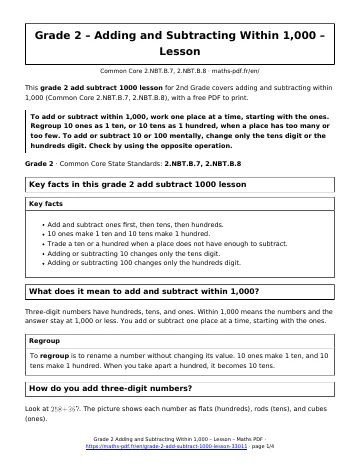
More 2nd Grade math
Lessons
See all One- and Two-Step Word Problems Lesson: Notes and Examples
- Skip Counting and Comparing Numbers Lesson: Notes and Examples
- Place Value to 1,000 Lesson: Notes and Examples
- Fluency Within 20, Even and Odd Numbers Lesson: Notes and Examples
- Arrays and Equal Groups Lesson: Notes and Examples
- Shapes and Equal Shares Lesson: Notes and Examples



Worksheets
See all- Fluency Within 20, Even and Odd Numbers Worksheets with Answers
- Place Value to 1,000 Worksheets with Answers
- Skip Counting and Comparing Numbers Worksheets with Answers
- Shapes and Equal Shares Worksheets with Answers
- Adding Within 100 Worksheets with Answers
- Telling Time to Five Minutes Worksheets with Answers



Tests
See all



Quizzes
See all- Measuring Length Quiz: 10 Questions with Answers
- Shapes and Equal Shares Quiz: 10 Questions with Answers
- Adding Within 100 Quiz: 10 Questions with Answers
- Picture Graphs, Bar Graphs and Line Plots Quiz: 10 Questions with Answers
- Adding and Subtracting Within 1,000 Quiz: 10 Questions with Answers
- Arrays and Equal Groups Quiz: 10 Questions with Answers