2nd Grade Adding Within 100 Lesson: Notes and Examples (Free PDF)

This 2nd grade addition within 100 lesson covers adding within 100 (Common Core 2.NBT.B.5, 2.NBT.B.6), with a free PDF to print.
Key takeaway: This lesson helps Grade 2 students add two-digit numbers within 100 using place value.
- Topic: Adding Within 100 (2nd grade)
- Content: One-page lesson with a definition, a worked example and key facts
- Standards: 2.NBT.B.5, 2.NBT.B.6
- Answers: Explanations included
- Format: Free printable PDF, US Letter, black and white
Key takeaway: A clear Grade 2 lesson on Adding Within 100, with definitions, rules and worked examples: how do you add two-digit numbers, what is regrouping when you add and how can you add on a number line. Read it before the practice worksheet; free to print or download as a PDF.
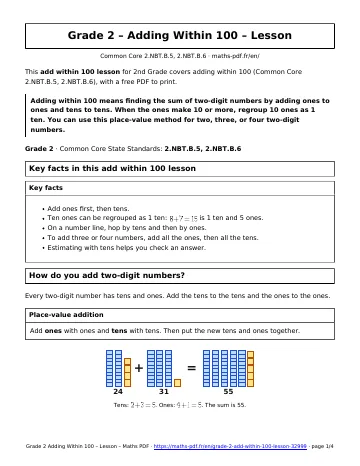
Adding within 100 means finding the sum of two-digit numbers by adding ones to ones and tens to tens. When the ones make 10 or more, regroup 10 ones as 1 ten. You can use this place-value method for two, three, or four two-digit numbers.
This lesson helps Grade 2 students add two-digit numbers within 100 using place value. Children learn to add ones and tens, regroup ten ones as one ten, and use number lines and blocks to see why the method works.
The lesson starts with adding tens and adding a one-digit number to a two-digit number. It then moves to sums that need regrouping, such as 36 + 27, and to adding three and four numbers in a column. It also shows how rounding to tens gives an estimate. Plan about 15 minutes, with base-ten blocks on the table.
Grade 2 · Common Core State Standards: 2.NBT.B.5, 2.NBT.B.6
Key facts in this 2nd grade addition within 100 lesson
- Add ones first, then tens.
- Next, ten ones can be regrouped as 1 ten: \(8 + 7 = 15\) is 1 ten and 5 ones.
- On a number line, hop by tens and then by ones.
- Then, to add three or four numbers, add all the ones, then all the tens.
- Estimating with tens helps you check an answer.
How do you add two-digit numbers?
Every two-digit number has tens and ones. Add the tens to the tens and the ones to the ones.
What is regrouping when you add?
Sometimes the ones add up to 10 or more. Ten ones are the same as one ten. You trade them for a ten rod. This trade is called regrouping.
How can you add on a number line?
Hop by tens first, then hop by ones. To add \(46 + 27\), hop 20 and then 7.
How do you add three or four two-digit numbers?
Add all the ones first. Look for pairs that make 10, like 8 and 2. Then add all the tens, plus any new tens.
Why does regrouping work?
Ten ones and one ten are worth the same amount. Picture a bag of 15 pennies. You can swap 10 pennies for 1 dime. Now you have 1 dime and 5 pennies. The total did not change, only the way you grouped it. Regrouping in addition works the same way, so a new ten goes into the tens column.
What are the steps? Try this method.
- Line up the numbers so the tens are over tens and the ones are over ones.
- Add the ones: \(6 + 7 = 13\). That is 1 ten and 3 ones. Write 3 in the ones place.
- Add the tens, plus the new ten: \(5 + 2 + 1 = 8\).
- Write the answer: \(56 + 27 = 83\).
Check your work by estimating. 56 is close to 60 and 27 is close to 30. Since 60 and 30 make 90, an answer near 83 makes sense.
2nd grade addition within 100 lesson: questions and answers
What does regrouping mean in addition?
Regrouping means trading 10 ones for 1 ten. If the ones add up to 13, you write 3 ones and move 1 ten to the tens column.
Should I add the ones or the tens first?
Add the ones first. Then you know if there is a new ten to add to the tens column.
How can I add on a number line?
Start at the first number. Hop by tens, then hop by ones. The last landing spot is the sum. For \(46 + 27\) hop 20, then 7.
How do I add four two-digit numbers?
Add the four ones digits first and regroup if the total is 10 or more. Then add the four tens digits and any new tens.
How can I check my addition?
Round both numbers to the nearest ten and add. The answer should be close. You can also add in a different order and get the same sum.
Common mistakes with this 2nd grade addition within 100 lesson
- Students add 28 + 15 as 313 by writing the sums of each column side by side. Ones make 13, so write 3 and carry 1 ten to the tens column.
- Children forget to add the carried ten and get 33 for 28 + 15. Write the small 1 above the tens column so it is added with 2 and 1 to get 4 tens.
- When adding four numbers, students lose track of the ones. Add all the ones first, write the total, then add all the tens including any regrouped ten.
How to study this chapter
- Build both numbers with blocks and push the ones together. When ten cubes appear, snap them into a rod. That is regrouping, and it is easy to see.
- Round both numbers to the nearest ten and add. 57 + 25 is about 60 + 30 = 90. The actual answer, 82, is close, so it makes sense.
- Also, parents can ask for sums that go over 100 or reach exactly 100, like 64 + 36. These show how hundreds begin and prepare for Grade 3.
Download the 2nd grade addition within 100 lesson as a PDF with the button below and keep it with your notes.
More questions about 2nd grade addition within 100 lesson
What does carrying mean in two-digit addition?
Carrying means moving ten ones to the tens column as one ten. If the ones add to 13, write 3 in the ones column and carry 1 ten. The ten is then added to the other tens. It is the same as regrouping.
Why do we add the ones before the tens?
Ones come first because adding them may make a new ten that must be added in the tens column. If you add tens first, you may have to go back and fix the answer. Starting at the right keeps the work in order.
How do you add numbers on a number line?
Start at the first number, hop by tens, then hop by ones. To add 57 + 25, hop 20 to 77, then hop 5 to 82. Breaking the second number into tens and ones makes the jumps easy, and it shows the same answer as the column method.
All Grade 2 chapters: Grade 2 math.
More 2nd Grade math
Lessons
See all Skip Counting and Comparing Numbers Lesson: Notes and Examples
- Place Value to 1,000 Lesson: Notes and Examples
- Money: Dollars and Coins Lesson: Notes and Examples
- One- and Two-Step Word Problems Lesson: Notes and Examples
- Measuring Length Lesson: Notes and Examples
- Shapes and Equal Shares Lesson: Notes and Examples





Worksheets
See all- Place Value to 1,000 Worksheets with Answers
- Picture Graphs, Bar Graphs and Line Plots Worksheets with Answers
- Skip Counting and Comparing Numbers Worksheets with Answers
- Shapes and Equal Shares Worksheets with Answers
- Subtracting Within 100 Worksheets with Answers
- Measuring Length Worksheets with Answers




Tests
See all





Quizzes
See all- Adding and Subtracting Within 1,000 Quiz: 10 Questions with Answers
- Subtracting Within 100 Quiz: 10 Questions with Answers
- Adding Within 100 Quiz: 10 Questions with Answers
- Place Value to 1,000 Quiz: 10 Questions with Answers
- Fluency Within 20, Even and Odd Numbers Quiz: 10 Questions with Answers
- Telling Time to Five Minutes Quiz: 10 Questions with Answers