Algebra 1 Exponent Rules and Radicals Worksheet Answer Key (PDF)


This exponent rules worksheet answers for Algebra 1 covers exponent rules and radicals (Common Core N-RN.A.1, N-RN.A.2, N-RN.B.3), with a free PDF to print.
Key takeaway: This answer key helps Algebra 1 students check their work on the exponent rules and radicals worksheet and see how each answer was built.
- Topic: Exponent Rules and Radicals (Algebra 1)
- Content: Step-by-step answers to 21 worksheet problems
- Standards: N-RN.A.1, N-RN.A.2, N-RN.B.3
- Answers: Every step shown, with the method to review
- Format: Free printable PDF, US Letter, black and white
This answer key helps Algebra 1 students check their work on the exponent rules and radicals worksheet and see how each answer was built. All 21 solutions show the rule used at each step.
Open it after you finish a section, not before. For each problem the key writes the simplified form, then the intermediate line that explains it. Also, the answers cover whole-number powers, zero and negative exponents, radicals in simplest form, rational exponents, rational versus irrational numbers, and the five applied problems. Then, use the notes beside worksheet problems 16 to 21 to see how a word problem turns into a power.
Key takeaway: This answer key for the Algebra 1 worksheet on Exponent Rules and Radicals shows every step and the rule used. Check your work after trying the problems alone; free PDF.
Algebra 1 · Common Core State Standards: N-RN.A.1, N-RN.A.2, N-RN.B.3
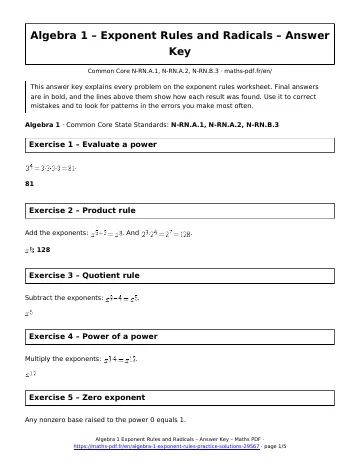
Exponent rules worksheet answers: worksheet problems 1 to 10
1 – Evaluate a power
\(3^{4} = 3 \cdot 3 \cdot 3 \cdot 3 = 81\).
81
2 – Product rule
Add the exponents: \(x^{5 + 3} = x^{8}\). And \(2^{3} \cdot 2^{4} = 2^{7} = 128\).
\(x^{8}\); 128
3 – Quotient rule
Subtract the exponents: \(x^{9 – 4} = x^{5}\).
\(x^{5}\)
4 – Power of a power
Multiply the exponents: \(x^{3 \cdot 4} = x^{12}\).
\(x^{12}\)
5 – Zero exponent
Any nonzero base raised to the power 0 equals 1.
1, 1, and 1
6 – Negative exponent
\(3^{-2} = \frac{1}{3^{2}} = \frac{1}{9}\).
\(\frac{1}{9}\)
7 – Power of a product
Apply the power to each factor: \(2^{3} \cdot (x^{4})^{3} = 8x^{12}\).
\(8x^{12}\)
8 – Negative exponent in a term
Only \(x\) has the negative exponent: \(4x^{-2} = \frac{4}{x^{2}}\).
\(\frac{4}{x^{2}}\)
9 – Quotient of monomials
Divide coefficients: \(6 \div 2 = 3\). Subtract exponents: \(x^{5-2} = x^{3}\), \(y^{2-1} = y\).
\(3x^{3}y\)
10 – Several rules
Square each factor: \(2^{2}x^{6}y^{-4} = 4x^{6}y^{-4}\).
Move \(y^{-4}\) to the denominator.
\(\frac{4x^{6}}{y^{4}}\)
Worksheet problems 11 and up
11 – Simplify a radical
The greatest perfect square factor is 16: \(\sqrt{48} = \sqrt{16 \cdot 3}\).
\(= 4\sqrt{3}\).
\(4\sqrt{3}\)
12 – Simplify another radical
Also, the greatest perfect square factor is 100: \(\sqrt{200} = \sqrt{100 \cdot 2} = 10\sqrt{2}\).
\(10\sqrt{2}\)
13 – Rational exponents
\(25^{1/2} = \sqrt{25} = 5\).
\(27^{2/3} = (\sqrt[3]{27})^{2} = 3^{2} = 9\).
\(16^{3/4} = (\sqrt[4]{16})^{3} = 2^{3} = 8\).
5, 9, and 8
14 – Radical and exponent forms
Also, the exponent \(\frac{1}{2}\) means a square root: \(5^{1/2} = \sqrt{5}\).
The cube root of \(x^{2}\) is \(x^{2/3}\).
\(\sqrt{5}\); \(x^{2/3}\)
15 – Rational or irrational
\(\sqrt{9} = 3\) is rational. \(\sqrt{10}\) is not a perfect square, so it is irrational. \(0.\overline{3} = \frac{1}{3}\) is rational. \(\pi\) is irrational.
rational, irrational, rational, irrational
16 – Bacteria
\(P = 100 \cdot 2^{6} = 100 \cdot 64 = 6400\).
6,400 bacteria
17 – Computer memory
\(2^{10} \cdot 2^{10} = 2^{20}\).
\(2^{20} = 1{,}048{,}576\).
\(2^{20}\) = 1,048,576 bytes
18 – Square garden
Side = \(\sqrt{75} = \sqrt{25 \cdot 3} = 5\sqrt{3}\).
Since \(\sqrt{3} \approx 1.732\), the side is about \(5(1.732) \approx 8.66\).
\(5\sqrt{3}\) ft ≈ 8.66 ft
Worksheet problem 19 and after
19 – Falling object
\(t = \frac{\sqrt{64}}{4} = \frac{8}{4} = 2\) seconds.
\(t = \frac{\sqrt{50}}{4} = \frac{5\sqrt{2}}{4}\) seconds, about 1.77 seconds.
2 s; \(\frac{5\sqrt{2}}{4}\) s
20 – Explain irrational sums
Suppose the sum were a rational number \(r\). Then \(\sqrt{2} = r – \frac{1}{2}\).
A difference of two rational numbers is rational, so \(\sqrt{2}\) would be rational. But \(\sqrt{2}\) is irrational. This contradiction shows the sum is irrational.
The sum is irrational
21 – Sunlight travel time
\(\frac{9.3 \times 10^{7}}{1.86 \times 10^{5}} = \frac{9.3}{1.86} \times 10^{7-5}\).
\(= 5 \times 10^{2} = 500\).
500 seconds
Key facts behind this exponent rules worksheet answers
- Product rule: aᵐ · aⁿ = aᵐ⁺ⁿ; quotient rule: aᵐ / aⁿ = aᵐ⁻ⁿ.
- Power rule: (aᵐ)ⁿ = aᵐⁿ.
- a⁰ = 1 and a⁻ⁿ = 1/aⁿ for a ≠ 0.
- Then, a^(1/2) = √a, and a^(m/n) is the n-th root of a raised to the m.
- A rational plus an irrational number is irrational.
Common mistakes with this exponent rules worksheet answers
- Students stop reading the key when the final answer matches. A correct answer reached by a wrong rule will fail on the next problem, so read the rule too.
- Students compare a decimal answer with a radical answer and call it wrong. Worksheet problem 18 gives both forms, so check the exact form and the rounded form.
- Students forget to put answers with negative exponents into positive form when the problem asks for it. Reread the instruction line for worksheet problem 10.
How to use these solutions
- Circle the rule named in the key for every missed problem. If one rule is circled three times, reread that part of the lesson.
- Redo the missed problems with new numbers, changing the exponent but keeping the structure. That proves the idea has moved, not just the answer.
- Parents can ask which of the four rules a problem used and why. Naming the rule matters more than the arithmetic.
Download the exponent rules worksheet answers as a PDF with the button below and keep it with your notes.
Exponent rules worksheet answers: frequently asked questions
Why does the key write radicals instead of decimals?
Because a radical such as \(5\sqrt{3}\) is exact, while a decimal is only an approximation. Teachers expect the exact form unless the question asks for a rounded number. When both appear, the key shows the exact form first and then the decimal.
How do I check an exponent simplification?
Substitute a small number for the variable in the original and in the answer, and compare the two values. For example, try \(x = 2\) in both. If the results differ, a rule was applied incorrectly. In other words, this check takes less than a minute.
What if my answer is equivalent but written differently?
Equivalent answers are fine if the problem allows them, but many problems require positive exponents or simplest radical form. Then, check the instruction. If the key shows \(\frac{4}{x^{2}}\) and you wrote \(4x^{-2}\), the second form does not meet a positive-exponent instruction.
All Algebra 1 chapters: Algebra 1 math.
More Algebra 1 math
Lessons
See all Exponential Functions and Growth Lesson: Notes and Examples
- Graphing Quadratic Functions and Transformations Lesson: Notes and Examples
- Linear Inequalities in Two Variables and Systems Lesson: Notes and Examples
- Slope and Rate of Change Lesson: Notes and Examples
- Scatter Plots, Lines of Fit and Two-Way Tables Lesson: Notes and Examples
- Writing Linear Equations and Functions Lesson: Notes and Examples






Worksheets
See all- Solving Linear Equations in One Variable Worksheets with Answers
- Exponent Rules and Radicals Worksheets with Answers
- Solving Quadratic Equations Worksheets with Answers
- Systems of Linear Equations Worksheets with Answers
- Adding, Subtracting and Multiplying Polynomials Worksheets with Answers
- Functions and Function Notation Worksheets with Answers






Tests
See all- Exponential Functions and Growth Test with Answer Key
- Structure of Algebraic Expressions Test with Answer Key
- Adding, Subtracting and Multiplying Polynomials Test with Answer Key
- Scatter Plots, Lines of Fit and Two-Way Tables Test with Answer Key
- Factoring Polynomials Test with Answer Key
- Writing Linear Equations and Functions Test with Answer Key






Quizzes
See all- Factoring Polynomials Quiz: 10 Questions with Answers
- Exponent Rules and Radicals Quiz: 10 Questions with Answers
- Exponential Functions and Growth Quiz: 10 Questions with Answers
- Structure of Algebraic Expressions Quiz: 10 Questions with Answers
- Linear Inequalities in Two Variables and Systems Quiz: 10 Questions with Answers
- Slope and Rate of Change Quiz: 10 Questions with Answers