2nd Grade One- and Two-Step Word Problems Worksheets with Answers (Free PDF)
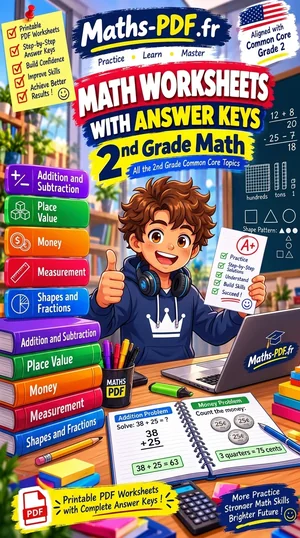
This 2nd grade word problems worksheet covers one- and two-step word problems (Common Core 2.OA.A.1), with a free PDF to print.
Key takeaway: This worksheet helps Grade 2 students practice one-step and two-step word problems.
- Topic: One- and Two-Step Word Problems (2nd grade)
- Content: 20 worksheet problems, from easy to challenging
- Standards: 2.OA.A.1
- Answers: On a separate page, so you can try every worksheet problem first
- Format: Free printable PDF, US Letter, black and white
This worksheet helps Grade 2 students practice one-step and two-step word problems. First, children solve add to, take from, put together, and take apart stories. Then they compare amounts and find missing changes and starts.
The set includes stories about cookies, books, marbles, stickers, pencils, apples, tickets, and beads. Next, children solve two-step problems with two numbers to find first. Finally, they work on a race to 100 points. Plan about 30 minutes, and let children draw bar models. Also, a pencil and scratch paper help children show each step.
These 20 problems practice one- and two-step word problems within 100. Students add to, take from, put together, take apart, and compare, and they also find unknowns at the start, the change, or the result.
The work follows Common Core standard 2.OA.A.1. Early problems are one step; the last six need two steps and bar models.
Key takeaway: This Grade 2 worksheet on One- and Two-Step Word Problems gives 20 problems, from warm-up questions to harder applications. The answer key is on a separate page; free printable PDF.
Grade 2 · Common Core State Standards: 2.OA.A.1
2nd grade word problems worksheet: worksheet problems 1 to 10
1 – Cookies at the bake sale
2 – Library shelf
3 – Marbles in two jars
4 – Stars and moons
5 – Pencil gap
6 – Fewer apples
7 – Extra raffle tickets
8 – Birds on the wire
Worksheet problem 9 and after
9 – Birthday cards
10 – Beads for bracelets
Worksheet problems 11 and up
11 – Buttons
12 – Crayon boxes
13 – Tickets by day
14 – Farmers market apples
15 – Sticker trade
16 – Pages read
17 – Class on field day
18 – Bead totals
Worksheet problem 19 and after
19 – Race to 100 points
20 – Crayon colors

Key facts behind this 2nd grade word problems worksheet
- Five story types: add to, take from, put together, take apart, and compare.
- Next, a bar model shows the parts and the whole so you can see which number is missing.
- More than and fewer than mean comparing: subtract the smaller number from the larger.
- Then, a two-step problem needs two math sentences; the first answer feeds the second.
- A ? or a letter can stand for the unknown number in an equation.
Common mistakes with this 2nd grade word problems worksheet
- When a story asks how many more, students add the two numbers. Instead, subtract the smaller from the larger. For example, 40 compared with 25 differs by 15.
- When the start is unknown, students subtract when they should add. For example, if some were taken away and 30 are left, add the taken amount to 30.
- In two-step problems, students use the wrong number in the second step. First, write the answer to step one. Then use it in step two.
Tips before you start the worksheet problems
- Draw a bar model for every problem. The bar shows which number is the whole and which parts are known.
- Underline the question in each story. Then check that your final answer matches what was asked. Then check the result once more before moving on.
- Teachers can ask students to write their own story for an equation. Writing a story shows deeper understanding. In other words, slow and careful work pays off here.
Download the 2nd grade word problems worksheet as a PDF with the button below and keep it with your notes.
2nd grade word problems worksheet: frequently asked questions
Why do some stories have more than one answer step?
Some problems have a hidden question that must be answered first. For example, you may need the total before you can find what is left. Writing a sentence for each step keeps the work clear. In other words, slow and careful work pays off here.
What does fewer than mean in a word problem?
Fewer than means a comparison where one amount is smaller. To find the smaller amount, subtract the difference from the larger. For example, if someone has 10 fewer than 50, the amount is 50 – 10. As a result, small mistakes are easier to catch.
How can drawing help with word problems?
A drawing shows the story. A bar model separates parts and whole, and a number line shows jumps. As a result, you can see which operation fits before you calculate. Also, saying the steps aloud helps you spot a slip.
All Grade 2 chapters: Grade 2 math.

More 2nd Grade math
Lessons
See all Arrays and Equal Groups Lesson: Notes and Examples
- Place Value to 1,000 Lesson: Notes and Examples
- Subtracting Within 100 Lesson: Notes and Examples
- Skip Counting and Comparing Numbers Lesson: Notes and Examples
- Telling Time to Five Minutes Lesson: Notes and Examples
- Adding Within 100 Lesson: Notes and Examples




Worksheets
See all- Place Value to 1,000 Worksheets with Answers
- Shapes and Equal Shares Worksheets with Answers
- Money: Dollars and Coins Worksheets with Answers
- Picture Graphs, Bar Graphs and Line Plots Worksheets with Answers
- Telling Time to Five Minutes Worksheets with Answers
- Skip Counting and Comparing Numbers Worksheets with Answers





Tests
See all- Picture Graphs, Bar Graphs and Line Plots Test with Answer Key
- Skip Counting and Comparing Numbers Test with Answer Key
- Fluency Within 20, Even and Odd Numbers Test with Answer Key
- Arrays and Equal Groups Test with Answer Key
- Measuring Length Test with Answer Key
- Adding and Subtracting Within 1,000 Test with Answer Key



Quizzes
See all- Fluency Within 20, Even and Odd Numbers Quiz: 10 Questions with Answers
- Shapes and Equal Shares Quiz: 10 Questions with Answers
- Arrays and Equal Groups Quiz: 10 Questions with Answers
- Place Value to 1,000 Quiz: 10 Questions with Answers
- Skip Counting and Comparing Numbers Quiz: 10 Questions with Answers
- Adding Within 100 Quiz: 10 Questions with Answers