7th Grade Compound Events and Simulations Test Answer Key and Scoring Guide (PDF)

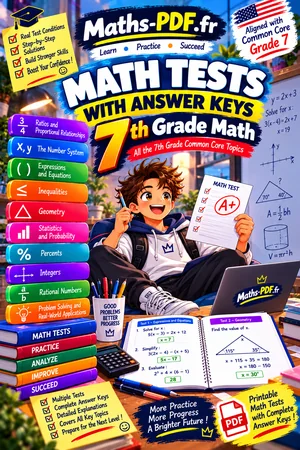
This 7th grade compound probability test answer key covers compound events and simulations (Common Core 7.SP.C.8), with a free PDF to print.
Key takeaway: This test answer key helps Grade 7 teachers and students score the compound events test.
- Topic: Compound Events and Simulations (7th grade)
- Content: Worked solutions and a scoring guide for 9 questions
- Standards: 7.SP.C.8
- Answers: Every step shown, with the method to review
- Format: Free printable PDF, US Letter, black and white
This test answer key helps Grade 7 teachers and students score the compound events test. Each of the 9 questions has a worked solution, and the key shows how the 20 points are earned.
Questions 1 to 7 are worth 2 points each, usually one for the sample space or setup and one for the probability. Question 3 gives 60 pizzas, question 4 gives nine twenty-fifths, and question 5 gives seven eighths. Questions 8 and 9 are worth 3 points each. Also, the notes show where partial credit applies, such as a correct list with an arithmetic slip.
Use this answer key and scoring guide to grade the compound events test. Each solution shows the full work, and the scoring note explains how the points are awarded. Give partial credit for correct steps even when the final answer is wrong.
Key takeaway: Worked answers for the Grade 7 test on Compound Events and Simulations, with the scoring for each problem. Use it to grade yourself after a timed attempt; free PDF.
Grade 7 · Common Core State Standards: 7.SP.C.8
7th grade compound probability test answer key: worked solutions
1 – Sample space [2 pts]
A1, A2, A3, B1, B2, B3.
Also, a with an odd number: A1, A3, which is 2 of 6.
\(\frac{2}{6}=\frac{1}{3}\)
6 outcomes; \(\frac{1}{3}\)
Scoring: 1 point for the sample space; 1 point for the probability.
2 – Two dice [2 pts]
Sum 8 occurs 5 times: \(\frac{5}{36}\).
Sums less than 4: 2 (once) and 3 (twice) = 3 outcomes: \(\frac{3}{36}=\frac{1}{12}\)
\(\frac{5}{36}\); \(\frac{1}{12}\)
Scoring: 1 point for each probability.
3 – Counting principle [2 pts]
\(3\times 4\times 5=60\).
\(\frac{1}{60}\)
60 pizzas; \(\frac{1}{60}\)
Scoring: 1 point for the count; 1 point for the probability.
4 – With replacement [2 pts]
\(\frac{3}{5}\times\frac{3}{5}=\frac{9}{25}\)
\(\frac{9}{25}\)
Scoring: 1 point for each probability used; the product earns the second point.
5 – At least one [2 pts]
All outcomes: 8. No heads: TTT only, so \(\frac{1}{8}\).
\(1-\frac{1}{8}=\frac{7}{8}\)
\(\frac{7}{8}\)
Scoring: 1 point for P(no heads); 1 point for the complement.
6 – Design a simulation [2 pts]
Let 0, 1, 2 mean blue and 3 to 9 mean not blue (3 of 10 = 30%).
Read three digits per trial; count trials with at least one of 0, 1, 2; divide by the number of trials.
Digits 0 to 2 = blue
Scoring: 1 point for the digit assignment; 1 point for the counting plan.
Question 7 and after
7 – Simulation results [2 pts]
Check each trial for a digit 0, 1, or 2.
Hits: 912, 057, 616, 249, 130, 552, 408, 792. The trials 384 and 877 have none.
That is 8 of 10, so the estimate is 0.8.
0.8
Scoring: 1 point for identifying hits; 1 point for the estimate.
8 – Spinner and coin [3 pts]
- \(4\times 2=8\) outcomes.
- 2H and 4H: \(\frac{2}{8}=\frac{1}{4}\).
- 3T and 4T: \(\frac{2}{8}=\frac{1}{4}\).
Scoring: 1 point for each part.
9 – Dice differences [3 pts]
- \(6\times 6=36\).
- Pairs: (1,2), (2,3), (3,4), (4,5), (5,6) and the reverses, 10 in all: \(\frac{10}{36}=\frac{5}{18}\).
- \(\frac{6}{36}=\frac{1}{6}\).
Scoring: 1 point for each part.
Total score
20 points
Key facts behind this 7th grade compound probability test answer key
- A compound event has two or more stages, such as two coin tosses.
- Next, the sample space lists every possible outcome.
- Counting principle: \(m \times n\) outcomes for two stages with m and n ways.
- Equally likely outcomes: \(P = favorable \div total\).
- A simulation uses random numbers to estimate a probability.
Common mistakes with this 7th grade compound probability test answer key
- Giving no credit for a correct list with a wrong fraction. Instead, award the setup point and take off only the answer point.
- Accepting a probability greater than 1 as correct. A probability must lie between 0 and 1, so ask the student to recount.
- Overlooking the simulation rule in question 6. Also, the answer needs a digit rule, a trial length, and a way to count.
How to learn from your test
- First, ask students to redo each missed question with a tree or a table. Then they compare it with the key.
- Also sort errors into counting, replacement, and simulation. In addition, the largest group shows what to review.
- Teachers can follow up with a new compound event, such as a spinner and a die.
Download the 7th grade compound probability test answer key as a PDF with the button below and keep it with your notes.
7th grade compound probability test answer key: frequently asked questions
How is the answer to question 4 found?
The bag has 3 green and 2 yellow marbles, so the probability of green is three fifths. Because the marble is replaced, both draws have this probability. The product is three fifths times three fifths, which is nine twenty-fifths.
How is the answer to question 5 found?
Three tosses have 8 outcomes, and only one has no heads. So the probability of no heads is one eighth. Subtracting from 1 gives seven eighths for at least one head.
What does full credit on question 3 include?
It multiplies 3, 4, and 5 to get 60 different pizzas. Then it gives the probability of one specific pizza as one sixtieth, since all pizzas are equally likely. Each part earns a point.
All Grade 7 chapters: Grade 7 math.
Free printable PDF
7th Grade Compound Events and Simulations Test Answer Key and Scoring Guide
Download PDF
More 7th Grade math
Lessons
See all Random Sampling and Inference Lesson: Notes and Examples
- Multiplying and Dividing Rational Numbers Lesson: Notes and Examples
- Compound Events and Simulations Lesson: Notes and Examples
- Circumference and Area of Circles Lesson: Notes and Examples
- Solving Two-Step Equations Lesson: Notes and Examples
- Comparing Two Populations Lesson: Notes and Examples



Worksheets
See all- Multiplying and Dividing Rational Numbers Worksheets with Answers
- Probability and Probability Models Worksheets with Answers
- Percent Problems: Tax, Tips, Discounts and Markups Worksheets with Answers
- Multistep Problems with Rational Numbers Worksheets with Answers
- Angle Relationships and Equations Worksheets with Answers
- Adding and Subtracting Rational Numbers Worksheets with Answers

Tests
See all- Angle Relationships and Equations Test with Answer Key
- Multistep Problems with Rational Numbers Test with Answer Key
- Random Sampling and Inference Test with Answer Key
- Cross-Sections of Three-Dimensional Figures Test with Answer Key
- Two-Step Inequalities Test with Answer Key
- Unit Rates with Fractions Test with Answer Key



Quizzes
See all- Cross-Sections of Three-Dimensional Figures Quiz: 10 Questions with Answers
- Two-Step Inequalities Quiz: 10 Questions with Answers
- Adding and Subtracting Rational Numbers Quiz: 10 Questions with Answers
- Area, Volume and Surface Area Quiz: 10 Questions with Answers
- Comparing Two Populations Quiz: 10 Questions with Answers
- Percent Problems: Tax, Tips, Discounts and Markups Quiz: 10 Questions with Answers