7th Grade Cross-Sections of Three-Dimensional Figures Test with Answer Key (Free PDF)

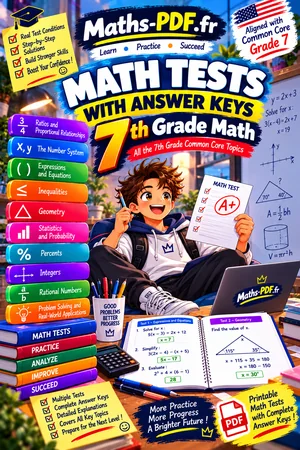
This 7th grade cross sections test covers cross-sections of three-dimensional figures (Common Core 7.G.A.3), with a free PDF to print.
Key takeaway: This test helps Grade 7 students show that they can name and measure cross-sections of prisms and pyramids.
- Topic: Cross-Sections of Three-Dimensional Figures (7th grade)
- Content: 9 questions with point values, about 45 minutes
- Standards: 7.G.A.3
- Answers: On a separate page, so you can try every worksheet problem first
- Format: Free printable PDF, US Letter, black and white
This test helps Grade 7 students show that they can name and measure cross-sections of prisms and pyramids. It takes 45 minutes and is worth 20 points.
The test has 9 questions. Question 1 cuts a prism parallel to its base, and question 2 uses a side face. Questions 3 and 4 cut a pyramid parallel to the base and through the apex. Question 5 names cross-sections in several cases, and question 6 scales a pyramid cut. Question 7 uses a box filled with sand. Questions 8 and 9 are worth 3 points each and use two planes on a pyramid and a corner cut of a cube.
This 45-minute test checks the two-dimensional shapes made when planes slice right rectangular prisms and right rectangular pyramids, including slices parallel and perpendicular to a base (Common Core 7.G.A.3). It has 9 questions worth 20 points in all. Show your work, because most questions give partial credit for correct steps.
Key takeaway: This Grade 7 test on Cross-Sections of Three-Dimensional Figures works as a class assessment or a timed review at home: time and points, 7th grade cross sections test: questions and test-taking strategy. The detailed answer key with scoring is on a separate page; free PDF.
Time and points
- Grade: Grade 7
- Chapter: Cross-Sections of Three-Dimensional Figures
- Standards: 7.G.A.3
- Time: 45 minutes
- Total: 20 points
7th grade cross sections test: questions
1 – Prism slice [2 pts]
First, name the shape of the cross-section and find its dimensions and area.
2 – Vertical slice [2 pts]
3 – Pyramid slice [2 pts]
Then, find the side length and area of the square cross-section.
4 – Through the apex [2 pts]
Now, name the shape of the cross-section and find its area.
5 – Name the slice [2 pts]
6 – Area comparison [2 pts]
Question 7 and after
7 – Storage box [2 pts]
8 – Two cuts [3 pts]
- Find the side and area of the cross-section made by plane A. (1 point)
- Find the shape and area of the cross-section made by plane B. (1 point)
- Which cross-section has the greater area? By how much? (1 point)
9 – Cube cuts [3 pts]
- A plane parallel to a face cuts the cube. Name the shape and find the area. (1 point)
- A plane cuts off a corner by meeting three faces. Name the shape. (1 point)
- Explain why a plane parallel to a face of a cube can never give a triangle. (1 point)

Key facts behind this 7th grade cross sections test
- A cross-section is the flat shape where a plane meets a solid.
- Prism slice parallel to a face: a rectangle congruent to that face.
- Pyramid slice parallel to the base: a smaller rectangle similar to the base.
- Pyramid slice through the apex and perpendicular to the base: a triangle.
- A slanted plane can give a triangle, trapezoid, or other polygon.
Common mistakes with this 7th grade cross sections test
- Naming a cut through the apex of a pyramid as a square. Also, a vertical plane through the apex meets the pyramid in a triangle.
- Using the base dimension for a cut that is closer to the apex. Scale the base by the fraction of the height that remains above the cut.
- Stopping at the area of the sand surface when a question also asks for the volume of sand. Instead, multiply the area by the depth.
Test-taking strategy
- First, sketch every cut and mark the plane. Then name the shape before you calculate.
- Also write the scale factor as a fraction for each pyramid question. Then multiply each side of the base by it.
- Parents can review the night before with a block of clay and a plastic knife. Then, ask the student to predict each shape before cutting.
Download the 7th grade cross sections test as a PDF with the button below and keep it with your notes.
7th grade cross sections test: frequently asked questions
How do I describe a cross-section on a test?
Name the shape and give its dimensions. For a cut parallel to the base of a box, say that the cross-section is a rectangle congruent to the base, and then give its length and width. A short sketch also earns credit.
How do I find the area of a triangle cross-section through the apex?
Find the base of the triangle from the base of the pyramid and its height from the height of the pyramid. Then use the formula of one half base times height. Then, label both lengths on your sketch.
How do I find a scale factor for a pyramid cut?
Divide the distance from the apex to the cut by the full height of the pyramid. For example, a cut 6 inches below the apex of a 9-inch pyramid has a scale factor of two thirds. Then, multiply every base length by it.
All Grade 7 chapters: Grade 7 math.
Free printable PDF
7th Grade Cross-Sections of Three-Dimensional Figures Test with Answer Key
Download PDF
More 7th Grade math
Lessons
See all Drawing Triangles from Given Conditions Lesson: Notes and Examples
- Probability and Probability Models Lesson: Notes and Examples
- Area, Volume and Surface Area Lesson: Notes and Examples
- Unit Rates with Fractions Lesson: Notes and Examples
- Compound Events and Simulations Lesson: Notes and Examples
- Cross-Sections of Three-Dimensional Figures Lesson: Notes and Examples






Worksheets
See all- Area, Volume and Surface Area Worksheets with Answers
- Solving Two-Step Equations Worksheets with Answers
- Solving Real-World Problems with Rational Numbers Worksheets with Answers
- Unit Rates with Fractions Worksheets with Answers
- Circumference and Area of Circles Worksheets with Answers
- Compound Events and Simulations Worksheets with Answers




Tests
See all- Circumference and Area of Circles Test with Answer Key
- Compound Events and Simulations Test with Answer Key
- Equivalent Linear Expressions Test with Answer Key
- Area, Volume and Surface Area Test with Answer Key
- Drawing Triangles from Given Conditions Test with Answer Key
- Multistep Problems with Rational Numbers Test with Answer Key






Quizzes
See all- Compound Events and Simulations Quiz: 10 Questions with Answers
- Area, Volume and Surface Area Quiz: 10 Questions with Answers
- Angle Relationships and Equations Quiz: 10 Questions with Answers
- Two-Step Inequalities Quiz: 10 Questions with Answers
- Unit Rates with Fractions Quiz: 10 Questions with Answers
- Scale Drawings Quiz: 10 Questions with Answers