6th Grade Ratios and Ratio Language Worksheet Answer Key (PDF)

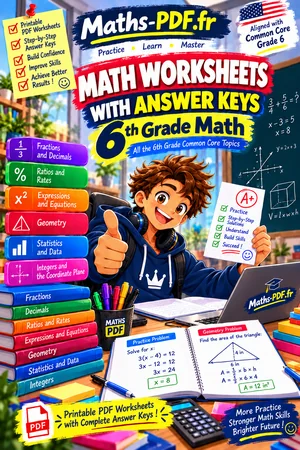
This 6th grade ratios worksheet answers covers ratios and ratio language (Common Core 6.RP.A.1), with a free PDF to print.
Key takeaway: This answer key helps Grade 6 students check their ratio work and see how each ratio was written, simplified, or scaled.
- Topic: Ratios and Ratio Language (6th grade)
- Content: Step-by-step answers to 20 worksheet problems
- Standards: 6.RP.A.1
- Answers: Every step shown, with the method to review
- Format: Free printable PDF, US Letter, black and white
This answer key helps Grade 6 students check their ratio work and see how each ratio was written, simplified, or scaled. All 20 worksheet problems have a worked solution, and the problems that use tape diagrams show the parts and the value of one part.
Use the key after you try each problem. First, worksheet problems 1 to 4 and 7 show the three ways to write a ratio in the correct order. Also, simplifying appears in worksheet problems 5, 8, 9, 10, and 12. Next, equivalence is explained in worksheet problems 11, 13, and 14. After that, the diagram and the sentence answer come with worksheet problems 15 to 19. Finally, worksheet problem 20 explains which lemonade has the stronger taste. Then, compare the order of your numbers as well as their values.
Key takeaway: Step-by-step answers to the Grade 6 worksheet on Ratios and Ratio Language, with the method behind each result. Check your work after trying the problems alone; free PDF.
Grade 6 · Common Core State Standards: 6.RP.A.1
6th grade ratios worksheet answers: worksheet problems 1 to 10
1 – Write a ratio
There are 3 red tiles and 5 blue tiles.
The ratio of red to blue is \(3:5\), or 3 to 5, or \(\frac{3}{5}\).
\(3:5\)
2 – Three ways to write it
Cats come first, dogs second.
\(4:7\), 4 to 7, \(\frac{4}{7}\)
\(4:7\)
3 – Part to whole
Part to whole: boys to all students.
The ratio is \(5:12\).
\(5:12\)
4 – Order matters
(a) Girls to boys: \(9:6\).
(b) Boys to girls: \(6:9\).
Also, the order of the numbers follows the order of the words.
(a) \(9:6\); (b) \(6:9\)
5 – Simplify a ratio
The greatest common factor of 12 and 18 is 6.
\(12 \div 6 = 2\) and \(18 \div 6 = 3\).
\(2:3\)
6 – Complete the equivalent ratio
\(3 \times 3 = 9\), so multiply 4 by 3 as well.
\(4 \times 3 = 12\)
\(9:12\)
7 – Fruit bowl
Total fruit: \(8 + 5 = 13\).
Apples to all fruit: \(8:13\).
\(8:13\)
8 – Basketball shots
Made to missed is \(9:6\).
Divide both numbers by 3: \(3:2\).
\(3:2\)
9 – Simplify with larger numbers
The greatest common factor is 12.
\(24 \div 12 = 2\), \(36 \div 12 = 3\).
\(2:3\)
10 – Same units
1 hour = 60 minutes, so the ratio is \(45:60\).
Divide both by 15: \(3:4\).
\(3:4\)
Worksheet problems 11 and up
11 – Three equivalent ratios
Multiply both numbers by the same number.
\(3 \times 2 : 7 \times 2 = 6:14\), \(3 \times 3 : 7 \times 3 = 9:21\), \(3 \times 4 : 7 \times 4 = 12:28\).
\(6:14\), \(9:21\), \(12:28\)
12 – Shapes in a quilt
The ratio is \(6:9\).
Divide both by 3.
\(2:3\)
13 – Are they equivalent?
\(6:9\) simplifies to \(2:3\) (divide by 3).
\(8:12\) simplifies to \(2:3\) (divide by 4).
Both simplify to \(2:3\).
Yes, they are equivalent.
14 – Not equivalent
\(4:6\) simplifies to \(2:3\).
\(6:10\) simplifies to \(3:5\).
\(2:3\) is not \(3:5\).
No, they are not equivalent.
15 – Trail mix
\(12 \div 3 = 4\), so the recipe is made 4 times.
\(2 \times 4 = 8\)
8 cups of raisins
16 – Mixing paint
\(15 \div 5 = 3\), so there are 3 batches.
\(3 \times 3 = 9\)
9 cups of red paint
17 – Little League record
Each group has \(3 + 2 = 5\) games.
\(20 \div 5 = 4\) groups.
Wins: \(3 \times 4 = 12\).
12 wins
Worksheet problem 18 and after
18 – Class ratio
Each group has \(4 + 5 = 9\) students.
\(27 \div 9 = 3\) groups.
Boys: \(4 \times 3 = 12\). Girls: \(5 \times 3 = 15\).
Check: \(12 + 15 = 27\).
12 boys and 15 girls
19 – Farmers market
Each group has \(5 + 3 = 8\) pieces.
\(64 \div 8 = 8\) groups.
Apples: \(5 \times 8 = 40\). Pears: \(3 \times 8 = 24\).
40 apples and 24 pears
20 – Which lemonade is stronger?
A: lemon to water is \(3:6\) = \(1:2\). That is 1 cup of lemon juice for every 2 cups of water.
B: \(4:12\) = \(1:3\). That is 1 cup of lemon juice for every 3 cups of water.
A has more lemon juice for the same amount of water.
Lemonade A is stronger.
Key facts behind this 6th grade ratios worksheet answers
- A ratio compares two quantities and can be written a:b, a to b, or a/b.
- Next, order matters: the first number matches the first quantity named.
- Ratios can compare part to part or part to whole.
- Then, multiply or divide both numbers by the same nonzero number to make equivalent ratios.
- A tape diagram splits a total into equal parts to solve ratio problems.
Common mistakes with this 6th grade ratios worksheet answers
- Marking a ratio wrong because it is in a different form from the key. Also, the forms 3:2, 3 to 2, and three halves are all acceptable if the order is right.
- Accepting an unsimplified ratio where the problem asks for simplest form. Also, a ratio such as 6 to 4 needs to be reduced to 3 to 2.
- Missing the units in word problems. Also, the key ends worksheet problem 17 with 12 wins and worksheet problem 18 with 12 boys and 15 girls.
How to use these solutions
- When your answer differs from the key, check the order of the quantities first. Also, a swapped order is the most common source of wrong answers.
- Check a scaled ratio by dividing both numbers by the multiplier. You should return to the original ratio.
- Parents can ask the student to explain how the key found the value of one part in worksheet problem 19 and why it was divided by 8.
Download the 6th grade ratios worksheet answers as a PDF with the button below and keep it with your notes.
6th grade ratios worksheet answers: frequently asked questions
How can I check a simplified ratio?
Divide both numbers by their greatest common factor and confirm that the results share no factor other than 1. For 24 to 36, the greatest common factor is 12, so the simplest form is 2 to 3, and 2 and 3 share nothing.
Why does the key add the parts of the ratio first?
The sum of the parts is the number of equal pieces in the total. For apples to pears in the ratio 5 to 3, there are 8 pieces. If 64 pieces of fruit were sold, each piece is 8, so there are 40 apples.
How do I know which lemonade is stronger?
Compare the amount of lemon juice for the same amount of water. Lemonade A has 1 cup of juice for every 2 cups of water, while B has 1 for every 3. A has more juice per cup of water, so it is stronger.
All Grade 6 chapters: Grade 6 math.

More 6th Grade math
Lessons
See all Converting Measurement Units with Ratios Lesson: Notes and Examples
- Unit Rates and Rate Language Lesson: Notes and Examples
- Solving One-Step Equations Lesson: Notes and Examples
- Equivalent Expressions and the Distributive Property Lesson: Notes and Examples
- Inequalities on the Number Line Lesson: Notes and Examples
- Writing and Reading Algebraic Expressions Lesson: Notes and Examples






Worksheets
See all- Solving One-Step Equations Worksheets with Answers
- Area of Triangles and Polygons Worksheets with Answers
- Percent as a Rate per 100 Worksheets with Answers
- Writing and Reading Algebraic Expressions Worksheets with Answers
- Ordering Rational Numbers and Absolute Value Worksheets with Answers
- Statistical Questions and Data Displays Worksheets with Answers






Tests
See all- Nets and Surface Area Test with Answer Key
- Ratio Tables and Graphs of Ratios Test with Answer Key
- Dividing Fractions by Fractions Test with Answer Key
- Integers and Rational Numbers on the Number Line Test with Answer Key
- Ratios and Ratio Language Test with Answer Key
- Multi-Digit and Decimal Operations Test with Answer Key





Quizzes
See all- Independent and Dependent Variables Quiz: 10 Questions with Answers
- Nets and Surface Area Quiz: 10 Questions with Answers
- Ratio Tables and Graphs of Ratios Quiz: 10 Questions with Answers
- Inequalities on the Number Line Quiz: 10 Questions with Answers
- The Coordinate Plane and Polygons Quiz: 10 Questions with Answers
- Solving One-Step Equations Quiz: 10 Questions with Answers