6th Grade Area of Triangles and Polygons Worksheet Answer Key (PDF)

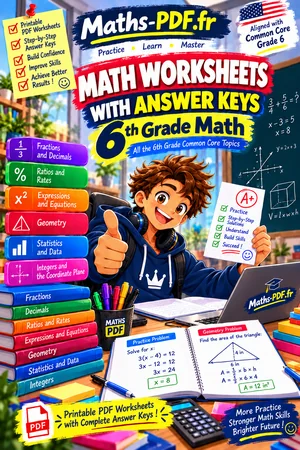
This 6th grade area of polygons worksheet answers covers area of triangles and polygons (Common Core 6.G.A.1), with a free PDF to print.
Key takeaway: This answer key helps Grade 6 students check their area work and understand each step, not only the final numbers.
- Topic: Area of Triangles and Polygons (6th grade)
- Content: Step-by-step answers to 20 worksheet problems
- Standards: 6.G.A.1
- Answers: Every step shown, with the method to review
- Format: Free printable PDF, US Letter, black and white
This answer key helps Grade 6 students check their area work and understand each step, not only the final numbers. Every one of the 20 worksheet worksheet problems has a short worked solution that shows the formula, the substitution, and the result with square units.
Use the key after you finish all the problems. Worksheet problems 1 to 6 show the basic formulas, 7 and 8 show how to work backward, 9 to 13 show how to split composite shapes, and 14 to 20 model how to turn a story into a calculation. Then compare your method too.
Key takeaway: Step-by-step answers to the Grade 6 worksheet on Area of Triangles and Polygons, with the method behind each result. Check your work after trying the problems alone; free PDF.
Grade 6 · Common Core State Standards: 6.G.A.1
6th grade area of polygons worksheet answers: worksheet problems 1 to 10
1 – Area of a right triangle
A triangle is half of a rectangle with the same base and height.
\(A = \frac{1}{2} \cdot 6 \cdot 4 = 12\)
\(12\text{ cm}^{2}\)
2 – Area of a triangle
\(A = \frac{1}{2} \cdot 10 \cdot 7 = 35\)
\(35\text{ in}^{2}\)
3 – Triangle with a decimal height
\(A = \frac{1}{2} \cdot 5 \cdot 3.5 = \frac{1}{2} \cdot 17.5 = 8.75\)
\(8.75\text{ m}^{2}\)
4 – Area of a parallelogram
Cut off the triangle on one side and move it to the other side to make a rectangle with base 8 and height 5.
\(A = bh = 8 \cdot 5 = 40\)
\(40\text{ cm}^{2}\)
5 – Another parallelogram
\(A = 12 \cdot 7 = 84\)
\(84\text{ ft}^{2}\)
6 – Area of a trapezoid
Draw a diagonal. One triangle has base 10 and height 4; the other has base 6 and height 4.
\(\frac{1}{2} \cdot 10 \cdot 4 = 20\) and \(\frac{1}{2} \cdot 6 \cdot 4 = 12\).
\(20 + 12 = 32\)
\(32\text{ cm}^{2}\)
7 – Find the height
\(30 = \frac{1}{2} \cdot 12 \cdot h = 6h\).
\(h = 30 \div 6 = 5\)
5 inches
Worksheet problem 8 and after
8 – Find the base
\(42 = \frac{1}{2} \cdot b \cdot 7 = 3.5b\).
\(b = 42 \div 3.5 = 12\)
12 meters
9 – L-shaped region
Method: find the area of the 10 by 6 rectangle and subtract the 4 by 3 corner that is missing.
\(10 \cdot 6 – 4 \cdot 3 = 60 – 12 = 48\)
\(48\text{ ft}^{2}\)
10 – Square plus triangle
Rectangle: \(8 \cdot 5 = 40\). Triangle: \(\frac{1}{2} \cdot 8 \cdot 3 = 12\).
\(40 + 12 = 52\)
\(52\text{ m}^{2}\)
Worksheet problems 11 and up
11 – Quadrilateral from two triangles
\(\frac{1}{2} \cdot 10 \cdot 3 = 15\) and \(\frac{1}{2} \cdot 10 \cdot 4 = 20\).
\(15 + 20 = 35\)
\(35\text{ cm}^{2}\)
12 – Triangle on the coordinate plane
The base on the x-axis is 6 units. The height is the y-coordinate of the top vertex, 5 units.
\(A = \frac{1}{2} \cdot 6 \cdot 5 = 15\)
\(15\text{ units}^{2}\)
13 – Pentagon on the coordinate plane
Rectangle: width 8 and height 4: \(8 \cdot 4 = 32\).
Triangle on top: base 8 and height \(6 – 4 = 2\): \(\frac{1}{2} \cdot 8 \cdot 2 = 8\).
\(32 + 8 = 40\)
\(40\text{ units}^{2}\)
14 – Triangular sail
\(A = \frac{1}{2} \cdot 4 \cdot 6 = 12\)
\(12\text{ m}^{2}\)
15 – Garden soil
Area: \(14 \cdot 9 = 126\) square feet.
Cost: \(126 \cdot \$0.50 = \$63.00\).
\(126\text{ ft}^{2}\); $63.00
16 – Trapezoid garden
Average the bases: \(\frac{12 + 20}{2} = 16\).
\(A = 16 \cdot 8 = 128\)
\(128\text{ ft}^{2}\)
17 – Compare areas
Triangle: \(\frac{1}{2} \cdot 10 \cdot 6 = 30\).
Rectangle: \(5 \cdot 6 = 30\).
The areas are equal (30 square units).
18 – Corner cut off
Rectangle: \(14 \cdot 9 = 126\).
Triangle: \(\frac{1}{2} \cdot 4 \cdot 3 = 6\).
\(126 – 6 = 120\)
\(120\text{ in}^{2}\)
Worksheet problem 19 and after
19 – Painting a gable
Area: \(\frac{1}{2} \cdot 12 \cdot 8 = 48\) square feet.
\(48 \div 24 = 2\)
2 cans
20 – Quilt triangles
One triangle: \(\frac{1}{2} \cdot 5 \cdot 4 = 10\) square inches.
\(6 \cdot 10 = 60\)
\(60\text{ in}^{2}\)
Key facts behind this 6th grade area of polygons worksheet answers
- Rectangle and parallelogram: A = bh.
- Triangle: A = (1/2)bh.
- Trapezoid: split into two triangles, or use A = (1/2)(b1 + b2)h.
- Then, the height is perpendicular to the base, not the slanted side.
- Area is measured in square units.
Common mistakes with this 6th grade area of polygons worksheet answers
- Marking an answer wrong because it is written as \(12\text{ cm}^{2}\) while yours says 12 square centimeters. Also, both are the same. Only a missing or wrong unit is a real error.
- Copying the answer to worksheet problem 9 without finding which rectangle was removed. Match your cut lines to the solution, because a different cut can still be correct if the total agrees.
- Giving up when the key shows a different split. Instead, try the key’s split on your own drawing and check that both methods reach the same area before deciding who is right.
How to use these solutions
- Cover the solution and read only the first line of each worked answer. If it shows the formula you chose, continue. If not, try the problem again before reading further.
- Keep a list of the worksheet problem numbers you missed. Most students will find that the misses cluster, for example on missing-height problems like 7 and 8 or on the coordinate shapes in 12 and 13.
- Teachers can use the key for peer marking. Then, ask partners to initial each step that is correct, which shows exactly where a method went wrong.
Download the 6th grade area of polygons worksheet answers as a PDF with the button below and keep it with your notes.
6th grade area of polygons worksheet answers: frequently asked questions
What should I do if my area answer does not match the key?
First recheck the height, since it must be perpendicular to the base. Then check whether you forgot the half for a triangle or the division by 2 for a trapezoid. If both are fine, redo the arithmetic and compare each line with the worked solution.
Do I lose credit for writing the area without units?
Many teachers deduct a point, because area without units is incomplete. A good habit is to write the unit on the answer line every time, such as square meters or square feet, so it becomes automatic on tests.
How do I know the answer to a cost problem is reasonable?
Estimate first. A parallelogram of 14 by 9 feet is about 126 square feet, so at 50 cents per square foot the cost should be near 63 dollars. If your answer is far from that, look for a slip in multiplying or in the price.
All Grade 6 chapters: Grade 6 math.

More 6th Grade math
Lessons
See all Area of Triangles and Polygons Lesson: Notes and Examples
- Equivalent Expressions and the Distributive Property Lesson: Notes and Examples
- Unit Rates and Rate Language Lesson: Notes and Examples
- Dividing Fractions by Fractions Lesson: Notes and Examples
- The Coordinate Plane and Polygons Lesson: Notes and Examples
- Percent as a Rate per 100 Lesson: Notes and Examples






Worksheets
See all- Greatest Common Factor and Least Common Multiple Worksheets with Answers
- Dividing Fractions by Fractions Worksheets with Answers
- Statistical Questions and Data Displays Worksheets with Answers
- Solving One-Step Equations Worksheets with Answers
- Area of Triangles and Polygons Worksheets with Answers
- Ratio Tables and Graphs of Ratios Worksheets with Answers





Tests
See all- Integers and Rational Numbers on the Number Line Test with Answer Key
- Dividing Fractions by Fractions Test with Answer Key
- Converting Measurement Units with Ratios Test with Answer Key
- Ordering Rational Numbers and Absolute Value Test with Answer Key
- Equivalent Expressions and the Distributive Property Test with Answer Key
- Percent as a Rate per 100 Test with Answer Key






Quizzes
See all- Greatest Common Factor and Least Common Multiple Quiz: 10 Questions with Answers
- Equivalent Expressions and the Distributive Property Quiz: 10 Questions with Answers
- Writing and Reading Algebraic Expressions Quiz: 10 Questions with Answers
- Percent as a Rate per 100 Quiz: 10 Questions with Answers
- Inequalities on the Number Line Quiz: 10 Questions with Answers
- Statistical Questions and Data Displays Quiz: 10 Questions with Answers