Algebra 2 Radicals and Rational Exponents Quiz: 10 Questions with Answers

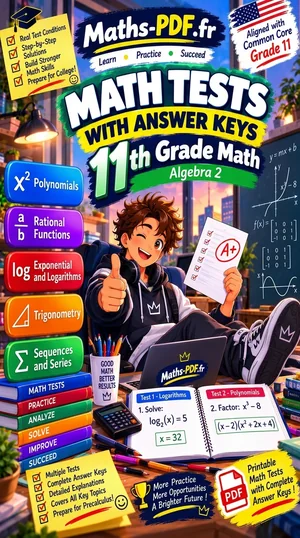
This rational exponents quiz for Algebra 2 covers radicals and rational exponents (Common Core N-RN.A.1, N-RN.A.2), with a free PDF to print.
Key takeaway: This rational exponents quiz helps Algebra 2 students check basic skills with fractional exponents before a test.
- Topic: Radicals and Rational Exponents (Algebra 2)
- Content: 10 multiple-choice questions with instant explanations
- Standards: N-RN.A.1, N-RN.A.2
- Answers: Explanations included
- Format: Free printable PDF, US Letter, black and white
This rational exponents quiz helps Algebra 2 students check basic skills with fractional exponents before a test. Also, it is a short way to see whether the root and power roles are secure.
The quiz has 10 multiple-choice questions and takes about 12 minutes. Also, it covers a diagram of 125 to the 2/3, an equivalent radical form, square roots, a negative exponent, the product rule, a graph point on the square root curve, a power of a product, a power equation, a table, and the cube root of a negative number. Each explanation points out the slip behind the wrong choices.
Answer ten multiple-choice questions on radicals and rational exponents. Choose one option for each question, then read the explanation to see why the correct choice works and which mistake, such as swapping the root index and the power, each wrong choice shows.
Key takeaway: Test yourself on Radicals and Rational Exponents (Algebra 2) with 11 questions; every answer comes with a short explanation. Take it after the lesson to see what you have mastered; free and printable.
Algebra 2 · Common Core State Standards: N-RN.A.1, N-RN.A.2
Rational exponents quiz: 10 questions
Question 6 and after
Remember
- a^(1/n) is the nth root of a.
- Next, a^(m/n) = (nth root of a)^m: root index = denominator, power = numerator.
- a^(-p) = 1 / a^p, also for fractional p.
- Product, quotient and power rules work by adding, subtracting and multiplying exponents.
- Even roots of negative numbers are not real.
Common mistakes with this rational exponents quiz
- Multiplying the base by the exponent. Also, an exponent such as 2/3 means the cube root squared, not the base times a fraction.
- Choosing a negative answer for a base raised to a negative exponent. A negative exponent gives a reciprocal, so the answer stays positive for a positive base.
- Believing the cube root of a negative number is not real. Odd roots of negative numbers are real.
- Multiplying the exponents when adding is needed. When powers of the same base multiply, add the exponents.
Tips to get a high score
- Turn each choice into a radical and evaluate it. Also, this works for every question and builds speed with the root and power order.
- Remember that the exponent 1/2 means a square root and that 1/3 means a cube root. Everything else builds on these.
- Retake the quiz after a day. Then time yourself, because a quick score shows the root and power steps are now automatic.
Download the rational exponents quiz as a PDF with the button below and keep it with your notes.
Rational exponents quiz: frequently asked questions
What is 25 to the -1/2?
It is 1/5. Also, the negative sign means take the reciprocal, and the exponent 1/2 means the square root. The square root of 25 is 5, so the answer is 1 over 5, a positive number.
What is the simplification of (27x to the 6th) to the 1/3?
Apply the 1/3 power to each factor. 27 to the 1/3 is 3, and x to the 6th to the 1/3 is x squared. So the result is 3x squared. Next, work factor by factor to avoid mistakes.
How do I solve x to the 3/2 equal to 27?
Raise both sides to the power 2/3. The left side becomes x, and 27 to the 2/3 is 9, since the cube root of 27 is 3 and 3 squared is 9. So x equals 9.
All Algebra 2 chapters: Algebra 2 math.
Free printable PDF
Algebra 2 Radicals and Rational Exponents Quiz: 10 Questions with Answers
Download PDF
More Algebra 2 math
Lessons
See all Complex Numbers: Adding, Subtracting and Multiplying Lesson: Notes and Examples
- Solving Quadratic Equations Lesson: Notes and Examples
- Sampling, Surveys and Experiments Lesson: Notes and Examples
- Polynomial Operations and Identities Lesson: Notes and Examples
- Conditional Probability and Independence Lesson: Notes and Examples
- Graphs of Trigonometric Functions and Identities Lesson: Notes and Examples




Worksheets
See all- The Normal Distribution Worksheets with Answers
- Sampling, Surveys and Experiments Worksheets with Answers
- Composition and Inverse Functions Worksheets with Answers
- Arithmetic and Geometric Sequences and Series Worksheets with Answers
- Conditional Probability and Independence Worksheets with Answers
- Transformations of Functions Worksheets with Answers



Tests
See all- Zeros and Graphs of Polynomial Functions Test with Answer Key
- Arithmetic and Geometric Sequences and Series Test with Answer Key
- Sampling, Surveys and Experiments Test with Answer Key
- Complex Conjugates and Complex Solutions Test with Answer Key
- Forms of Quadratic Functions Test with Answer Key
- Complex Numbers: Adding, Subtracting and Multiplying Test with Answer Key






Quizzes
See all- Transformations of Functions Quiz: 10 Questions with Answers
- Conditional Probability and Independence Quiz: 10 Questions with Answers
- Systems of Linear and Quadratic Equations Quiz: 10 Questions with Answers
- Composition and Inverse Functions Quiz: 10 Questions with Answers
- Graphs of Trigonometric Functions and Identities Quiz: 10 Questions with Answers
- Sampling, Surveys and Experiments Quiz: 10 Questions with Answers