Algebra 2 Conditional Probability and Independence Quiz: 10 Questions with Answers
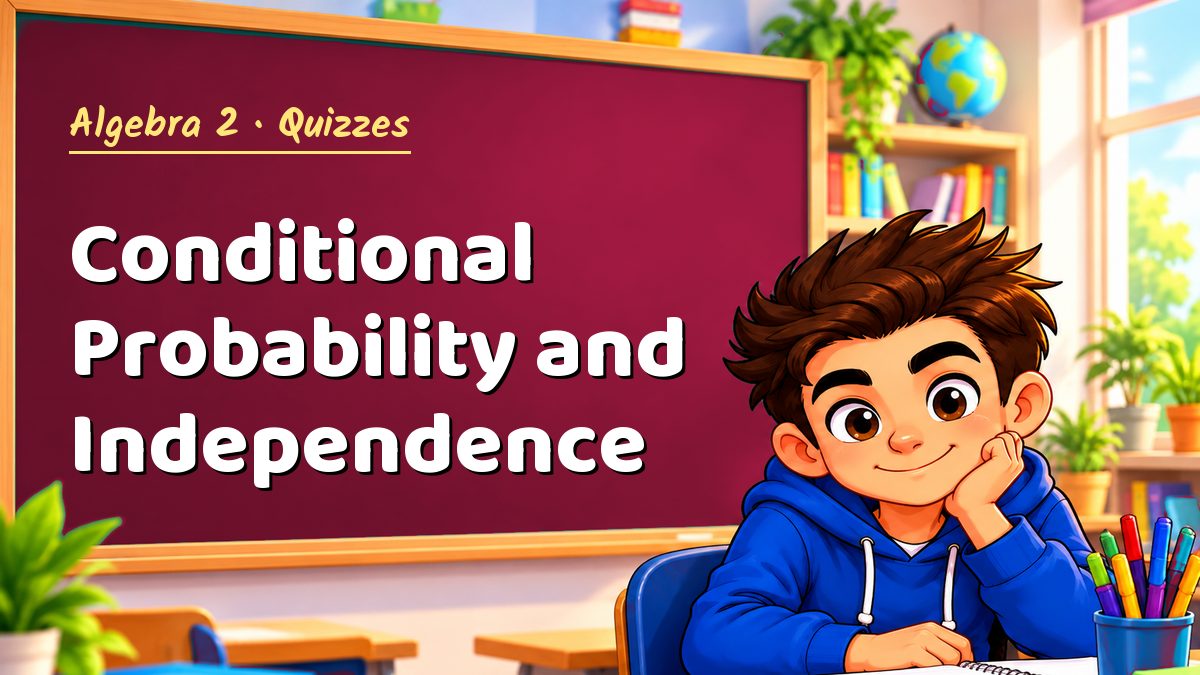
This algebra 2 conditional probability quiz covers conditional probability and independence (Common Core S-CP.A.1, S-CP.A.2, S-CP.A.3, S-CP.A.4, S-CP.A.5, S-CP.B.6, S-CP.B.7, S-CP.B.8, S-CP.B.9), with a free PDF to print.
Key takeaway: This probability quiz helps Algebra 2 students check basic skills with complements, independence, tables, and counting before a test.
- Topic: Conditional Probability and Independence (Algebra 2)
- Content: 10 multiple-choice questions with instant explanations
- Standards: S-CP.A.1, S-CP.A.2, S-CP.A.3, S-CP.A.4, S-CP.A.5, S-CP.B.6, S-CP.B.7, S-CP.B.8, S-CP.B.9
- Answers: Explanations included
- Format: Free printable PDF, US Letter, black and white
This probability quiz helps Algebra 2 students check basic skills with complements, independence, tables, and counting before a test. Also, it is a short way to find which rule is still unclear.
The quiz has 10 multiple-choice questions and takes about 12 minutes. Also, it covers the complement, the product of independent events, counting sums of 7, the addition rule, a conditional probability from a table, permutations, combinations, a tree diagram, the definition of independence, and a Venn diagram. Each explanation points out the slip behind the wrong answers.
Answer ten multiple-choice questions on conditional probability and independence. Choose one option for each question, then read the explanation to see why the correct choice works and which mistake, such as treating dependent events as independent, each wrong choice shows.
Key takeaway: Test yourself on Conditional Probability and Independence (Algebra 2) with 12 questions; every answer comes with a short explanation. Take it after the lesson to see what you have mastered; free and printable.
Algebra 2 · Common Core State Standards: S-CP.A.1, S-CP.A.2, S-CP.A.3, S-CP.A.4, S-CP.A.5, S-CP.B.6, S-CP.B.7, S-CP.B.8, S-CP.B.9
Algebra 2 conditional probability quiz: 10 questions
Question 5 and after
Question 10 and after
Remember
- P(not A) = 1 – P(A); P(A or B) = P(A) + P(B) – P(A and B).
- P(A given B) = P(A and B) / P(B).
- Independent: P(A and B) = P(A)·P(B).
- Multiplication rule: P(A and B) = P(A)·P(B given A).
- Permutations P(n, r) = n!/(n – r)!; combinations C(n, r) = n!/(r!(n – r)!).
Common mistakes with this algebra 2 conditional probability quiz
- Reporting P(A) as the complement. The complement is 1 minus P(A), so a probability of 0.2 has a complement of 0.8.
- Using combinations when order matters. If runners finish in places, the order counts, so use permutations.
- Adding two probabilities for an overlapping event without subtracting the overlap. Subtract P(A and B) once.
- Calling events independent because they feel unrelated. Independence is a numerical test using the product rule.
Tips to get a high score
- For counting questions, say whether order matters before choosing a formula. Also, this one habit sorts most permutation and combination questions.
- For table questions, circle the given group first and use its total as the denominator.
- Retake the quiz after a day, and check each answer by asking if the probability is between 0 and 1.
Download the algebra 2 conditional probability quiz as a PDF with the button below and keep it with your notes.
Algebra 2 conditional probability quiz: frequently asked questions
What does it mean for two events to be independent?
Knowing that one event happened does not change the probability of the other. In symbols, P(A and B) equals P(A) times P(B). Rolling a die and flipping a coin are independent, since neither affects the other.
How many 2-person teams can be chosen from 8 people?
Order does not matter, so use combinations: C(8, 2) equals 8 times 7 divided by 2, which is 28. Using permutations would give 56, which counts each team twice.
How do I find P(not A)?
Subtract P(A) from 1. If P(A) is 0.6, then P(not A) is 0.4. The complement rule is useful when the event itself is hard to count but its opposite is easy.
All Algebra 2 chapters: Algebra 2 math.
Free printable PDF
Algebra 2 Conditional Probability and Independence Quiz: 10 Questions with Answers
Download PDF
More Algebra 2 math
Lessons
See all Solving Quadratic Equations Lesson: Notes and Examples
- Transformations of Functions Lesson: Notes and Examples
- Forms of Quadratic Functions Lesson: Notes and Examples
- Complex Conjugates and Complex Solutions Lesson: Notes and Examples
- Conditional Probability and Independence Lesson: Notes and Examples
- Systems of Linear and Quadratic Equations Lesson: Notes and Examples
Worksheets
See all- The Normal Distribution Worksheets with Answers
- Composition and Inverse Functions Worksheets with Answers
- Radians and the Unit Circle Worksheets with Answers
- Rational Expressions Worksheets with Answers
- Logarithms Worksheets with Answers
- Arithmetic and Geometric Sequences and Series Worksheets with Answers



Tests
See all- Forms of Quadratic Functions Test with Answer Key
- Exponential Growth and Decay Test with Answer Key
- Polynomial Operations and Identities Test with Answer Key
- Zeros and Graphs of Polynomial Functions Test with Answer Key
- Systems of Linear and Quadratic Equations Test with Answer Key
- Graphs of Trigonometric Functions and Identities Test with Answer Key




Quizzes
See all- Arithmetic and Geometric Sequences and Series Quiz: 10 Questions with Answers
- Graphs of Trigonometric Functions and Identities Quiz: 10 Questions with Answers
- Transformations of Functions Quiz: 10 Questions with Answers
- Radicals and Rational Exponents Quiz: 10 Questions with Answers
- The Normal Distribution Quiz: 10 Questions with Answers
- Radical and Rational Equations Quiz: 10 Questions with Answers