Algebra 2 Polynomial Operations and Identities Worksheet Answer Key (PDF)

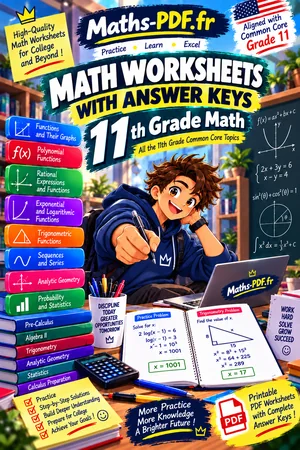
This polynomial identities worksheet answers for Algebra 2 covers polynomial operations and identities (Common Core A-APR.A.1, A-APR.C.4), with a free PDF to print.
Key takeaway: This answer key helps Algebra 2 students check the polynomial operations worksheet and follow each expansion.
- Topic: Polynomial Operations and Identities (Algebra 2)
- Content: Step-by-step answers to 21 worksheet problems
- Standards: A-APR.A.1, A-APR.C.4
- Answers: Every step shown, with the method to review
- Format: Free printable PDF, US Letter, black and white
This answer key helps Algebra 2 students check the polynomial operations worksheet and follow each expansion. All 21 problems are solved in full, with every distribution step and every combination of like terms shown.
The key names the identity used in problems 8 to 13, gives the mental math route for the arithmetic problems, and states the final polynomial in standard form. Word problems finish with units and a sentence. Proofs show each algebra step with a reason. Try each problem first, then compare your partial products before comparing the final line.
Every worksheet problem on polynomial operations and identities is solved here, one step at a time. Compare your method as well as your final answer, because the steps show where forgetting the middle term of a squared binomial can go wrong. Final answers appear in bold so you can find them quickly when you only need a check.
Key takeaway: Step-by-step answers to the Algebra 2 worksheet on Polynomial Operations and Identities, with the method behind each result. Check your work after trying the problems alone; free PDF.
Algebra 2 · Common Core State Standards: A-APR.A.1, A-APR.C.4
Polynomial identities worksheet answers: worksheet problems 1 to 10
1 – Add polynomials
Combine like terms: \((3 + 1)x^{2} + (2 – 4)x + (-5 + 9)\).
\(4x^{2} – 2x + 4\)
2 – Subtract polynomials
Change every sign in the second polynomial: \(5x^{3} – x + 2 – 2x^{3} – 3x^{2} + 7\).
Combine like terms.
\(3x^{3} – 3x^{2} – x + 9\)
3 – Degree and leading coefficient
Standard form lists powers from highest to lowest: \(-3x^{4} + 7x^{2} + 5x – 1\).
Degree 4, leading coefficient -3
4 – Monomial times polynomial
\(3x \cdot 2x^{2} = 6x^{3}\), \(3x \cdot (-x) = -3x^{2}\), \(3x \cdot 4 = 12x\).
\(6x^{3} – 3x^{2} + 12x\)
5 – Two binomials
\(x^{2} – 7x + 4x – 28\).
\(x^{2} – 3x – 28\)
6 – Binomials with coefficients
\(6x^{2} + 10x – 9x – 15\).
\(6x^{2} + x – 15\)
7 – Binomial times trinomial
\(x^{3} – 3x^{2} + 4x + 2x^{2} – 6x + 8\).
\(x^{3} – x^{2} – 2x + 8\)
8 – Square of a difference
\((a – b)^{2} = a^{2} – 2ab + b^{2}\) with \(a = x\), \(b = 5\).
\(x^{2} – 10x + 25\)
9 – Difference of squares
\((3x)^{2} – 2^{2}\).
\(9x^{2} – 4\)
10 – Two variables
\((2x)^{2} + 2(2x)(3y) + (3y)^{2}\).
\(4x^{2} + 12xy + 9y^{2}\)
Worksheet problems 11 and up
11 – Cube of a binomial
\(x^{3} + 3x^{2}(1) + 3x(1)^{2} + 1^{3}\).
\(x^{3} + 3x^{2} + 3x + 1\)
12 – Mental math: a square
\(47^{2} = (50 – 3)^{2} = 2500 – 300 + 9\).
\(2,209\)
13 – Mental math: product
\(53 \cdot 47 = (50 + 3)(50 – 3) = 50^{2} – 3^{2} = 2500 – 9\).
\(2,491\)
14 – Area of a square
\((x + 5)^{2} = x^{2} + 2(5)x + 25\).
\(x^{2} + 10x + 25\) square feet
15 – Verify an identity
\((x + y)^{2} = x^{2} + 2xy + y^{2}\) and \((x – y)^{2} = x^{2} – 2xy + y^{2}\).
Subtract: \(x^{2} + 2xy + y^{2} – x^{2} + 2xy – y^{2} = 4xy\).
Verified: both sides equal \(4xy\)
16 – Pythagorean triple
\(x^{2} – y^{2} = 16 – 1 = 15\), \(2xy = 8\), \(x^{2} + y^{2} = 17\).
\(15^{2} + 8^{2} = 225 + 64 = 289 = 17^{2}\).
15, 8, 17
17 – Garden path
Outer rectangle: \((x + 6)(x + 10) = x^{2} + 16x + 60\).
Garden: \(x(x + 4) = x^{2} + 4x\).
Subtract: \(x^{2} + 16x + 60 – (x^{2} + 4x)\).
\(12x + 60\) square feet
18 – Ticket revenue
\(R = (40 – 2x)(120 + 10x) = 4800 + 400x – 240x – 20x^{2}\).
\(R = -20x^{2} + 160x + 4800\)
Worksheet problem 19 and after
19 – Difference of cubes of binomials
\((x + 2)^{3} = x^{3} + 6x^{2} + 12x + 8\) and \((x – 2)^{3} = x^{3} – 6x^{2} + 12x – 8\).
Subtract term by term.
\(12x^{2} + 16\)
20 – Find the error
Squaring a binomial is not squaring each term. The middle term \(2(x)(6) = 12x\) is missing.
\(x^{2} + 12x + 36\)
21 – Prove a pattern
\(2n(2n + 2) + 1 = 4n^{2} + 4n + 1\).
This equals \((2n + 1)^{2}\), a perfect square. Example: \(4 \cdot 6 + 1 = 25 = 5^{2}\).
\((2n + 1)^{2}\)
Key facts behind this polynomial identities worksheet answers
- Polynomials are closed under addition, subtraction, and multiplication.
- Combine like terms; subtract by changing every sign.
- Degree of a product = sum of the degrees.
- (a ± b)² = a² ± 2ab + b² and (a + b)(a – b) = a² – b².
- (x² – y²)² + (2xy)² = (x² + y²)² makes Pythagorean triples.
Common mistakes with this polynomial identities worksheet answers
- Comparing only the final polynomial. A wrong coefficient is easier to trace if you compare the partial products line by line.
- Treating the key’s standard form as a different answer. Terms in a different order are equal, but the key lists them from highest to lowest degree.
- Skipping the reasons in the proof for problem 21. Also, a proof needs a reason for each step, and the key labels them.
- Accepting a mental math answer without checking it. Also, the key checks 47 squared by a second method to catch slips.
How to use these solutions
- When your answer differs, substitute x equal to 2 in both your result and the key’s result. If the numbers differ, one has an error.
- Redo one problem from each group: sums, products, identities, and word problems. Also, this shows which group needs more work.
- Teachers can use the key’s reasons in proofs as sentence models for students who struggle with justification.
Download the polynomial identities worksheet answers as a PDF with the button below and keep it with your notes.
Polynomial identities worksheet answers: frequently asked questions
How is 47 squared found without a calculator?
Write 47 as 50 minus 3 and use the square of a difference. Also, that gives 2500 – 300 + 9, which is 2209. Also, the identity turns a hard multiplication into three easy steps.
How is (x + 2) cubed minus (x – 2) cubed simplified?
Expand each cube, then subtract. Also, the x cubed terms cancel and the x squared terms cancel, leaving 12x squared + 16. Only even powers of 2 survive because the odd terms double.
What is the Pythagorean triple from x equal to 4 and y equal to 1?
Compute x squared minus y squared, which is 15, then 2xy, which is 8, then x squared plus y squared, which is 17. Since 15 squared plus 8 squared equals 289, which is 17 squared, it is a right triangle.
All Algebra 2 chapters: Algebra 2 math.

More Algebra 2 math
Lessons
See all Conditional Probability and Independence Lesson: Notes and Examples
- Rational Expressions Lesson: Notes and Examples
- Exponential Growth and Decay Lesson: Notes and Examples
- Dividing Polynomials and the Remainder Theorem Lesson: Notes and Examples
- Composition and Inverse Functions Lesson: Notes and Examples
- Zeros and Graphs of Polynomial Functions Lesson: Notes and Examples




Worksheets
See all- Systems of Linear and Quadratic Equations Worksheets with Answers
- Graphs of Trigonometric Functions and Identities Worksheets with Answers
- Logarithms Worksheets with Answers
- Forms of Quadratic Functions Worksheets with Answers
- Rational Expressions Worksheets with Answers
- Arithmetic and Geometric Sequences and Series Worksheets with Answers




Tests
See all- Dividing Polynomials and the Remainder Theorem Test with Answer Key
- Systems of Linear and Quadratic Equations Test with Answer Key
- Forms of Quadratic Functions Test with Answer Key
- Logarithms Test with Answer Key
- Complex Numbers: Adding, Subtracting and Multiplying Test with Answer Key
- Graphs of Trigonometric Functions and Identities Test with Answer Key




Quizzes
See all- Transformations of Functions Quiz: 10 Questions with Answers
- Polynomial Operations and Identities Quiz: 10 Questions with Answers
- Graphs of Trigonometric Functions and Identities Quiz: 10 Questions with Answers
- Radical and Rational Equations Quiz: 10 Questions with Answers
- Radicals and Rational Exponents Quiz: 10 Questions with Answers
- Complex Numbers: Adding, Subtracting and Multiplying Quiz: 10 Questions with Answers