Precalculus Logarithms and Their Properties Lesson: Notes and Examples (Free PDF)
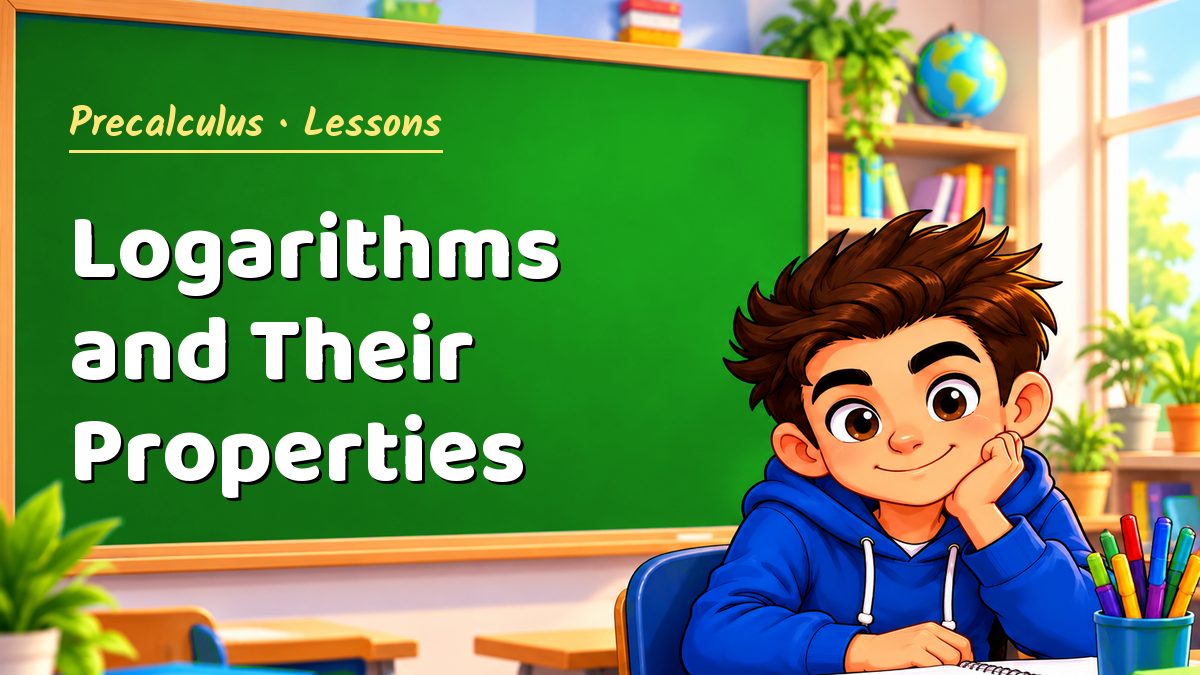

This properties of logarithms lesson for Precalculus covers logarithms and their properties (Common Core F-LE.A.4, F-IF.C.7e, F-BF.B.5), with a free PDF to print.
Key takeaway: This lesson helps precalculus students understand logarithms as the inverse of exponentials and use their properties.
- Topic: Logarithms and Their Properties (Precalculus)
- Content: One-page lesson with a definition, a worked example and key facts
- Standards: F-LE.A.4, F-IF.C.7e, F-BF.B.5
- Answers: Explanations included
- Format: Free printable PDF, US Letter, black and white
Key takeaway: A clear Precalculus lesson on Logarithms and Their Properties, with definitions, rules and worked examples: what is a logarithm, what are the properties of logarithms and where are logarithms used. Read it before the practice worksheet; free to print or download as a PDF.
A logarithm is an exponent: log_b x = y means b^y = x. Logarithms and exponentials are inverse functions, so log_b x is defined only for x > 0 and its graph is the reflection of b^x over y = x. The product, quotient and power rules turn multiplication into addition, division into subtraction, and powers into multiplication.
This lesson helps precalculus students understand logarithms as the inverse of exponentials and use their properties. First, you learn to switch between logarithmic and exponential form. Then you apply the product, quotient and power rules, and finally you use the change of base formula and read logarithmic graphs.
The lesson covers evaluating logs, domain restrictions, common and natural logs, expanding and condensing expressions, and real scales such as decibels and pH. Each section has a short worked case. Plan about 40 minutes, and practice converting between the two forms until it feels automatic.
Precalculus · Common Core State Standards: F-LE.A.4, F-IF.C.7e, F-BF.B.5
Key facts in this properties of logarithms lesson
- log_b x = y if and only if b^y = x (b > 0, b not 1, x > 0).
- log_b 1 = 0 and log_b b = 1.
- Product rule adds logs, quotient rule subtracts, power rule multiplies.
- Change of base: log_b M = ln M / ln b.
- The graph of log_b x has the vertical asymptote x = 0 and passes through (1, 0).
What is a logarithm?
A logarithm answers the question: what exponent is needed? We define \(\log_{b}x=y\) to mean \(b^{y}=x\), where \(b>0\), \(b\ne1\) and \(x>0\). For example \(\log_{2}32=5\) because \(2^{5}=32\). The base-10 logarithm is written \(\log x\) and the base-\(e\) (natural) logarithm is written \(\ln x\).
Two values come straight from the definition: \(\log_{b}1=0\) and \(\log_{b}b=1\). Also \(b^{\log_{b}x}=x\) and \(\log_{b}b^{x}=x\), because the logarithm and the exponential undo each other.
How is a logarithm graph related to an exponential graph?
\(f(x)=b^{x}\) and \(g(x)=\log_{b}x\) are inverse functions, so their graphs are mirror images across \(y=x\). The log graph has domain \((0,\infty)\), range all real numbers, a vertical asymptote \(x=0\) and the point \((1,0)\).
What are the properties of logarithms?
| Rule | Formula |
|---|---|
| Product | \(\log_{b}(MN)=\log_{b}M+\log_{b}N\) |
| Quotient | \(\log_{b}\frac{M}{N}=\log_{b}M-\log_{b}N\) |
| Power | \(\log_{b}M^{p}=p\log_{b}M\) |
| Change of base | \(\log_{b}M=\frac{\ln M}{\ln b}\) |
To expand a logarithm, apply the rules to split it into simple pieces. To condense it, work backward. Example: \(\log_{2}\frac{8x^{3}}{y}=\log_{2}8+3\log_{2}x-\log_{2}y=3+3\log_{2}x-\log_{2}y\).
Example (change of base): Most calculators have only \(\log\) and \(\ln\) keys. To find \(\log_{3}20\), compute \(\frac{\ln 20}{\ln 3}\approx\frac{2.9957}{1.0986}\approx 2.727\). This makes sense because \(3^{2}=9\) and \(3^{3}=27\), and 20 lies between them, so the exponent must be between 2 and 3. Estimating between two known powers is a quick way to catch a calculator mistake. You can also check your answer by raising the base to it: \(3^{2.727}\approx 20\).
Where are logarithms used?
Logarithms measure quantities that span huge ranges. Sound level in decibels is \(L=10\log\frac{I}{I_{0}}\), acidity is \(\text{pH}=-\log[\text{H}^{+}]\), and earthquake magnitude grows with the logarithm of the wave amplitude. Each step of 1 on a log scale means a factor of 10 in the quantity, so a 20 dB increase is a 100 times larger intensity.
Remember that only positive numbers have logarithms. The expression \(\log(x-3)\) is defined only for \(x>3\), and a graph shifted by \(h\) has its vertical asymptote at \(x=h\).
Properties of logarithms lesson: questions and answers
What does log base 2 of 8 mean?
It asks which power of 2 gives 8. Since 2 cubed is 8, log base 2 of 8 equals 3.
What is the difference between log and ln?
The notation log usually means base 10, and ln means base e, about 2.718. Both follow the same properties.
Why can’t you take the log of a negative number?
A positive base raised to any real power is always positive, so no exponent produces a negative number or zero. The domain of a logarithm is x > 0.
How do you evaluate a logarithm with a calculator?
Use the change of base formula. For log base 3 of 20, compute ln 20 divided by ln 3, which is about 2.727.
Does log(A + B) equal log A + log B?
No. The product rule applies to log(AB), not log(A + B). For example log(10 + 10) = log 20, not 2.
Common mistakes with this properties of logarithms lesson
- Students think the log of a sum equals the sum of the logs. However, only a product turns into a sum, so do not split an addition inside a log.
- Students mix up the base and the argument when converting. Instead, remember that the base of the log becomes the base of the power.
- Students forget that the argument must be positive. First, check the domain before you simplify, because a negative argument has no real log.
How to study this chapter
- First, say each log in words: the power to which the base is raised to get the argument. Then write the exponential form.
- Next, memorize the log of one and the log of the base. Also remember that logs undo exponentials.
- Parents can ask what power gives the number. That question is the whole definition. Then write the matching exponential form, and check that the power returns the number.
Download the properties of logarithms lesson as a PDF with the button below and keep it with your notes.
More questions about properties of logarithms lesson
What is the natural logarithm?
The natural logarithm is the log with base e, written ln. It answers the question: to what power must e be raised to get this number. It appears in continuous growth, decay and calculus, so it is the most common log in science.
How do you expand a logarithm of a product with a power?
Use the product rule to split the factors into a sum, then use the power rule to bring each exponent down as a multiplier. For example, the log of x cubed times y becomes three log x plus log y.
What does the graph of a logarithm look like?
It rises slowly, passes through the point 1, 0, and has the y-axis as a vertical asymptote. It is the reflection of an exponential graph over the line y equals x, so its domain is positive numbers only.
All Precalculus chapters: Precalculus math.
Free printable PDF
Precalculus Logarithms and Their Properties Lesson: Notes and Examples
Download PDF
More Precalculus math
Lessons
See all




Worksheets
See all Polynomial Functions and Their Graphs Worksheets with Answers
- The Binomial Theorem Worksheets with Answers
- Inverse Functions Worksheets with Answers
- Trigonometric Identities Worksheets with Answers
- Graphs of Trigonometric Functions Worksheets with Answers
- Law of Sines and Law of Cosines Worksheets with Answers






Tests
See all- Law of Sines and Law of Cosines Test with Answer Key
- Trigonometric Identities Test with Answer Key
- Inverse Trigonometric Functions and Equations Test with Answer Key
- Logarithms and Their Properties Test with Answer Key
- Graphs of Trigonometric Functions Test with Answer Key
- The Binomial Theorem Test with Answer Key




Quizzes
See all- Polynomial Functions and Their Graphs Quiz: 10 Questions with Answers
- Combining and Composing Functions Quiz: 10 Questions with Answers
- Rational Functions and Asymptotes Quiz: 10 Questions with Answers
- Trigonometric Identities Quiz: 10 Questions with Answers
- Graphs of Trigonometric Functions Quiz: 10 Questions with Answers
- Functions, Domain and Range Quiz: 10 Questions with Answers