8th Grade Scientific Notation Worksheets with Answers (Free PDF)

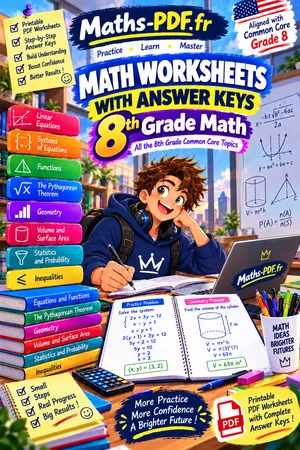
This 8th grade scientific notation worksheet covers scientific notation (Common Core 8.EE.A.3, 8.EE.A.4), with a free PDF to print.
Key takeaway: This worksheet helps Grade 8 students practice scientific notation until the steps are routine.
- Topic: Scientific Notation (8th grade)
- Content: 20 worksheet problems, from easy to challenging
- Standards: 8.EE.A.3, 8.EE.A.4
- Answers: On a separate page, so you can try every worksheet problem first
- Format: Free printable PDF, US Letter, black and white
This worksheet helps Grade 8 students practice scientific notation until the steps are routine. The worksheet problems begin with converting numbers and end with real measurements and an error to explain.
There are 20 worksheet problems. First, worksheet problems 1 to 6 convert between standard form and scientific notation, including distances and tiny lengths. Next, worksheet problems 7 and 8 compare numbers and tell how many times larger one is. Then worksheet problems 9 to 13 multiply, divide, add, and subtract. After that, worksheet problems 14 to 16 order numbers and compare populations and cells. Finally, worksheet problems 17 to 20 use light, phone storage, planets, and a claim. Allow about 40 minutes.
These 20 problems practice scientific notation, comparing sizes and calculating with very large and very small numbers (Common Core 8.EE.A.3 and 8.EE.A.4). Each problem has its own space for work, so print the page and write directly on it.
The problems start with direct skill checks and grow harder as you go. Later items add, multiply and divide in scientific notation and use real measurements. Use the answer key afterwards to check every step.
Key takeaway: This Grade 8 worksheet on Scientific Notation gives 20 problems, from warm-up questions to harder applications. The answer key is on a separate page; free printable PDF.
Grade 8 · Common Core State Standards: 8.EE.A.3, 8.EE.A.4
8th grade scientific notation worksheet: worksheet problems 1 to 10
1 – Large number
First, write 4,500 in scientific notation.
2 – Small number
Next, write 0.00032 in scientific notation.
3 – Standard form 1
4 – Standard form 2
5 – Distance to the Sun
6 – Tiny length
7 – Which is larger
8 – How many times
9 – Multiply
10 – Multiply and adjust
Worksheet problems 11 and up
11 – Divide
12 – Add
13 – Subtract
14 – Order
Now, order from least to greatest: A \(2.5 \times 10^{3}\), B \(3 \times 10^{-2}\), C \(1.2 \times 10^{4}\), D \(9 \times 10^{2}\).
15 – Population comparison
16 – Red blood cells
First, a red blood cell is about \(7 \times 10^{-6}\) meter wide. About how many cells fit side by side across 1 millimeter (\(1 \times 10^{-3}\) meter)?
17 – Light from the Sun
Light travels about \(1.86 \times 10^{5}\) miles per second. Sunlight takes about \(5 \times 10^{2}\) seconds to reach Earth. How far is that? Round the front number to the nearest tenth.
Worksheet problem 18 and after
18 – Movie downloads
19 – Earth and Moon
20 – Find the error

Key facts behind this 8th grade scientific notation worksheet
- Form: \(a \times 10^{n}\) with \(1 \le a < 10\).
- \(93{,}000{,}000 = 9.3 \times 10^{7}\) and \(0.00032 = 3.2 \times 10^{-4}\).
- Next, to multiply, multiply the front numbers and add the exponents; to divide, subtract the exponents.
- Also, to add or subtract, first write both numbers with the same power of 10.
- Then, to tell how many times as large one value is, divide the two values.
Common mistakes with this 8th grade scientific notation worksheet
- Students move the decimal point the wrong way. However, a number greater than 10 needs a positive exponent, so check the direction against the size of the number.
- Students multiply the exponents instead of adding them. Instead, add exponents when you multiply powers of ten.
- Students subtract numbers with different powers without rewriting. Because the powers must match, change one number first.
Tips before you start the worksheet problems
- First, do the conversion worksheet problems in pairs, one to scientific and one back to standard form. Then each answer checks the other.
- Also, after any calculation, ask whether the front number is between 1 and 10. If not, adjust the exponent.
- Teachers can ask students to explain a mistaken answer aloud, because correcting an error builds understanding.
Download the 8th grade scientific notation worksheet as a PDF with the button below and keep it with your notes.
8th grade scientific notation worksheet: frequently asked questions
How do you tell how many times larger one number is than another?
Divide the larger number by the smaller one, using scientific notation. For example, \(8 \times 10^{9}\) divided by \(2 \times 10^{6}\) is \(4 \times 10^{3}\), so the first number is 4,000 times as large.
How do you use scientific notation for units?
Convert the units first, and then compute. For example, to compare a length in meters with one in millimeters, write both in meters. Then divide, and say what the result means in the story.
How do you estimate before you calculate?
Round each front number to a single digit and add the exponents. For example, 4.1 times 10 to the 3rd times 1.9 times 10 to the 2nd is about 4 times 2, or 8, times 10 to the 5th. Then compare your answer.
All Grade 8 chapters: Grade 8 math.

More 8th Grade math
Lessons
See all Distance on the Coordinate Plane Lesson: Notes and Examples
- Square Roots and Cube Roots Lesson: Notes and Examples
- Proportional Relationships and Slope Lesson: Notes and Examples
- Scatter Plots and Association Lesson: Notes and Examples
- Scientific Notation Lesson: Notes and Examples
- Linear Functions as Models Lesson: Notes and Examples






Worksheets
See all- Scatter Plots and Association Worksheets with Answers
- Angles in Triangles and Parallel Lines Worksheets with Answers
- Translations, Reflections and Rotations Worksheets with Answers
- The Pythagorean Theorem Worksheets with Answers
- Two-Way Tables and Relative Frequency Worksheets with Answers
- Distance on the Coordinate Plane Worksheets with Answers





Tests
See all- Proportional Relationships and Slope Test with Answer Key
- Angles in Triangles and Parallel Lines Test with Answer Key
- Volume of Cylinders, Cones and Spheres Test with Answer Key
- Two-Way Tables and Relative Frequency Test with Answer Key
- Scatter Plots and Association Test with Answer Key
- Scientific Notation Test with Answer Key






Quizzes
See all- Linear Functions as Models Quiz: 10 Questions with Answers
- The Pythagorean Theorem Quiz: 10 Questions with Answers
- Angles in Triangles and Parallel Lines Quiz: 10 Questions with Answers
- Slope and Similar Triangles Quiz: 10 Questions with Answers
- Dilations and Similar Figures Quiz: 10 Questions with Answers
- Two-Way Tables and Relative Frequency Quiz: 10 Questions with Answers