7th Grade Probability and Probability Models Worksheet Answer Key (PDF)

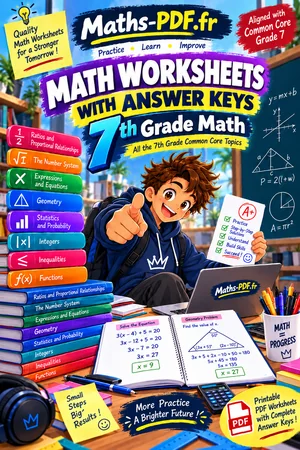
This 7th grade probability worksheet answers covers probability and probability models (Common Core 7.SP.C.5, 7.SP.C.6, 7.SP.C.7), with a free PDF to print.
Key takeaway: This answer key helps Grade 7 students check their probabilities and predictions.
- Topic: Probability and Probability Models (7th grade)
- Content: Step-by-step answers to 20 worksheet problems
- Standards: 7.SP.C.5, 7.SP.C.6, 7.SP.C.7
- Answers: Every step shown, with the method to review
- Format: Free printable PDF, US Letter, black and white
This answer key helps Grade 7 students check their probabilities and predictions. All 20 worksheet problems have a worked solution, and the key shows the count of favorable and total outcomes.
Use the key after you try every problem. Worksheet problem 1 gives a probability of 0, and worksheet problems 2 to 4 give one sixth, one half, and one half. Also, worksheet problem 5 gives one half for red. Worksheet problem 7 gives four elevenths, and worksheet problem 8 gives 0.633 for heads. Worksheet problems 9 to 20 cover predictions and models. Then, compare your counts as well as your fractions.
Use this answer key to check your work on the probability models worksheet. Every solution shows the steps, and the final answer appears in bold. If your answer is different, compare each step and look for the first place where the work changes.
Key takeaway: This answer key for the Grade 7 worksheet on Probability and Probability Models shows every step and the rule used. Check your work after trying the problems alone; free PDF.
Grade 7 · Common Core State Standards: 7.SP.C.5, 7.SP.C.6, 7.SP.C.7
7th grade probability worksheet answers: worksheet problems 1 to 10
1 – Impossible event
No face shows 7, so there are 0 favorable outcomes.
\(P=0\div 6=0\)
0; impossible
2 – One outcome
1 favorable outcome out of 6.
\(\frac{1}{6}\)
3 – Even number
Even faces: 2, 4, 6, which is 3 outcomes out of 6.
\(\frac{3}{6}=\frac{1}{2}\)
\(\frac{1}{2}\)
4 – Prime number
Primes: 2, 3, 5, which is 3 outcomes of 6.
\(\frac{3}{6}=\frac{1}{2}\)
\(\frac{1}{2}\)
5 – Marble bag
Total: \(5+3+2=10\).
\(P(\text{red})=\frac{5}{10}=\frac{1}{2}\).
\(P(\text{not red})=1-\frac{1}{2}=\frac{1}{2}\)
\(\frac{1}{2}\) and \(\frac{1}{2}\)
6 – Spinner
\(\frac{3}{8}\)
\(\frac{3}{8}\)
7 – Letter cards
Vowels: A, E, A, I, which is 4 cards out of 11.
\(\frac{4}{11}\)
8 – Relative frequency
\(\frac{38}{60}=\frac{19}{30}\approx 0.63\).
The theoretical probability is 0.5; with 60 tosses a difference is expected.
\(\frac{19}{30}\approx 0.63\)
9 – Predict rainy days
\(0.35\times 20=7\)
About 7 days
10 – Spin results
\(\frac{18}{50}=0.36\), \(\frac{12}{50}=0.24\), \(\frac{20}{50}=0.40\).
Check: \(0.36+0.24+0.40=1\)
0.36, 0.24, 0.40
Worksheet problems 11 and up
11 – Missing probability
The probabilities add up to 1.
\(1-0.4-0.3=0.3\)
0.3
12 – Expected rolls
\(\frac{1}{6}\times 120=20\)
About 20 times
13 – Complement
\(1-0.35=0.65\)
0.65
14 – Probability model
Common denominator 12: \(\frac{2}{12}+\frac{3}{12}+\frac{4}{12}=\frac{9}{12}\).
\(x=1-\frac{9}{12}=\frac{3}{12}=\frac{1}{4}\)
\(\frac{1}{4}\)
15 – Snow days
\(0.15\times 60=9\)
About 9 days; unlikely on any given day
16 – Free throws
\(\frac{36}{48}=\frac{3}{4}\).
\(\frac{3}{4}\times 20=15\)
About 15
17 – Raffle
\(\frac{4}{200}=\frac{1}{50}=0.02=2\%\)
\(\frac{1}{50}\), or 2%
18 – Lunch choice
Relative frequency: \(\frac{14}{40} = 0.35\).
\(0.35 \times 100 = 35\)
About 35 greens
19 – Die experiment
\(\frac{9}{40}=0.225\) compared with \(\frac{1}{6}\approx 0.167\).
The experiment gave 5 more often than the theory predicts, which can happen by chance.
\(\frac{9}{40}=0.225\) versus \(\frac{1}{6}\approx 0.167\)
Worksheet problem 20 and after
20 – Adding marbles
New total: \(10+2=12\). Red: \(5+2=7\).
\(P(\text{red})=\frac{7}{12}\approx 0.58\), which is greater than \(\frac{1}{2}\).
\(\frac{7}{12}\), greater than before
Key facts behind this 7th grade probability worksheet answers
- Probability is between 0 (impossible) and 1 (certain).
- Equally likely outcomes: \(P = favorable \div total\).
- Relative frequency = number of times the outcome happens ÷ number of trials.
- Then, the probabilities of all outcomes in a model add up to 1.
- \(P(not A) = 1 – P(A)\).
Common mistakes with this 7th grade probability worksheet answers
- Marking a probability wrong because it is written as a decimal when the key shows a fraction. Equal values are both correct.
- Ignoring the comparison in worksheet problems 8, 19, and 20. Also, the key says how the experimental result compares with the theory.
- Skipping the check that the probabilities add to 1. Also, the key adds them in worksheet problems 11 and 14.
How to use these solutions
- First, find the count that differs from the key. Also, most errors come from counting outcomes.
- Also redo each missed prediction by multiplying the probability by the trials. In addition, a calculator check is quick.
- Parents can ask the student to explain why worksheet problem 14 has an answer of one fourth.
Download the 7th grade probability worksheet answers as a PDF with the button below and keep it with your notes.
7th grade probability worksheet answers: frequently asked questions
How does the key find the answer to worksheet problem 7?
The word MATHEMATICS has 11 letters. The vowels are A, E, A, and I, which is 4 letters. So the probability of drawing a vowel is 4 out of 11, which cannot be simplified.
How does the key find the answer to worksheet problem 14?
Also, the known probabilities one sixth, one fourth, and one third add to three fourths. Subtracting from 1 leaves one fourth for x. Because all four probabilities must add to 1, this is the missing value.
How does the key predict snow days in worksheet problem 15?
The chance of snow is 0.15 on each of 60 days. Multiplying 0.15 by 60 gives 9 snow days. A probability of 0.15 is unlikely, so snow on any one day is unlikely.
All Grade 7 chapters: Grade 7 math.

More 7th Grade math
Lessons
See all Equivalent Linear Expressions Lesson: Notes and Examples
- Cross-Sections of Three-Dimensional Figures Lesson: Notes and Examples
- Drawing Triangles from Given Conditions Lesson: Notes and Examples
- Multistep Problems with Rational Numbers Lesson: Notes and Examples
- Angle Relationships and Equations Lesson: Notes and Examples
- Solving Real-World Problems with Rational Numbers Lesson: Notes and Examples






Worksheets
See all- Solving Two-Step Equations Worksheets with Answers
- Area, Volume and Surface Area Worksheets with Answers
- Proportional Relationships and y = kx Worksheets with Answers
- Circumference and Area of Circles Worksheets with Answers
- Solving Real-World Problems with Rational Numbers Worksheets with Answers
- Probability and Probability Models Worksheets with Answers




Tests
See all- Angle Relationships and Equations Test with Answer Key
- Percent Problems: Tax, Tips, Discounts and Markups Test with Answer Key
- Random Sampling and Inference Test with Answer Key
- Proportional Relationships and y = kx Test with Answer Key
- Equivalent Linear Expressions Test with Answer Key
- Area, Volume and Surface Area Test with Answer Key






Quizzes
See all- Probability and Probability Models Quiz: 10 Questions with Answers
- Drawing Triangles from Given Conditions Quiz: 10 Questions with Answers
- Equivalent Linear Expressions Quiz: 10 Questions with Answers
- Comparing Two Populations Quiz: 10 Questions with Answers
- Multiplying and Dividing Rational Numbers Quiz: 10 Questions with Answers
- Compound Events and Simulations Quiz: 10 Questions with Answers