7th Grade Two-Step Inequalities Lesson: Notes and Examples (Free PDF)
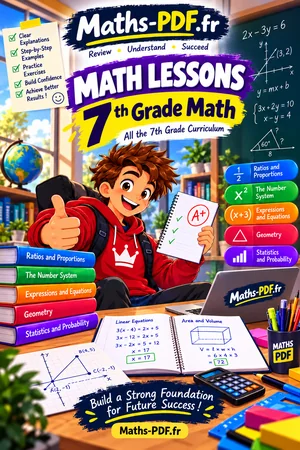
This 7th grade two step inequalities lesson covers two-step inequalities (Common Core 7.EE.B.4b), with a free PDF to print.
Key takeaway: This lesson helps Grade 7 students solve two-step inequalities and graph their solutions.
- Topic: Two-Step Inequalities (7th grade)
- Content: One-page lesson with a definition, a worked example and key facts
- Standards: 7.EE.B.4b
- Answers: Explanations included
- Format: Free printable PDF, US Letter, black and white
Key takeaway: A clear Grade 7 lesson on Two-Step Inequalities, with definitions, rules and worked examples: how do you solve \, when do you reverse the inequality symbol and how do you use inequalities in word problems. Read it before the practice worksheet; free to print or download as a PDF.
An inequality compares expressions with the symbols <, >, ≤, or ≥ and usually has many solutions. To solve a two-step inequality, undo addition or subtraction and then multiplication or division, just as with an equation. Reverse the symbol when you multiply or divide by a negative number, and graph the solution set on a number line.
This lesson helps Grade 7 students solve two-step inequalities and graph their solutions. The steps match the steps for equations, with one new rule. When you multiply or divide by a negative number, you reverse the inequality symbol.
First, the lesson reviews the symbols and the open and closed circles on a number line. Next, it solves inequalities of the form \(px + q > r\) with the inverse operations. Then it handles negative coefficients and parentheses. Finally, it turns stories about budgets, weight limits, and fees into inequalities. Plan about 25 minutes, and test a number in every answer.
Grade 7 · Common Core State Standards: 7.EE.B.4b
Key facts in this 7th grade two step inequalities lesson
- Solve \(px + q > r\) with the same steps as an equation.
- Reverse the symbol when you multiply or divide both sides by a negative number.
- Use an open circle for \(<\) and \(>\), and a closed circle for \(\le\) and \(\ge\).
- Then, shade the side of the number line that contains the solutions.
- Interpret the solution set in the context of the problem.
What is an inequality and what is its solution set?
An inequality compares two expressions with a symbol such as \(<\) or \(>\). Unlike an equation, it usually has infinitely many solutions, called the solution set.
How do you solve \(px + q > r\)?
Solve exactly like a two-step equation: undo the addition or subtraction, and then undo the multiplication or division.
Example. \(2x + 3 > 11\). Subtract 3: \(2x > 8\). Divide by 2: \(x > 4\). Any number greater than 4 works, such as 4.1 or 10.
When do you reverse the inequality symbol?
For example, \(-2x + 4 < 10\) gives \(-2x < 6\). Dividing by \(-2\) reverses the symbol, so \(x > -3\). Test: \(x = 0\) gives \(4 < 10\), which is true, and 0 is greater than \(-3\).
How do you use inequalities in word problems?
Look for phrases: “at most” means \(\le\), “at least” means \(\ge\), “fewer than” means \(<\), and “more than” means \(>\). Then interpret the answer in the story.
Real situations often limit the answer further. A bus cannot carry \(3.5\) people, so a solution such as \(x < 12.6\) means a whole-number answer of at most 12. A negative number of tickets or hours makes no sense either, so always read the solution set against the story. Graph the full set of numbers, and then circle the values that make sense in the problem.
Maya has \(\$40\). Tickets cost \(\$6\) each plus a \(\$4\) fee, so \(6t + 4 \le 40\), which gives \(t \le 6\). She can buy at most 6 tickets, and since tickets must be whole numbers, the possible values are 0, 1, 2, 3, 4, 5, and 6.
A quick way to check any answer is to test one number inside the shaded part and one number outside it. The first must make the original inequality true, and the second must make it false. If both tests agree with the graph, you can trust the solution.
7th grade two step inequalities lesson: questions and answers
What is the difference between an equation and an inequality?
An equation has one solution or a few. An inequality usually has infinitely many solutions, shown as a shaded part of the number line.
When do you flip the inequality sign?
Flip it only when you multiply or divide both sides by a negative number. For example, \(-3x > 9\) becomes \(x < -3\).
When do you use an open circle?
Use an open circle for \(<\) and \(>\) because the endpoint is not a solution. Use a closed circle for \(\le\) and \(\ge\) because the endpoint is included.
How do you check a solution to an inequality?
Pick a number from the shaded part and substitute it into the original inequality. The statement must be true. Also test a value outside the set to see that it fails.
What does at least mean?
At least means greater than or equal to. If you need at least 85 dollars, then your total must be \(\ge 85\).
Common mistakes with this 7th grade two step inequalities lesson
- Forgetting to reverse the symbol when dividing by a negative number. Dividing both sides of \(-2x < 8\) by \(-2\) turns the less-than into a greater-than.
- Reversing the symbol when adding or subtracting a negative number. Only multiplication and division by a negative number reverse the symbol.
- Using a closed circle for a strict inequality. Also, a strict symbol, such as greater than, needs an open circle at the endpoint.
How to study this chapter
- First, solve the inequality as if it were an equation. Then decide whether a negative number forced a reversal.
- Also test one number from your solution set and one from outside it. The first should make the inequality true, and the second should make it false.
- Parents can use a budget. Then, ask how many items a student can buy and still keep a set amount of money.
Download the 7th grade two step inequalities lesson as a PDF with the button below and keep it with your notes.
More questions about 7th grade two step inequalities lesson
Why does the inequality symbol reverse when you divide by a negative?
Multiplying by a negative number flips the order of numbers on the number line. For example, 2 is less than 5, but negative 2 is greater than negative 5. So the symbol must reverse to keep the statement true.
How do you solve an inequality with parentheses?
First distribute, then solve with inverse operations. For \(3(x – 2) \ge 12\), expand to \(3x – 6 \ge 12\). Then, add 6 to get \(3x \ge 18\), and divide by 3 to get \(x \ge 6\). The symbol stays because 3 is positive.
How do you write a solution to a story problem?
Solve the inequality, then interpret it in the context. If the answer is \(x \le 7.5\) for the number of items, only whole numbers make sense, so the greatest number is 7. Then, write a sentence with units.
All Grade 7 chapters: Grade 7 math.

More 7th Grade math
Lessons
See all Random Sampling and Inference Lesson: Notes and Examples
- Comparing Two Populations Lesson: Notes and Examples
- Scale Drawings Lesson: Notes and Examples
- Circumference and Area of Circles Lesson: Notes and Examples
- Proportional Relationships and y = kx Lesson: Notes and Examples
- Equivalent Linear Expressions Lesson: Notes and Examples




Worksheets
See all- Proportional Relationships and y = kx Worksheets with Answers
- Area, Volume and Surface Area Worksheets with Answers
- Solving Two-Step Equations Worksheets with Answers
- Two-Step Inequalities Worksheets with Answers
- Multistep Problems with Rational Numbers Worksheets with Answers
- Multiplying and Dividing Rational Numbers Worksheets with Answers

Tests
See all- Solving Real-World Problems with Rational Numbers Test with Answer Key
- Proportional Relationships and y = kx Test with Answer Key
- Angle Relationships and Equations Test with Answer Key
- Area, Volume and Surface Area Test with Answer Key
- Multiplying and Dividing Rational Numbers Test with Answer Key
- Probability and Probability Models Test with Answer Key



Quizzes
See all- Comparing Two Populations Quiz: 10 Questions with Answers
- Circumference and Area of Circles Quiz: 10 Questions with Answers
- Equivalent Linear Expressions Quiz: 10 Questions with Answers
- Solving Real-World Problems with Rational Numbers Quiz: 10 Questions with Answers
- Multistep Problems with Rational Numbers Quiz: 10 Questions with Answers
- Drawing Triangles from Given Conditions Quiz: 10 Questions with Answers