5th Grade Adding and Subtracting Fractions with Unlike Denominators Test Answer Key and Scoring Guide (PDF)

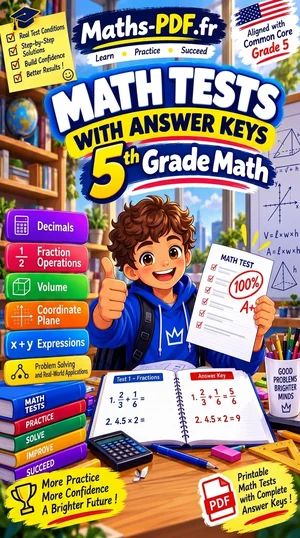
This 5th grade adding fractions with unlike denominators test answer key covers adding and subtracting fractions with unlike denominators (Common Core 5.NF.A.1, 5.NF.A.2), with a free PDF to print.
Key takeaway: This answer key helps fifth grade students see how each point on the unlike fractions test was earned.
- Topic: Adding and Subtracting Fractions with Unlike Denominators (5th grade)
- Content: Worked solutions and a scoring guide for 9 questions
- Standards: 5.NF.A.1, 5.NF.A.2
- Answers: Every step shown, with the method to review
- Format: Free printable PDF, US Letter, black and white
This answer key helps fifth grade students see how each point on the unlike fractions test was earned. Also, it gives full solutions to all nine questions, with the common denominator named, each renaming shown, and a sentence of reasoning for the reasonableness question.
Question 4 shows regrouping across a fraction that is too small, question 5 gives the correct sum next to a benchmark explanation, and question 9 finds missing numbers by subtracting. Add your points out of 20, then spend about 15 minutes redoing every question that lost credit. Then, write each correction with its common denominator.
This answer key gives worked solutions and a scoring guide for each of the 9 test questions, worth 20 points in all. Use the scoring notes to give partial credit when a student sets up the problem correctly but makes an arithmetic slip.
Key takeaway: Worked answers for the Grade 5 test on Adding and Subtracting Fractions with Unlike Denominators, with the scoring for each problem. Use it to grade yourself after a timed attempt; free PDF.
Grade 5 · Common Core State Standards: 5.NF.A.1, 5.NF.A.2
5th grade adding fractions with unlike denominators test answer key: worked solutions
1 – Add unlike fractions [2 pts]
(a)
The least common denominator of 3 and 4 is 12.
Rename the fractions: \(\frac{1}{3} = \frac{4}{12}\) and \(\frac{1}{4} = \frac{3}{12}\).
Add: \(\frac{4}{12} + \frac{3}{12} = \frac{7}{12}\).
\(\frac{7}{12}\)
(b)
The least common denominator of 6 and 8 is 24.
Rename the fractions: \(\frac{5}{6} = \frac{20}{24}\) and \(\frac{1}{8} = \frac{3}{24}\).
Add: \(\frac{20}{24} + \frac{3}{24} = \frac{23}{24}\).
\(\frac{23}{24}\)
Scoring: 1 point for each correct sum in simplest form (renaming correctly with a common denominator).
2 – Subtract unlike fractions [2 pts]
(a)
The least common denominator of 8 and 2 is 8.
Rename the fractions: \(\frac{7}{8} = \frac{7}{8}\) and \(\frac{1}{2} = \frac{4}{8}\).
Subtract: \(\frac{7}{8} – \frac{4}{8} = \frac{3}{8}\).
\(\frac{3}{8}\)
(b)
The least common denominator of 3 and 5 is 15.
Rename the fractions: \(\frac{2}{3} = \frac{10}{15}\) and \(\frac{1}{5} = \frac{3}{15}\).
Subtract: \(\frac{10}{15} – \frac{3}{15} = \frac{7}{15}\).
\(\frac{7}{15}\)
Scoring: 1 point for each correct difference.
3 – Add from a model [2 pts]
(a) \(\frac{2}{3} + \frac{1}{4}\).
(b) \(\frac{8}{12} + \frac{3}{12} = \frac{11}{12}\): \(\frac{11}{12}\).
Scoring: 1 point for the correct sentence (either order); 1 point for the sum.
Question 4 and after
4 – Mixed numbers [3 pts]
(a)
The least common denominator of 5 and 10 is 10.
Rename the fractions: \(3\frac{2}{5} = 3\frac{4}{10}\) and \(2\frac{7}{10} = 2\frac{7}{10}\).
Add: \(3\frac{4}{10} + 2\frac{7}{10} = 5\frac{11}{10}\).
Simplify: \(5\frac{11}{10} = 6\frac{1}{10}\).
\(6\frac{1}{10}\)
(b)
The least common denominator of 4 and 6 is 12.
Rename the fractions: \(6\frac{1}{4} = 6\frac{3}{12}\) and \(2\frac{5}{6} = 2\frac{10}{12}\).
The first fraction is smaller than the second, so regroup 1 whole as \(\frac{12}{12}\): \(6\frac{3}{12} = 5\frac{15}{12}\).
Subtract: \(5\frac{15}{12} – 2\frac{10}{12} = 3\frac{5}{12}\).
\(3\frac{5}{12}\)
Scoring: (a) 1 point for the correct sum in simplest form. (b) 1 point for regrouping correctly, 1 point for the correct difference.
5 – Is it reasonable? [2 pts]
(a) \(\frac{3}{8}\) is a little less than \(\frac{1}{2}\) and \(\frac{5}{9}\) is a little more than \(\frac{1}{2}\), so the sum is close to 1. But \(\frac{8}{17}\) is less than \(\frac{1}{2}\), so it is too small. (Adding the denominators is the error.)
(b) \(\frac{27}{72} + \frac{40}{72} = \frac{67}{72}\): \(\frac{67}{72}\).
Scoring: 1 point for a valid benchmark explanation; 1 point for the correct sum.
Question 6 and after
6 – Two ropes [2 pts]
The least common denominator of 2 and 3 is 6.
Rename the fractions: \(4\frac{1}{2} = 4\frac{3}{6}\) and \(2\frac{2}{3} = 2\frac{4}{6}\).
The first fraction is smaller than the second, so regroup 1 whole as \(\frac{6}{6}\): \(4\frac{3}{6} = 3\frac{9}{6}\).
Subtract: \(3\frac{9}{6} – 2\frac{4}{6} = 1\frac{5}{6}\).
\(1\frac{5}{6}\)
The first rope is \(1\frac{5}{6}\) feet longer.
Scoring: 1 point for a correct setup with a common denominator; 1 point for the correct difference with units.
7 – Trail mix [3 pts]
(a) The LCD of 4, 3, and 2 is 12: \(\frac{9}{12} + \frac{8}{12} + \frac{6}{12} = \frac{23}{12} = 1\frac{11}{12}\): \(1\frac{11}{12}\) cups.
(b) \(2 – 1\frac{11}{12} = \frac{1}{12}\): Yes, it fits, with \(\frac{1}{12}\) cup of room left.
Scoring: (a) 1 point for renaming all three fractions with a common denominator, 1 point for the total. (b) 1 point for a correct answer to both parts.
8 – Practice goal [2 pts]
(a) \(1\frac{3}{12} + 2\frac{6}{12} + 1\frac{8}{12} = 4\frac{17}{12} = 5\frac{5}{12}\): \(5\frac{5}{12}\) hours.
(b) \(6 – 5\frac{5}{12} = \frac{7}{12}\): \(\frac{7}{12}\) hour.
Scoring: 1 point for each correct answer.
Question 9 and after
9 – Missing numbers [2 pts]
(a) \(? = \frac{5}{6} – \frac{1}{4} = \frac{10}{12} – \frac{3}{12} = \frac{7}{12}\): \(\frac{7}{12}\).
(b) \(? = 5\frac{3}{6} – 3\frac{2}{6} = 2\frac{1}{6}\): \(2\frac{1}{6}\).
Scoring: 1 point for each correct missing number.
Total score
20 points
Key facts behind this 5th grade adding fractions with unlike denominators test answer key
- Fractions must have the same denominator before they can be added or subtracted.
- Next, the least common denominator is the smallest number both denominators divide into.
- Only the numerators are added or subtracted. The denominator stays the same.
- Then, to subtract mixed numbers, regroup one whole as a fraction when needed.
- Benchmarks 0, 1/2, and 1 help check that an answer makes sense.
Common mistakes with this 5th grade adding fractions with unlike denominators test answer key
- Students lose points because a renaming is not shown. Instead, write the equivalent fractions before you add. Slow down at that step and check it twice.
- Students copy the explanation in question 5 without understanding it. Also, say why a sum of two fractions near one half should be near one.
- Students leave an improper fraction in question 4. Instead, convert it to a mixed number to match the key.
- Students mix up the order in question 9. Also, subtract the known part from the total to find the missing part.
How to learn from your test
- Sort lost points into renaming, regrouping, and word problems. Practice the biggest group first. Repeat this habit on every problem for the best results.
- Redo question 6 with new mixed numbers. Also, a fresh problem shows whether you understand the regrouping. Repeat this habit on every problem for the best results.
- Teachers can ask students to explain one correction with a bar model. Repeat this habit on every problem for the best results.
Download the 5th grade adding fractions with unlike denominators test answer key as a PDF with the button below and keep it with your notes.
5th grade adding fractions with unlike denominators test answer key: frequently asked questions
What are the answers to the first two questions?
One third plus one fourth is seven twelfths, and five sixths plus one eighth is twenty-three twenty-fourths. So, seven eighths minus one half is three eighths, and two thirds minus one fifth is seven fifteenths. Also, each uses a common denominator.
How is the mixed number sum in question 4 found?
Rename the second number in tenths: 3 and 4 tenths plus 2 and 7 tenths. Add the wholes to get 5 and the fractions to get 11 tenths. Regroup to get 6 and 1 tenth.
How do you find the missing number in question 9?
For five sixths minus a number equals one fourth, subtract: ten twelfths minus three twelfths is seven twelfths. For the second part, subtract 3 and 1 third from 5 and 1 half to get 2 and 1 sixth.
All Grade 5 chapters: Grade 5 math.
Free printable PDF
5th Grade Adding and Subtracting Fractions with Unlike Denominators Test Answer Key and Scoring Guide
Download PDF
More 5th Grade math
Lessons
See all Adding and Subtracting Decimals Lesson: Notes and Examples
- Dividing by Two-Digit Divisors Lesson: Notes and Examples
- Multiplying Fractions and Mixed Numbers Lesson: Notes and Examples
- Dividing Unit Fractions and Whole Numbers Lesson: Notes and Examples
- Multiplying Multi-Digit Whole Numbers Lesson: Notes and Examples
- Classifying Two-Dimensional Figures Lesson: Notes and Examples





Worksheets
See all- Volume of Rectangular Prisms Worksheets with Answers
- Place Value and Powers of Ten Worksheets with Answers
- Multiplying Multi-Digit Whole Numbers Worksheets with Answers
- Converting Measurement Units Worksheets with Answers
- Patterns and Ordered Pairs Worksheets with Answers
- Numerical Expressions and Order of Operations Worksheets with Answers





Tests
See all- Place Value and Powers of Ten Test with Answer Key
- Area of Rectangles with Fractional Sides Test with Answer Key
- Multiplying Multi-Digit Whole Numbers Test with Answer Key
- Dividing by Two-Digit Divisors Test with Answer Key
- Multiplying and Dividing Decimals Test with Answer Key
- Line Plots and Data Test with Answer Key





Quizzes
See all- Area of Rectangles with Fractional Sides Quiz: 10 Questions with Answers
- Line Plots and Data Quiz: 10 Questions with Answers
- Patterns and Ordered Pairs Quiz: 10 Questions with Answers
- Multiplying Multi-Digit Whole Numbers Quiz: 10 Questions with Answers
- Multiplying Fractions and Mixed Numbers Quiz: 10 Questions with Answers
- Fractions as Division Quiz: 10 Questions with Answers