AP Statistics Probability Rules and Simulation Worksheet Answer Key (PDF)

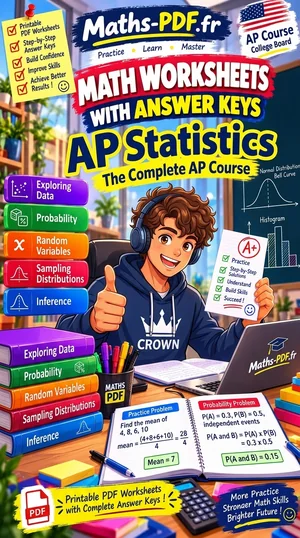
This probability rules worksheet answers for AP Statistics covers probability rules and simulation (Common Core AP STAT 4.1, AP STAT 4.2, AP STAT 4.3, AP STAT 4.4, HSS-CP.A.1, HSS-CP.B.7), with a free PDF to print.
Key takeaway: This answer key helps AP Statistics students check their probability worksheet and see how each probability was found.
- Topic: Probability Rules and Simulation (AP Statistics)
- Content: Step-by-step answers to 20 worksheet problems
- Standards: AP STAT 4.1, AP STAT 4.2, AP STAT 4.3, AP STAT 4.4, HSS-CP.A.1, HSS-CP.B.7
- Answers: Every step shown, with the method to review
- Format: Free printable PDF, US Letter, black and white
This answer key helps AP Statistics students check their probability worksheet and see how each probability was found. All 16 solutions show the sample space or diagram, the rule, and the result.
First, use it after finishing a group of worksheet problems. Next, compare your sample space with the key’s, because every count depends on it. Then check the rule that the key names. For the simulations, the key lists the digit assignment, the trial, and the estimate. Finally, the interpretation worksheet problems give model sentences in context, so you can see how much detail the exam expects.
Key takeaway: This answer key for the AP Statistics worksheet on Probability Rules and Simulation shows every step and the rule used. Check your work after trying the problems alone; free PDF.
AP Statistics · Common Core State Standards: AP STAT 4.1, AP STAT 4.2, AP STAT 4.3, AP STAT 4.4, HSS-CP.A.1, HSS-CP.B.7
Probability rules worksheet answers: worksheet problems 1 to 10
1 – Interpret a probability
Probability describes long-run frequency.
In many days with conditions like tomorrow’s, it rains on about 30% of them.
2 – Law of large numbers
With few flips, chance variation is large; with many flips, the proportion is close to the true probability 0.5.
The law of large numbers: the relative frequency approaches the true probability as flips increase.
3 – Gambler's fallacy
Coin flips are independent; the coin has no memory.
No: P(heads) is still 0.5. The long-run proportion balances out through many more flips, not by compensation.
4 – Equally likely outcomes
Total 10. \(P(\text{red})=\frac{5}{10}=0.5\). \(P(\text{blue or green})=\frac{3+2}{10}=0.5\).
0.5 and 0.5.
5 – Sample space of two coins
HH, HT, TH, TT are equally likely. Exactly one head: HT, TH.
\(P=\frac{2}{4}=0.5\).
0.5.
6 – Two dice
Sum 7: 6 outcomes. Sum 11: (5,6), (6,5), 2 outcomes.
\(\frac{6}{36}=\frac{1}{6}\) and \(\frac{2}{36}=\frac{1}{18}\).
1/6 and 1/18.
Worksheet problem 7 and after
7 – Complement rule
\(1-0.82=0.18\).
0.18.
8 – At least one
No 6 on either die: \(\frac{5}{6}\times\frac{5}{6}=\frac{25}{36}\). Complement: \(1-\frac{25}{36}=\frac{11}{36}\).
11/36, about 0.306.
9 – Mutually exclusive events
A card cannot be both a king and a queen.
\(\frac{4}{52}+\frac{4}{52}=\frac{8}{52}=\frac{2}{13}\).
2/13, about 0.154.
10 – General addition rule
\(P(\text{heart})=\frac{13}{52},\; P(\text{king})=\frac{4}{52},\; P(\text{king of hearts})=\frac{1}{52}\).
\(\frac{13+4-1}{52}=\frac{16}{52}=\frac{4}{13}\).
4/13, about 0.308.
Worksheet problems 11 and up
11 – Read a Venn diagram
Honor roll: \(\frac{40+15}{200}=0.275\). Sports: \(\frac{15+35}{200}=0.25\). Both: \(\frac{15}{200}=0.075\).
0.275, 0.25, and 0.075.
12 – Neither
Or: \(0.275+0.25-0.075=0.45\). Neither: \(1-0.45=0.55\), which matches \(\frac{110}{200}\).
0.45 and 0.55.
13 – Are they mutually exclusive?
\(P(A\text{ and }B)=0.5+0.3-0.6=0.2\).
P(A and B) = 0.2, which is not 0, so A and B are not mutually exclusive.
14 – Run a simulation
Trials: 0 3 8 -> 2; 1 5 6 -> 3; 4 9 2 -> 2; 7 6 1 -> 2; 0 5 8 -> 2; 2 3 4 -> 3; 9 6 7 -> 1; 1 5 2 -> 3; 8 3 0 -> 2; 6 4 9 -> 2 made shots.
Trials with at least 2 made: 9 of 10.
Estimated probability 0.9 (more trials give a better estimate).
Worksheet problem 15 and after
15 – Compare with the exact value
Exact: \(3(0.7)^{2}(0.3)+(0.7)^{3}=0.441+0.343=0.784\).
The estimate (0.9) differs from 0.784 because only 10 trials were run. A simulation with hundreds of trials would be closer.
16 – Design a simulation
Use a random digit generator. Digits 1 to 25 are not available as single digits, so use two-digit pairs 00 to 99: 00 to 24 means prize, 25 to 99 means no prize.
Read pairs until the first prize, record how many boxes, and repeat many times; average the counts.
Assign 00-24 as prize, read pairs until a prize, record the count, repeat many trials and average.
17 – Probability of a union
\(P(A\text{ or }B)=0.4+0.35=0.75\). Neither: \(1-0.75=0.25\).
0.75 and 0.25.
18 – Raffle
First prize: \(\frac{8}{200}=0.04\).
Win none in 3 draws: \(\frac{192}{200}\times\frac{191}{199}\times\frac{190}{198}\approx 0.8842\).
0.04; about 0.884 chance of winning nothing.
19 – Multi-step
\(0.60+0.45-0.25=0.80\). Neither: \(1-0.80=0.20\).
80% have at least one; 20% have neither.
20 – At least one six
No 6 in a roll has probability 5/6, and the rolls are independent: \(\left(\frac{5}{6}\right)^{4}=\frac{625}{1296}\approx 0.482\).
Complement: \(1-0.482=0.518\).
About 0.518.
Key facts behind this probability rules worksheet answers
- Probability = long-run relative frequency; always between 0 and 1.
- Law of large numbers: more trials bring the relative frequency closer to the probability.
- Complement rule: P(A not happening) = 1 – P(A).
- General addition rule: P(A or B) = P(A) + P(B) – P(A and B); subtract nothing if A and B are mutually exclusive.
- Simulation: assign digits, simulate trials, repeat many times, then estimate.
Common mistakes with this probability rules worksheet answers
- Students compare only the number. However, the key also names the rule, and a correct number from the wrong rule will not repeat.
- Students give a probability as a fraction that is not reduced. Because the key reduces fractions, check yours.
- Students describe a simulation without the estimate. Instead, finish with the estimated probability and a sentence.
How to use these solutions
- First, mark each missed worksheet problem as sample space, rule, or simulation. Then practice the largest group.
- Also, check each probability by confirming that it lies between 0 and 1. A value outside that range signals a setup or arithmetic error.
- Parents can ask the student to explain which rule an answer used and why. A clear reason shows more understanding than the number itself.
Download the probability rules worksheet answers as a PDF with the button below and keep it with your notes.
Probability rules worksheet answers: frequently asked questions
Why does the key list the sample space?
Listing the sample space makes the count of favorable outcomes visible and prevents missed cases. It also lets you check that the probabilities add to 1. The key lists it for every problem with equally likely outcomes.
How does the key describe a simulation?
It states the digit assignment, what one trial is, how many trials are run, what is recorded, and the estimate. A statement of each part earns the points on the exam.
How does the key interpret a probability?
It says that if the situation were repeated many times, the event would occur about that proportion of the time. It does not say what will happen on one trial. The sentence names the event in context.
All AP Statistics chapters: AP Statistics math.

More AP Statistics math
Lessons
See all Sampling Methods and Bias in Surveys Lesson: Notes and Examples
- Two Categorical Variables and Two-Way Tables Lesson: Notes and Examples
- Scatterplots and Correlation Lesson: Notes and Examples
- Random Variables, Expected Value and Combining Variables Lesson: Notes and Examples
- Graphs of Quantitative Data and Shape Lesson: Notes and Examples
- Inference for the Difference of Two Proportions Lesson: Notes and Examples




Worksheets
See all- Experimental Design and Random Assignment Worksheets with Answers
- Conditional Probability and Independence Worksheets with Answers
- t Intervals and t Tests for a Mean Worksheets with Answers
- Chi-Square Tests Worksheets with Answers
- Graphs of Quantitative Data and Shape Worksheets with Answers
- Inference for the Slope of a Regression Line Worksheets with Answers



Tests
See all- Two Categorical Variables and Two-Way Tables Test with Answer Key
- Chi-Square Tests Test with Answer Key
- Variables and Categorical Data Displays Test with Answer Key
- Binomial and Geometric Distributions Test with Answer Key
- Sampling Methods and Bias in Surveys Test with Answer Key
- Conditional Probability and Independence Test with Answer Key





Quizzes
See all- Graphs of Quantitative Data and Shape Quiz: 10 Questions with Answers
- Inference for the Slope of a Regression Line Quiz: 10 Questions with Answers
- Sampling Distributions and the Central Limit Theorem Quiz: 10 Questions with Answers
- Inference for the Difference of Two Proportions Quiz: 10 Questions with Answers
- Scatterplots and Correlation Quiz: 10 Questions with Answers
- Two Categorical Variables and Two-Way Tables Quiz: 10 Questions with Answers