AP Statistics Conditional Probability and Independence Worksheet Answer Key (PDF)

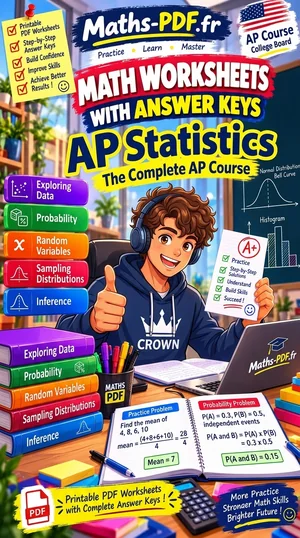
This ap statistics conditional probability worksheet answers covers conditional probability and independence (Common Core AP STAT 4.5, AP STAT 4.6, HSS-CP.A.2, HSS-CP.A.3, HSS-CP.A.4, HSS-CP.B.6, HSS-CP.B.8), with a free PDF to print.
Key takeaway: This answer key helps AP Statistics students check their conditional probability worksheet and see the setup behind each answer.
- Topic: Conditional Probability and Independence (AP Statistics)
- Content: Step-by-step answers to 20 worksheet problems
- Standards: AP STAT 4.5, AP STAT 4.6, HSS-CP.A.2, HSS-CP.A.3, HSS-CP.A.4, HSS-CP.B.6, HSS-CP.B.8
- Answers: Every step shown, with the method to review
- Format: Free printable PDF, US Letter, black and white
This answer key helps AP Statistics students check their conditional probability worksheet and see the setup behind each answer. All 16 solutions show the condition, the denominator, and the formula used.
First, use it after finishing a group of worksheet problems. Next, compare the condition you chose with the key’s, because the denominator depends on it. Then check each multiplication along a tree. For the independence worksheet problems, the key compares the two probabilities and states a conclusion. Finally, the interpretation worksheet problems give model sentences in context, so you can see how much detail the exam expects.
Key takeaway: This answer key for the AP Statistics worksheet on Conditional Probability and Independence shows every step and the rule used. Check your work after trying the problems alone; free PDF.
AP Statistics · Common Core State Standards: Also, AP STAT 4.5, AP STAT 4.6, HSS-CP.A.2, HSS-CP.A.3, HSS-CP.A.4, HSS-CP.B.6, HSS-CP.B.8
Ap statistics conditional probability worksheet answers: worksheet problems 1 to 10
1 – Conditional from a table
First: \(\frac{48}{80}=0.60\). Second: \(\frac{48}{70}\approx 0.686\).
0.60 and about 0.686; the conditions are different.
2 – Use the formula
\(P(A\mid B)=\frac{0.2}{0.4}=0.5\). \(P(B\mid A)=\frac{0.2}{0.5}=0.4\).
0.5 and 0.4. Note both equal the unconditional probabilities.
3 – General multiplication rule
\(P(\text{1st red})=\frac{6}{10}\). \(P(\text{2nd red}\mid\text{1st red})=\frac{5}{9}\).
\(\frac{6}{10}\times\frac{5}{9}=\frac{30}{90}=\frac{1}{3}\).
1/3, about 0.333.
4 – Tree diagram
\(P(+)=0.02(0.95)+0.98(0.04)=0.0190+0.0392=0.0582\).
0.0582.
5 – Reverse conditional
\(P(D\mid +)=\frac{0.0190}{0.0582}\approx 0.326\).
About 32.6%. Most positives are false positives because the disease is rare.
6 – Independence check
\(P(A)P(B)=0.30\times 0.50=0.15\), which equals P(A and B).
Yes, A and B are independent.
Worksheet problem 7 and after
7 – Independent events
\(P(A\text{ and }B)=0.6\times 0.25=0.15\). \(P(A\text{ or }B)=0.6+0.25-0.15=0.70\).
0.15 and 0.70.
8 – Exclusive vs independent
\(P(A\text{ and }B)=0\) but \(P(A)P(B)=0.12\).
They are not independent: knowing A occurred means B cannot occur.
9 – At least one
Miss all three: \(0.2^{3}=0.008\). At least one: \(1-0.008=0.992\).
0.992.
10 – Table independence
\(P(\text{passed})=\frac{50}{100}=0.5\). \(P(\text{passed}\mid\text{tutored})=\frac{30}{40}=0.75\).
Not independent: the tutored students were more likely to pass (0.75 compared with 0.5).
Worksheet problems 11 and up
11 – Without replacement
\(\frac{13}{52}\times\frac{12}{51}\times\frac{11}{50}=\frac{1716}{132600}=\frac{11}{850}\).
11/850, about 0.0129.
12 – Interpret a conditional
On rainy days 35% of buses are late; overall 12% are late.
Not independent: knowing that it rains changes the probability of being late.
13 – Pets
Cat: 30 of 100, so 0.30. Dog: 40 of 100, so 0.40. Both: 12 of 100, so 0.12.
\(0.30\times 0.40=0.12\).
0.12 equals P(cat and dog), so they are independent.
14 – Conditional with a tree
\(P(\text{defective})=0.6(0.02)+0.4(0.05)=0.012+0.020=0.032\).
\(P(B\mid\text{defective})=\frac{0.020}{0.032}=0.625\).
0.032 and 0.625.
15 – Find P(B | A)
\(P(B\mid A)=\frac{0.18}{0.45}=0.4\).
P(B | A) = 0.4 = P(B), so A and B are independent.
16 – Quality check
Defective then good: \(\frac{3}{10}\times\frac{7}{9}=\frac{21}{90}\). Good then defective: \(\frac{7}{10}\times\frac{3}{9}=\frac{21}{90}\).
Sum: \(\frac{42}{90}=\frac{7}{15}\).
7/15, about 0.467.
Worksheet problem 17 and after
17 – Two tests
\(0.9(0.8)+0.1(0.3)=0.72+0.03=0.75\).
0.75.
18 – Is it independent?
\(P(\text{junior})=\frac{15}{30}=0.5\). \(P(\text{junior}\mid\text{band})=\frac{9}{12}=0.75\).
Not independent: 0.75 is not 0.5.
19 – Multi-step
Urgent: \(0.4(0.10)+0.6(0.02)=0.04+0.012=0.052\).
\(P(\text{work}\mid\text{urgent})=\frac{0.04}{0.052}\approx 0.769\).
About 0.769.
20 – Draw a tree
Left-handed: \(0.4(0.30)+0.6(0.10)=0.12+0.06=0.18\).
\(P(\text{guard}\mid\text{left})=\frac{0.12}{0.18}\approx 0.667\).
0.18 and about 0.667.
Key facts behind this ap statistics conditional probability worksheet answers
- P(A | B) = P(A and B) / P(B): restrict to the outcomes where B occurred.
- General multiplication rule: P(A and B) = P(B) P(A | B).
- Independent: P(A | B) = P(A), so P(A and B) = P(A) P(B).
- Mutually exclusive events with positive probabilities are never independent.
- Tree diagrams multiply along branches and add the paths that fit the event.
Common mistakes with this ap statistics conditional probability worksheet answers
- Students compare only the number. However, the key also names the condition, and a correct number for the wrong condition is a wrong answer.
- Students round the probabilities before multiplying. Instead, keep fractions or full decimals, and round only the final answer.
- Students write an interpretation with no context. Because the exam needs context, name the events in words.
How to use these solutions
- First, mark each missed worksheet problem as condition, tree, or independence. Then practice the largest group with new data.
- Also, check each tree by adding the final path probabilities. They must add to 1, so a different total shows a slip on a branch.
- Parents can ask the student to read an interpretation aloud and say what the condition is.
Download the ap statistics conditional probability worksheet answers as a PDF with the button below and keep it with your notes.
Ap statistics conditional probability worksheet answers: frequently asked questions
Why does the key name the condition first?
The condition decides the denominator and the meaning of the answer. Naming it first prevents the common error of reversing the two events. It also helps you write the interpretation sentence in context.
How does the key decide whether two events are independent?
It compares the probability of one event given the other with the probability of the event alone. If they are equal, the events are independent. If they differ, they are dependent. The key states both values.
How does the key explain the reversed conditional?
It computes both probabilities and shows that they differ, then explains that the first starts from the cause and the second from the observed result. The sentence names both groups in context.
All AP Statistics chapters: AP Statistics math.
Free printable PDF
AP Statistics Conditional Probability and Independence Worksheet Answer Key
Download PDF
More AP Statistics math
Lessons
See all Variables and Categorical Data Displays Lesson: Notes and Examples
- Mean, Median, Standard Deviation and Outliers Lesson: Notes and Examples
- Sampling Methods and Bias in Surveys Lesson: Notes and Examples
- Probability Rules and Simulation Lesson: Notes and Examples
- Least-Squares Regression and Residuals Lesson: Notes and Examples
- Sampling Distributions and the Central Limit Theorem Lesson: Notes and Examples



Worksheets
See all- z-Scores and the Normal Distribution Worksheets with Answers
- Chi-Square Tests Worksheets with Answers
- Inference for the Difference of Two Means Worksheets with Answers
- Least-Squares Regression and Residuals Worksheets with Answers
- Inference for the Slope of a Regression Line Worksheets with Answers
- Sampling Methods and Bias in Surveys Worksheets with Answers

Tests
See all- Random Variables, Expected Value and Combining Variables Test with Answer Key
- Scatterplots and Correlation Test with Answer Key
- Least-Squares Regression and Residuals Test with Answer Key
- Binomial and Geometric Distributions Test with Answer Key
- Inference for the Difference of Two Means Test with Answer Key
- Mean, Median, Standard Deviation and Outliers Test with Answer Key





Quizzes
See all- Random Variables, Expected Value and Combining Variables Quiz: 10 Questions with Answers
- Least-Squares Regression and Residuals Quiz: 10 Questions with Answers
- Chi-Square Tests Quiz: 10 Questions with Answers
- Inference for the Difference of Two Proportions Quiz: 10 Questions with Answers
- Mean, Median, Standard Deviation and Outliers Quiz: 10 Questions with Answers
- Sampling Distributions and the Central Limit Theorem Quiz: 10 Questions with Answers