AP Calculus AB Evaluating Limits Algebraically Test Answer Key and Scoring Guide (PDF)
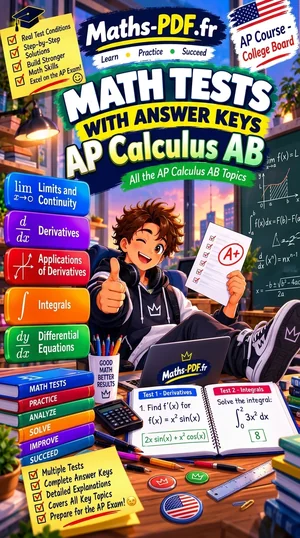
This evaluating limits test answer key for AP Calculus AB covers evaluating limits algebraically (Common Core AP CALC AB 1.5, AP CALC AB 1.6, AP CALC AB 1.7, AP CALC AB 1.8), with a free PDF to print.
Key takeaway: This answer key helps AP Calculus AB students and teachers grade the limit algebra test and understand each solution.
- Topic: Evaluating Limits Algebraically (AP Calculus AB)
- Content: Worked solutions and a scoring guide for 8 questions
- Standards: AP CALC AB 1.5, AP CALC AB 1.6, AP CALC AB 1.7, AP CALC AB 1.8
- Answers: Every step shown, with the method to review
- Format: Free printable PDF, US Letter, black and white
This answer key helps AP Calculus AB students and teachers grade the limit algebra test and understand each solution. Also, it lists all 8 questions with the substitution test, the algebraic step and the limit value, and it shows how the 20 points are divided.
Grade the technique choice separately from the algebra. Also, a student who picks the conjugate correctly but expands wrongly needs algebra practice. Also, a student who tries factoring on a radical needs help choosing techniques. Record both kinds of error and plan a short review on the larger group before the next assessment.
Use this answer key to score the limit algebra test out of 20 points. Each solution shows the work and a scoring guide that says how the points are awarded. Give partial credit for a correct setup, a correct derivative or integral, and a correct final statement with units where they apply.
Key takeaway: Full answer key for the AP Calculus AB test on Evaluating Limits Algebraically: each problem is solved with the expected steps and points. Use it to grade yourself after a timed attempt; free PDF.
AP Calculus AB · Common Core State Standards: AP CALC AB 1.5, AP CALC AB 1.6, AP CALC AB 1.7, AP CALC AB 1.8
Evaluating limits test answer key: worked solutions
1 – Substitution and limit laws [2 pts]
- \((-1)^{3}-4(-1)+2=-1+4+2=5\). \(5\)
- \(\frac{6}{3}+2(3)=2+6=8\). \(8\)
Scoring: 1 point per part.
2 – Factoring [2 pts]
Substitution gives \(\frac{0}{0}\). Factor: \(\frac{(x-5)(x+2)}{x-5}=x+2\). The limit is \(7\).
Final answer: \(7\).
Scoring: 1 point for factoring and canceling; 1 point for the correct limit.
3 – Rationalizing [3 pts]
Multiply by the conjugate: \(\frac{(x+25)-25}{x(\sqrt{x+25}+5)}=\frac{1}{\sqrt{x+25}+5}\). Substitute \(x=0\): \(\frac{1}{10}\).
Final answer: \(\frac{1}{10}\).
Scoring: 1 point for identifying the conjugate; 1 point for simplifying; 1 point for the limit.
4 – Trigonometric limit [2 pts]
\(\frac{\sin 6x}{2x}=3\cdot\frac{\sin 6x}{6x}\to 3\cdot 1=3\).
Final answer: \(3\).
Scoring: 1 point for rewriting with 6x in the denominator; 1 point for the limit.
5 – Squeeze Theorem [3 pts]
\(\lim_{x\to 0}(2-x^{2})=2\) and \(\lim_{x\to 0}(2+x^{2})=2\). Both bounds have the same limit.
So, by the Squeeze Theorem, \(\lim_{x\to 0} h(x)=2\).
Scoring: 1 point for each bound limit; 1 point for the conclusion naming the Squeeze Theorem.
Question 6 and after
6 – Difference quotient limit [2 pts]
\(f(1)=3\) and \(f(1+h)=2(1+2h+h^{2})+1+h=3+5h+2h^{2}\).
\(\frac{5h+2h^{2}}{h}=5+2h\to 5\). Final answer: \(5\).
Scoring: 1 point for expanding and simplifying the quotient; 1 point for the limit.
7 – Hole in a graph [3 pts]
- No. The denominator is \(0\) at \(x=2\).
- \(\frac{(x+3)(x-2)}{x-2}=x+3\), so the limit is \(5\).
- The graph is the line \(y=x+3\) with a hole at \((2,5)\); the outputs approach height \(5\) from both sides.
Scoring: 1 point per part.
8 – Cost per item [3 pts]
- \(\frac{144-100}{2}=22\), so \$22.
- \(\frac{(n-10)(n+10)}{n-10}=n+10\), so the limit is \$20.
Scoring: 1 point for (a); 1 point for factoring in (b); 1 point for the limit in (b).
Total score
20 points
Key facts behind this evaluating limits test answer key
- Direct substitution works when the function is defined and continuous at the target.
- Next, the form 0/0 means “simplify more”, not “the limit is 0” and not “does not exist”.
- Multiply by the conjugate to remove a square root from a limit.
- lim sin(x)/x = 1 and lim (1 – cos x)/x = 0 as x approaches 0 (radians).
Common mistakes with this evaluating limits test answer key
- Graders sometimes accept a limit without the cancellation step. The step is the heart of the question, so require it for full credit.
- Students lose points in question 8 by leaving the answer without units. The key states dollars per item, and your answer should include units.
- Students forget to name the theorem in question 5. The key names the Squeeze Theorem and lists the bounds, so compare your wording.
How to learn from your test
- Mark each lost point as technique, algebra or notation. Also, the largest group shows what to practice, and it is often notation.
- Ask students to rewrite one corrected solution from the substitution test onward. Starting at the test builds the right habit.
- Teachers can ask students why zero over zero does not mean the limit is zero. Also, a clear answer shows conceptual understanding.
Download the evaluating limits test answer key as a PDF with the button below and keep it with your notes.
Evaluating limits test answer key: frequently asked questions
How are points usually split on a limit question?
One point for recognizing the form and choosing a technique, one for the algebra and one for the value. A 2-point question combines the first two. Also, this split shows whether the weakness is method or arithmetic.
What if a student gets the right limit but cancels terms?
Do not give full credit. Also, a correct answer from an invalid step may be luck, and AP graders look at the reasoning. Next, ask the student to redo the problem with factoring and explain why only factors can cancel.
Why does question 6 use a difference quotient?
It previews the definition of the derivative. Also, the limit as h approaches zero of the quotient simplifies after expanding and canceling h. The key shows the expansion, so students see how limit algebra leads to derivatives.
All AP Calculus AB chapters: AP Calculus AB math.
Free printable PDF
AP Calculus AB Evaluating Limits Algebraically Test Answer Key and Scoring Guide
Download PDF
More AP Calculus AB math
Lessons
See all Infinite Limits and Asymptotes Lesson: Notes and Examples
- Product Rule, Quotient Rule and Trig Derivatives Lesson: Notes and Examples
- Power, Sum and Basic Function Derivative Rules Lesson: Notes and Examples
- Mean Value Theorem and Extreme Value Theorem Lesson: Notes and Examples
- Increasing, Decreasing and the First Derivative Test Lesson: Notes and Examples
- Evaluating Limits Algebraically Lesson: Notes and Examples

Worksheets
See all- Power, Sum and Basic Function Derivative Rules Worksheets with Answers
- Related Rates Worksheets with Answers
- Linearization and L'Hopital's Rule Worksheets with Answers
- Implicit Differentiation Worksheets with Answers
- Evaluating Limits Algebraically Worksheets with Answers
- Optimization Worksheets with Answers

Tests
See all- Differential Equations and Slope Fields Test with Answer Key
- Increasing, Decreasing and the First Derivative Test Test with Answer Key
- Optimization Test with Answer Key
- Continuity and the Intermediate Value Theorem Test with Answer Key
- Evaluating Limits Algebraically Test with Answer Key
- Power, Sum and Basic Function Derivative Rules Test with Answer Key

Quizzes
See all- Concavity and the Second Derivative Quiz: 10 Questions with Answers
- Fundamental Theorem of Calculus and Antiderivatives Quiz: 10 Questions with Answers
- The Derivative as a Limit Quiz: 10 Questions with Answers
- Related Rates Quiz: 10 Questions with Answers
- Evaluating Limits Algebraically Quiz: 10 Questions with Answers
- Increasing, Decreasing and the First Derivative Test Quiz: 10 Questions with Answers